

Can Thesis Clarity actually improve focus and mental performance, or is it another nootropic supplement leaning heavily on productivity marketing?
Thesis Clarity is part of the broader Thesis supplement lineup and is marketed as a formula specifically designed to support concentration, mental sharpness, and cognitive clarity throughout the day.
In this review, we’ll break down what Thesis Clarity is, how it claims to work, and whether the marketing actually matches the evidence.
Key Takeaways
- Marketed for focus, clarity, and cognitive performance
- Uses common nootropic ingredients associated with mental alertness
- Personalized-branding approach helps it stand out
- No clinical trials on the finished formula itself
- Effects are likely subtle and highly individual
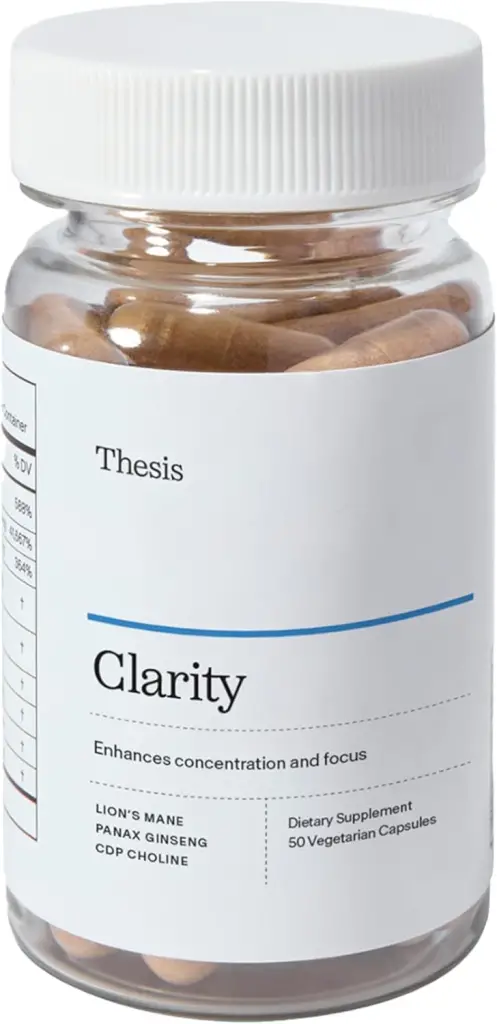
What is the Thesis Clarity Supplement?
Thesis Clarity is a nootropic supplement formula designed to support focus, concentration, and mental clarity. Like many products in the nootropic space, it combines ingredients commonly associated with cognitive support, such as caffeine, L-theanine, alpha-GPC, lion’s mane, or other brain-health compounds, depending on the formulation.
One of the brand’s biggest selling points is its personalized approach, where users may be guided toward specific blends based on their goals and experiences.
At its core, it’s a cognitive-support supplement, not a proven performance-enhancing treatment.
How It Claims to Work
The product claims to improve concentration, mental sharpness, productivity, and overall cognitive efficiency.
Marketing around Thesis Clarity often emphasizes smoother focus, reduced mental fog, and sustained attention without the harsh crash associated with stronger stimulants.
The brand also positions its formulas as more thoughtfully designed and individualised compared to generic nootropic products.
Reality Check
Some ingredients commonly used in nootropic supplements do have research behind them.
For example:
- caffeine and L-theanine may support alertness and focus
- lion’s mane has growing interest in neurological research
- alpha-GPC has been studied for cognitive support
But the effects from over-the-counter nootropics are typically:
- modest
- inconsistent
- highly dependent on the individual
There are also no published clinical studies showing that Thesis Clarity itself produces major or reliable cognitive enhancement.
Many users who notice benefits may simply be responding to stimulant effects, improved routine consistency, or placebo-related expectations rather than a dramatic neurological upgrade.
Red Flags to Consider
Personalized branding can create inflated expectations
The brand’s quiz-based and personalised approach makes the product feel more scientifically tailored than standard supplements. While customisation may improve user engagement, it does not automatically mean the formulas are clinically superior.
Productivity-focused marketing
The supplement is marketed heavily toward productivity, focus, and “unlocking mental performance.” This kind of branding can make relatively mild nootropic effects sound much more transformative than they realistically are.
Ingredient reputation doing most of the work
Much of the credibility comes from well-known nootropic ingredients rather than direct evidence showing the finished formula itself outperforms competitors.
Effects can depend heavily on stimulants
Some users may notice effects from caffeine or other stimulating ingredients rather than deeper cognitive enhancement. This can make the experience feel stronger initially while offering a limited long-term difference.
Broad cognitive promises
The product may imply improvements in focus, memory, motivation, clarity, and productivity all at once. This kind of wide-ranging positioning is common in the nootropic industry and often stretches beyond what evidence clearly supports.
No product-specific clinical validation
There are no known human trials proving that Thesis Clarity itself significantly improves cognitive performance compared to a placebo.
Does It Really Work?
It may help some users feel more alert, focused, or mentally engaged depending on their sensitivity to the ingredients used.
It will not dramatically increase intelligence, eliminate brain fog permanently, or function like prescription cognitive medication.
Any benefits are likely to be subtle, temporary, and highly individual.
Pricing
Thesis products are generally sold through subscription-style plans, with monthly costs commonly ranging from $79–$129 depending on the package selected.
What To Do If Scammed
Review subscription terms carefully, monitor recurring billing, and avoid assuming that personalised supplement quizzes automatically reflect medical or neurological expertise.
Conclusion
Thesis Clarity is built around legitimate nootropic concepts and recognizable cognitive-support ingredients, but the marketing pushes the idea of optimized mental performance further than the evidence currently supports.
In reality, it functions more as a modern nootropic supplement… marketed like a personalised cognitive upgrade.
Also read – I Tried the MERIOR Bread Maker — Worth It for Beginners? Here’s My Honest Review