

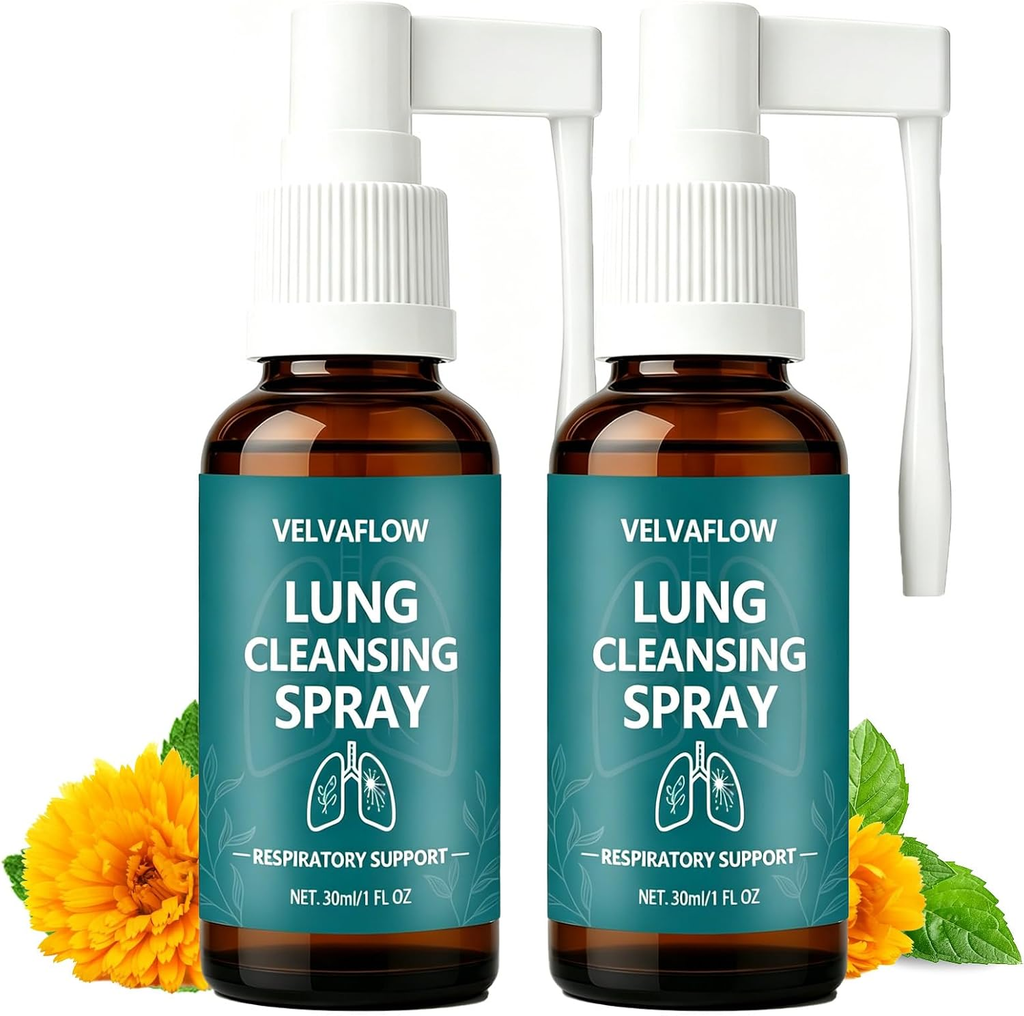
VelvaFlow Lung Spray makes some very specific promises about clearing mucus, calming airway inflammation, and helping people breathe more easily. The problem is that these are not ordinary wellness claims. They involve the lungs and respiratory symptoms, so I want to see evidence that the product actually does what its advertising says before giving it any credit.
The product also raises questions about its formula, its subscription offer, and the conditions attached to its refund guarantee. Here’s what I found about VelvaFlow Lung Cleansing Spray, including the warning signs I would want a buyer to know about.
Key Takeaways
- There is no convincing clinical evidence that VelvaFlow clears deep lung mucus, repairs lung damage, or treats breathing problems.
- The advertised formula features eucalyptus, peppermint, licorice root, and calendula, but the product page does not clearly establish the amount of each ingredient or provide product-specific clinical trial results.
- The website advertises a 60-day money-back guarantee, but its subscription and refund conditions deserve a closer look.
- The advertised monthly subscription starts at $29.95, compared with a listed one-time price of $34.95. The subscription option was reportedly preselected when an independent reviewer inspected the checkout offer.
- I would skip this product. The respiratory claims are much stronger than the evidence available to support them.
What Is VelvaFlow Lung Spray?
VelvaFlow Lung Cleansing Spray is marketed as an oral botanical spray intended to support respiratory health. The instructions on its website recommend two sprays into the back of the mouth, twice daily. Its sales pitch is aimed particularly at people who experience persistent coughing, mucus, chest tightness, wheezing, or breathing difficulties. It also targets smokers and former smokers who may be concerned about accumulated mucus or damage to their lungs.
The company highlights four botanical ingredients:
- Eucalyptus: Promoted as helping loosen mucus.
- Peppermint: Marketed as helping soothe irritation and ease the feeling of congestion.
- Licorice root: Included for its purported anti-inflammatory effects.
- Calendula: Marketed as supporting tissue recovery and soothing irritation.
These ingredients may have traditional uses, but that does not establish that this particular combination can clean the lungs or treat respiratory conditions. That distinction matters because VelvaFlow is not simply promising a refreshing taste or a soothing throat. It claims to reach deep into the lungs, break down hardened mucus, calm airway inflammation, and help restore easier breathing.
Those are substantial medical claims, and they require substantially better evidence than a list of familiar herbs.
Why I Looked Into VelvaFlow
I became particularly interested in the way VelvaFlow describes its delivery method. The sales page argues that conventional remedies only address mucus near the surface, while its spray supposedly reaches a deeper layer that other products cannot. It even presents the product as a solution to buildup that has remained in the lungs for years.
But how does a spray used in the mouth reach that specific layer? What evidence demonstrates that its ingredients arrive at the claimed location in effective amounts? And how has the company established that the formula actually removes mucus or improves lung function?
I could not find convincing clinical evidence answering those questions. The product page does not link to a published, controlled human trial demonstrating that VelvaFlow itself produces the advertised respiratory benefits. It also does not provide convincing product-specific evidence showing that the spray reaches a particular depth in the lungs or restores damaged respiratory structures.
The delivery claim is one of the biggest reasons I would not buy it.
What I Found About the Ingredients
I do not dismiss an ingredient simply because it is herbal. Some plant-derived substances have legitimate uses, and certain ingredients have been investigated for respiratory symptoms. However, evidence about an individual ingredient cannot automatically be transferred to a finished product containing that ingredient. The concentration, formulation, route of administration, and actual dose all matter.
VelvaFlow does not clearly establish the amount of each botanical delivered per spray on the sales page I reviewed. Without that information, it is difficult to assess whether the product contains meaningful quantities or evaluate its safety properly.
The licorice root ingredient deserves particular attention. The U.S. National Center for Complementary and Integrative Health warns that glycyrrhizin, a component of licorice, can cause serious adverse effects, including irregular heartbeat. People with high blood pressure and certain heart or kidney conditions may face particular risks. The relevance to VelvaFlow depends on the actual formulation, amount, and route of exposure, which are not adequately established by its marketing.
The other ingredients do not solve the central problem either. Even if one or more of them has a legitimate use in another preparation, that does not prove that VelvaFlow can break down mucus deep in the lungs, restore cilia, or relieve wheezing.
I would want to see a complete ingredient label, quantities, appropriate safety testing, and clinical research on the finished product before considering those claims credible.
Does VelvaFlow Actually Clean Your Lungs?
This is where I have the greatest difficulty accepting the marketing. The American Lung Association explains that the lungs have their own mechanisms for clearing contaminants and that there is inadequate scientific evidence to recommend most commercial lung-detox products. It also warns that some products marketed as lung cleanses can be harmful, particularly when potentially dangerous substances are inhaled.
VelvaFlow claims that its spray helps break down mucus, soothe airway inflammation, restore cilia, and improve breathing. Yet I could not find a reliable clinical trial of the finished product establishing these benefits.
The claim about restoring cilia is particularly ambitious. Cilia are tiny hair-like structures that help move mucus and trapped particles out of the respiratory tract. Claiming that a product restores their function requires evidence that the product actually produces that effect, not merely that one of its ingredients has been used traditionally.
The same applies to claims about reducing chest pressure, preventing nighttime breathing difficulties, or improving wheezing. These symptoms can have different causes, and a product cannot be assumed to address them simply because its ingredients sound soothing.
I also would not confuse a cooling or refreshing sensation in the mouth and throat with proof that the lungs have been cleaned. Those are two very different things. My conclusion is straightforward: VelvaFlow’s advertised lung-cleansing effects remain unproven.
What About the Customer Reviews?
VelvaFlow’s website displays a 4.9-star rating and claims to have more than 12,000 ratings. It also features testimonials describing improvements in coughing, chest tightness, and breathing.
Those testimonials may sound reassuring, but they are presented on the seller’s own website. I could not independently verify the claimed total or establish that the testimonials represent typical customer outcomes.
An independent review published by MalwareTips on August 8, 2026, also raised concerns about the product’s testimonials and the similarity of some promotional language to testimonials appearing elsewhere. These observations do not prove that every review is fabricated, but they are reasons not to treat the advertised ratings as independent evidence of effectiveness.
I also found a marketplace listing for a product sold under the VelvaFlow Lung Cleansing Spray name. That listing is not enough to establish that it has the same formulation, manufacturing source, or quality controls as the product sold through VelvaFlow’s own website.
I would therefore be cautious about using ratings from one listing to judge the product sold through another seller. Ultimately, even genuine customer reviews cannot establish that a spray removes deep lung mucus or repairs lung tissue. That requires appropriate clinical evidence.
Is VelvaFlow Lung Spray Worth the Price?
The website lists the spray at $34.95 for a one-time purchase, with a monthly subscription advertised at a lower starting price of $29.95. For me, the price is not the main problem. I would consider paying for a reasonably priced product if there were credible evidence that it delivered the benefit being advertised.
VelvaFlow has not established that. I would be paying for a product with unclear ingredient quantities, no convincing product-specific clinical evidence, and marketing claims that extend to lung function and respiratory symptoms. The possibility of recurring charges makes the offer less attractive.
I would rather spend that money on an appropriate medical assessment or a treatment with evidence supporting its use for the actual problem.
Who Might Consider It?
I would not recommend VelvaFlow as a lung-cleansing treatment. Someone who is merely looking for a refreshing oral spray should also verify the complete ingredient list, intended use, and safety information rather than assuming this product is suitable for them.
People with persistent coughing, unexplained chest tightness, wheezing, or difficulty breathing should not rely on VelvaFlow to address those symptoms. If you have ongoing respiratory symptoms, speak with a qualified healthcare professional about the cause and appropriate treatment. Severe or sudden breathing difficulty requires urgent medical attention.
Who Should Skip It?
I would particularly advise the following people to avoid relying on VelvaFlow:
- Smokers and former smokers looking for a way to reverse lung damage or remove years of accumulated mucus.
- People with persistent coughing or wheezing who need to identify the underlying cause rather than mask symptoms.
- Anyone experiencing chest tightness or nighttime breathing difficulties who might delay getting appropriate medical care.
- People who need clear safety information before using a botanical product, particularly if they have existing health conditions or take medication.
- Budget-conscious buyers who do not want to risk recurring subscription charges for a product without convincing evidence of effectiveness.
Alternatives I Would Consider
Rather than buying a product that promises to clean the lungs, I would choose an approach based on the symptoms and their likely cause.
- For persistent mucus or coughing: Seek a medical assessment, particularly if symptoms are prolonged, recurrent, or worsening. The appropriate treatment depends on what is causing them.
- For smoking-related concerns: Stopping smoking and avoiding secondhand smoke are more defensible ways to protect lung health than relying on a cleansing spray. The American Lung Association explains that the lungs can begin recovering when exposure to harmful substances stops.
- For diagnosed asthma or another respiratory condition: Use treatments recommended by a qualified healthcare professional rather than replacing them with an unproven herbal product.
- For a simple dry or irritated throat: Ask a pharmacist about appropriate symptom relief. A product that soothes the throat should not be mistaken for a treatment that cleans the lungs.
I would not substitute another product marketed with equally ambitious lung-detox claims. The important thing is to address the actual problem rather than pay for a promise that has not been demonstrated.
Conclusion
I would skip VelvaFlow Lung Cleansing Spray. The product is built around an appealing idea: a couple of sprays that supposedly clear years of mucus buildup, soothe inflammation, restore the lungs’ natural cleaning mechanisms, and make breathing easier. But the company has not provided convincing clinical evidence to substantiate those claims.
The formula also lacks enough detail on the sales page for me to assess its ingredients and their quantities properly. On top of that, the subscription arrangement and reported restrictions attached to the refund guarantee give me more reasons to be cautious. I am not claiming that the product has been conclusively proven fraudulent. I am saying that its most important health claims have not been adequately demonstrated, and the available information does not give me enough confidence to recommend buying it.
If you are struggling with coughing, mucus, wheezing, or difficulty breathing, I would not trust VelvaFlow to clean your lungs or resolve the underlying cause. You deserve an approach supported by evidence, not just an impressive sales page.
For me, VelvaFlow is a pass.
Also read – Is Boost Lab Neck Firming Serum Worth It? My Honest Review