

Sentivo Detector is marketed as a 4-in-1 home air monitor that measures carbon monoxide, natural gas, humidity and temperature. Unlike conventional carbon monoxide alarms that primarily alert users when dangerous concentrations are detected, Sentivo promises a live numerical reading that lets homeowners monitor changes in their indoor environment.
The idea sounds useful, particularly for households using gas appliances, generators or other fuel-burning equipment. However, this is also a safety product, so its accuracy and reliability matter considerably more than its appearance or advertised features. I looked into the device, its technical specifications and the seller’s own disclosures to see what buyers should know before purchasing.
Key Takeaways
- Sentivo is a plug-in monitor marketed for carbon monoxide, natural gas, humidity and temperature.
- The seller advertises an electrochemical CO sensor with a displayed range of 0–1,000 ppm.
- The manufacturer explicitly states that Sentivo is not UL 2034 certified and does not replace a certified carbon monoxide alarm.
- The advertised 100-night guarantee has different refund conditions depending on the reason for returning the device.
- The seller operates a relatively new online store, and independent evidence validating the device’s performance is limited.
What Is Sentivo Detector?
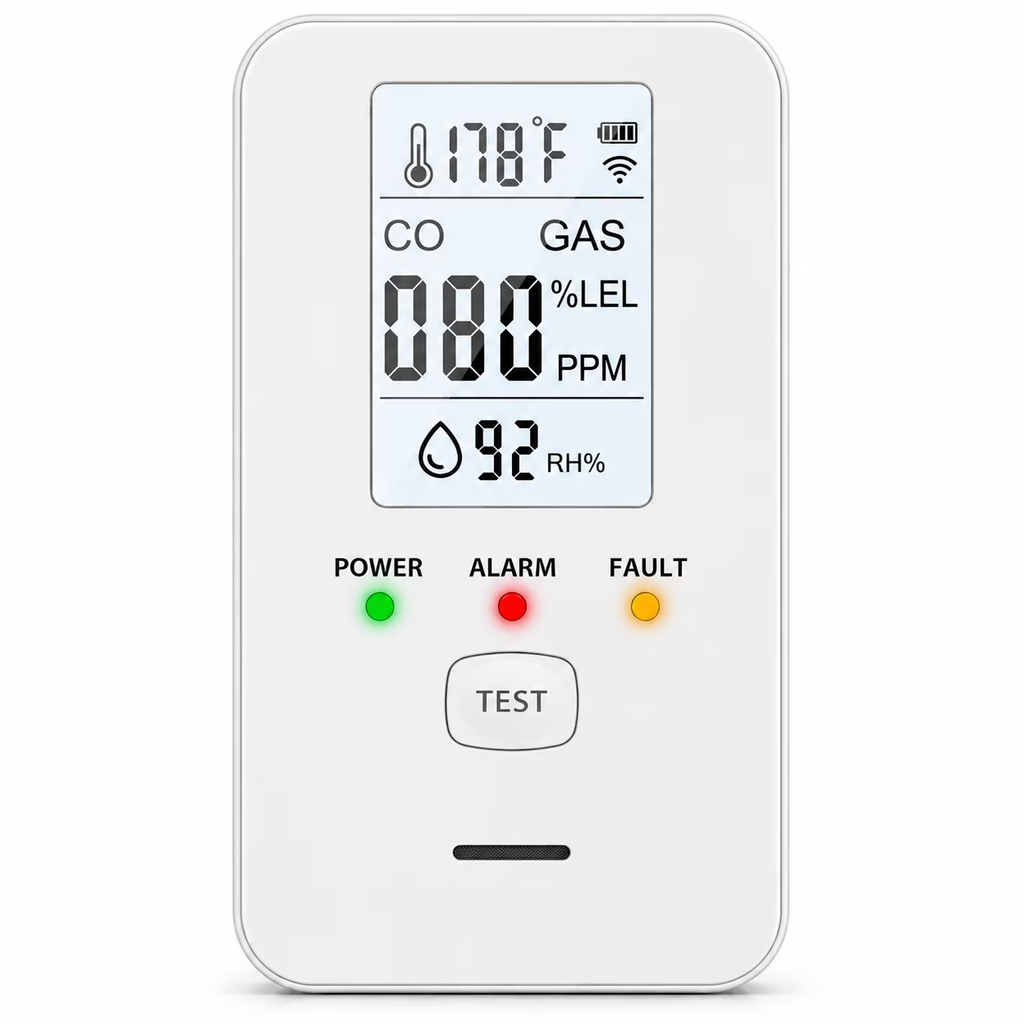
Sentivo Detector is an electronic home monitoring device sold through the Primo Goods website. It was previously marketed under the name AirGuard, with the seller explaining that the product was renamed to distinguish it from copycat listings.
The device plugs into a standard electrical outlet and displays readings on a built-in screen. Its four advertised monitoring functions are:
- Carbon monoxide detection
- Natural gas detection
- Humidity monitoring
- Temperature monitoring
It also has a rechargeable backup battery, allowing it to continue operating during a power outage, according to the seller.
The product is intended to provide more information than a conventional alarm that only sounds when certain conditions are met. Instead of simply waiting for an alarm, users are supposed to be able to check the displayed readings throughout the day. However, a display showing a number is only useful if the sensor measures that number accurately and reliably.
How Does Sentivo Work?
According to the product specifications, Sentivo uses an electrochemical sensor to measure carbon monoxide. Electrochemical sensors detect gas through a chemical reaction that produces an electrical signal. The device processes that signal and displays an estimated concentration in parts per million (PPM).
The seller lists the following specifications:
- CO measurement range: 0–1,000 ppm
- Advertised CO accuracy: ±10%
- Gas detection: Methane and butane
- Gas detection modes: Three levels
- Sensitivity settings: Two modes
- Display: 2-inch TFT screen
- Battery: 1,000mAh rechargeable battery
- Self-test: Built-in
The seller also claims that the display updates continuously and that users can switch between different sensitivity settings.
These specifications describe what the manufacturer says the device can do. They do not independently establish that it meets recognised safety requirements. In particular, the advertised ±10% accuracy should not be confused with independent verification. I could not locate a publicly available independent laboratory report establishing that the finished Sentivo device consistently achieves this accuracy.
Is Sentivo a Certified Carbon Monoxide Detector?
This is the most important issue in the investigation. Sentivo’s own sales material explicitly states that the device is not UL 2034 certified. It also describes the product as a supplemental monitoring device that should be used alongside a certified carbon monoxide alarm. That distinction matters.
UL 2034 is a recognised safety standard covering single and multiple-station carbon monoxide alarms. It establishes requirements for how these devices respond to carbon monoxide at specified concentrations and how they perform under different operating conditions.
A monitor displaying a live CO reading is not automatically equivalent to a certified alarm. The ability to display a number does not establish that the device will reliably warn occupants when carbon monoxide reaches dangerous levels. The seller’s disclaimer is therefore significant. Although Sentivo is advertised as a way to monitor carbon monoxide from low concentrations, it should not be treated as the household’s primary protection against carbon monoxide poisoning.
For comparison, the US Consumer Product Safety Commission identifies UL 2034 as the relevant voluntary standard for residential carbon monoxide alarms.
Does Sentivo Actually Work?
There are two separate questions here: whether the device can display environmental readings and whether it can provide reliable protection against carbon monoxide exposure.
The first is technically plausible. Electronic sensors can measure carbon monoxide, while separate sensors can monitor temperature, humidity and combustible gases.
The second requires stronger evidence. I could not identify independent certification records or publicly available laboratory test results confirming Sentivo’s advertised accuracy, response times or reliability. The seller describes its sensor technology and provides technical specifications, but these are manufacturer claims rather than independent verification.
There is also a distinction between measuring carbon monoxide and detecting every possible household gas hazard. Sentivo’s product pages refer to methane and butane detection, but buyers should not assume that this means it detects every combustible gas or provides the same protection as a properly certified gas alarm.
The product may function as an additional monitoring device, but the available evidence is insufficient to establish that it provides dependable safety protection.
Pricing and Refund Policy
Sentivo is sold through Primo Goods, which advertises different product configurations and promotional prices. The website’s collection page has displayed several versions of the detector, with prices ranging from approximately $69 to $119 depending on the model and offer. Promotional discounts and bundle prices may change.
The seller also advertises a 100-night money-back guarantee and a lifetime warranty. However, the refund conditions deserve attention. One sales page says customers who are simply unhappy with the product receive a 75% refund, while customers returning a defective or damaged device may qualify for a full refund. Another page describes the 100-night offer as a full refund with return shipping covered.
That difference is important. A 100-night guarantee does not necessarily mean every customer can return the product for a complete refund regardless of the reason. Buyers should read the refund policy attached to the actual checkout rather than relying solely on the headline guarantee.
Who Sells Sentivo Detector?
Sentivo is sold by Primo Goods through primo-goods.com. The website identifies AXIS Primo Goods LLC as the business behind the product and gives a Sheridan, Wyoming address. It also provides an email address and customer support telephone number.
The store’s domain was registered in April 2026, making it relatively new at the time of this investigation. A recent domain registration does not prove that a business is fraudulent, but it does mean there is limited operating history to assess. The seller also claims that Sentivo is its exclusive product and that the earlier AirGuard name was changed because other sellers were using similar branding.
A trademark application for SENTIVO DETECTOR was filed by AXIS Primo Goods LLC in July 2026. However, a pending trademark application is not evidence that the device has passed electrical or safety certification.
I also found automated website reputation reports raising concerns about the relatively young store and limited business history. These reports are risk indicators, not proof that customers have been defrauded.
Red Flags to Consider
It is not UL 2034 certified
This is the clearest limitation. The seller openly acknowledges that Sentivo is not certified to this standard and should not replace a certified CO alarm.
The advertised accuracy is not independently established
The seller claims ±10% accuracy, but I could not locate independent test documentation verifying that figure for the finished device.
The refund guarantee is not as straightforward as it sounds
The 100-night offer is advertised prominently, but the conditions differ depending on whether the customer reports a fault or simply changes their mind. One page specifies a 75% refund for a change of mind.
The store has limited operating history
Primo Goods’ domain was registered in April 2026. While this does not establish fraudulent activity, the business has a relatively short public track record.
Marketing claims can create a false sense of security
The product is promoted around the idea that users can see carbon monoxide levels before a conventional alarm sounds. That may be useful as an additional monitoring feature, but it should not encourage anyone to remove, ignore or delay installing a certified alarm.
Is Sentivo Detector Legit or a Scam?
Sentivo appears to be a real product offered by an identifiable online retailer. I did not find sufficient evidence to conclude that the seller is running a confirmed scam or that customers are systematically being denied their purchases. However, that does not make it a dependable carbon monoxide safety device.
The seller’s own disclosure that Sentivo is not UL 2034 certified is particularly important. Its advertised sensor accuracy has not been independently established in the material I could locate, and its refund guarantee has conditions that are less generous than the headline presentation might suggest.
My assessment is that Sentivo may have a place as a supplementary air-monitoring gadget, but I would not recommend relying on it for carbon monoxide protection. Anyone purchasing it should still install and maintain properly certified carbon monoxide alarms.
For a product dealing with a potentially fatal household hazard, an attractive display and a live numerical reading are not substitutes for independently verified safety performance.
Also read – CrabbiCrawler Baby Toy Review: Is It Worth It? My Experience After One Month