

Dermachom sells at-home light therapy devices marketed as alternatives to conventional nail fungus treatments. Rather than applying antifungal medication or visiting a clinic, customers are encouraged to place their affected fingers or toes inside a device and allow its laser or LED technology to target the infection.
The company has several models, including Onychom Pro, Pentachom Pro and Pentachom SE. They use different combinations of infrared, red, blue and violet light, with the more expensive models promising broader coverage and additional treatment modes. But do these devices actually eliminate nail fungus? I looked into their specifications, the science behind light-based treatment, customer experiences and the company’s product claims.
Key Takeaways
- Dermachom sells three main nail fungus devices: Onychom Pro, Pentachom Pro and Pentachom SE.
- The devices use different combinations of laser diodes and LEDs, including infrared, blue, red and violet light.
- Scientific evidence for laser treatment of nail fungus remains limited, particularly for complete fungal clearance.
- I could not identify published clinical trials demonstrating that any of the three Dermachom devices cures onychomycosis.
- Customer reviews include complaints about ineffective treatment, charging problems, broken hinges and difficulties obtaining support.
- The company advertises money-back guarantees, but its policies and promotional claims vary across different product pages and websites.
What Is Dermachom?
Dermachom is an online retailer specialising in devices and products marketed for fungal nail infections, medically known as onychomycosis.
Its device range includes:
- Onychom Pro: A compact device using four advertised wavelengths: 905nm infrared, 650nm red, 470nm blue and 405nm violet. It is marketed for treating individual affected nails.
- Pentachom Pro: An LED-based device advertised with 20 specialised LEDs, comprising 15 antifungal LEDs and five antimicrobial LEDs. It is designed to cover multiple nails during one treatment session.
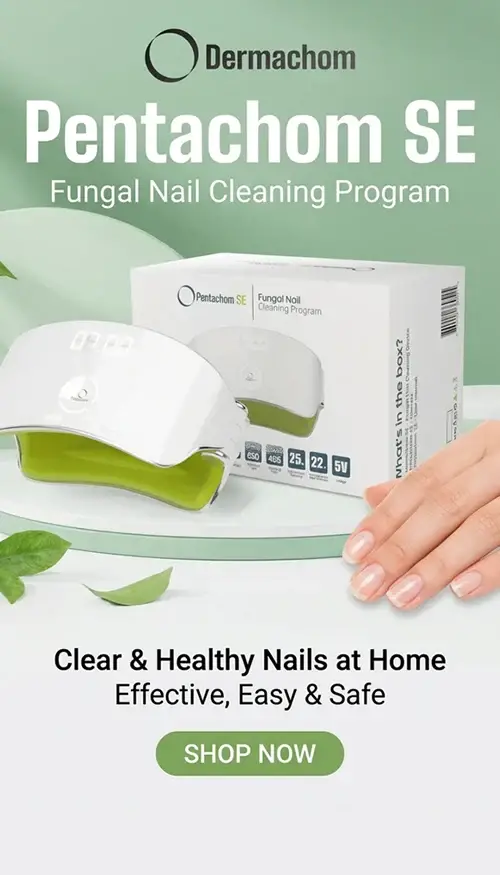
- Pentachom SE: A more expensive device combining five laser diodes and 15 LEDs. It offers four treatment modes and is marketed as an advanced at-home nail fungus solution.
The products are rechargeable and designed for repeated use. Depending on the model, the recommended treatment session is approximately seven minutes.
The company’s central promise is that its light technology can reach fungal organisms beneath the nail and help restore clearer, healthier-looking nails without conventional medication.
How Do Dermachom’s Devices Work?
The devices use different wavelengths of light, which Dermachom assigns different functions.
- 905nm infrared light: This is the main wavelength promoted for deeper penetration beneath the nail plate. It is used in the Onychom Pro and Pentachom SE devices.
- 650nm red light: Dermachom associates this wavelength with circulation and cellular recovery around the affected nail.
- 470nm blue light: The company markets this as an antimicrobial wavelength intended to target organisms on the nail surface.
- 405nm violet light: This is promoted for surface-level fungal targeting.
The Pentachom SE also advertises a disinfect mode combining 465nm blue light with UV-C light sources. These wavelengths are not interchangeable. They interact with biological tissue differently, and evidence supporting one light-based application does not automatically validate another.
There is also a difference between demonstrating that a wavelength has antimicrobial activity in laboratory conditions and proving that a consumer device can deliver enough energy through a human nail to eliminate an established fungal infection.
Dermachom’s descriptions explain what the company intends each wavelength to accomplish. They do not independently establish that the devices achieve those results.
Do Onychom Pro, Pentachom Pro and Pentachom SE Actually Work?
This is where the available evidence becomes less convincing. Laser and light-based treatments for onychomycosis have been investigated in clinical studies. However, results have been inconsistent, and researchers have not established that these devices reliably produce complete fungal cures.
A 2020 Cochrane review examined topical and device-based treatments for fungal toenail infections. The evidence available for laser treatment was uncertain, and the studies did not establish a reliable improvement in fungal cure rates.
A separate systematic review published in 2021 examined laser monotherapy for dermatophyte toenail infections. It found limited evidence of complete, clinical and microbiological cures. The researchers concluded that the effectiveness of laser treatment as a standalone therapy remained limited.
The US Food and Drug Administration also makes an important distinction between laser devices that temporarily improve the appearance of fungus-affected nails and devices that actually treat the infection. Clearance for temporary improvement in the appearance of a nail does not establish that the fungus has been eliminated.
This distinction matters because a nail can look clearer as it grows out without the underlying infection necessarily disappearing.
I could not locate published clinical trials demonstrating that Onychom Pro, Pentachom Pro or Pentachom SE achieves complete fungal clearance.
Does Having More Wavelengths Make a Device More Effective?
Dermachom’s marketing places considerable emphasis on the number of lasers, LEDs and treatment modes available on its devices. Pentachom Pro, for example, advertises 20 specialised LEDs, while Pentachom SE combines five laser diodes with 15 LEDs. However, more light sources do not automatically mean better treatment.
For a light-based treatment to work, researchers need to establish that the wavelength, energy delivered, exposure time and treatment depth are appropriate for the target organism. The device must also demonstrate meaningful results in controlled clinical testing.
Simply combining several wavelengths does not establish that a device can eliminate fungi beneath the nail. Dermachom also claims that Pentachom Pro is five times more efficient than an average device. I could not find independent comparative testing supporting that figure.
How Much Do Dermachom Devices Cost?
Dermachom’s current product listings show the following promotional prices:
| Device | Advertised price |
|---|---|
| Onychom Pro | $89.99 |
| Pentachom Pro | $119.99 |
| Pentachom SE | $199.99 |
These prices are subject to change, and the company has displayed different prices on separate product pages and sales websites. For example, Pentachom SE has also appeared at $149.99 and $174.99 on other Dermachom-branded pages.
The price differences make it important to check which seller and product listing you are purchasing from.
The company also sells replacement and complementary products, including antifungal enhancer pens. These are marketed as additions to the light treatment, but I could not identify independent clinical evidence establishing that using them alongside the devices produces a reliable fungal cure.
What Are Customers Saying About Dermachom?
Customer feedback is mixed, and the independent reviews raise some concerns. At the time of this investigation, Dermachom’s Trustpilot profile had a 2.7 out of 5 rating from 44 reviews. Approximately 48% of the displayed reviews were one-star ratings, while 36% were five-star ratings.
Some customers report seeing improvements after several months of consistent use. Others say they used the devices for extended periods without noticeable changes.
There are also complaints about product reliability. One customer reported that a device stopped working after approximately a week, despite following the charging instructions. Another described purchasing a replacement after the original device’s hinge broke, only to experience a similar problem with the second unit.
A separate customer described charging problems that left the device completely unresponsive. The customer also complained about difficulties obtaining a satisfactory resolution from support.
These are individual customer accounts, not independently verified findings. Nevertheless, repeated complaints about charging and mechanical failures are relevant when assessing a device intended for daily use over several months.
The company’s website displays considerably more positive ratings, including ratings of 4.7 out of 5 for some products. However, those are seller-displayed figures and should not be treated as independently verified treatment success rates.
Dermachom’s Refund Policy
Dermachom advertises money-back guarantees, but the advertised periods are not consistent across its different pages. Some current product listings promote a 90-day money-back guarantee. Other pages and older promotional material refer to a 180-day guarantee.
There is also a Trustpilot complaint from a customer who said the company did not honour its advertised 180-day refund policy after the device allegedly failed to work properly.
That is one customer’s allegation, not proof that the company routinely refuses refunds. Still, it is worth considering alongside the conflicting guarantee periods.
Before purchasing, buyers should establish the exact return window, whether opened devices qualify, whether proof of regular use is required and who pays return shipping.
A long guarantee is only useful if customers can understand and exercise the return conditions.
Red Flags to Consider
No published clinical trial of the devices
I could not find published clinical research demonstrating that any of Dermachom’s three main devices produces complete fungal clearance. Evidence about laser treatment in general cannot be used as proof that these particular machines work.
Treatment claims go beyond established evidence
The company uses language suggesting that its devices eliminate fungus, reach infections beneath the nail and prevent reinfection. These are substantial medical claims, and the available product-specific evidence does not establish them.
More LEDs do not prove better results
The 20-LED Pentachom Pro and the laser-and-LED Pentachom SE are marketed as advanced solutions. However, the number of light sources does not establish clinical effectiveness.
Customer complaints about device reliability
Charging failures, broken hinges and difficulties obtaining replacements appear in customer feedback. These complaints deserve attention because the devices are intended for consistent use over an extended period.
Inconsistent prices and refund periods
Different Dermachom-branded websites display different prices for the same models, alongside varying money-back guarantee periods. Buyers should verify the actual seller and terms before ordering.
The UV-C marketing deserves clarification
Pentachom SE’s disinfect mode is described as combining blue light with UV-C sources. UV-C radiation can damage eyes and skin, depending on exposure. The company should provide clear safety information about the UV-C components, including how exposure is prevented during normal operation. I could not independently verify the device’s UV-C output or safety testing.
Is Dermachom a Scam or Legit?
Dermachom is a real online seller offering physical nail-care devices. Its existence as a retailer, however, does not establish that its products can cure fungal infections.
The main concern is the gap between the company’s treatment claims and the available scientific evidence. Laser and LED treatments have been investigated for nail fungus, but research has not established that they reliably eliminate established infections. I also could not locate product-specific clinical trials validating the Onychom Pro, Pentachom Pro or Pentachom SE.
Customer complaints about ineffective treatment, charging problems and broken components add further concerns, while the inconsistent refund information makes purchasing less straightforward.
My verdict is that Dermachom sells inadequately substantiated nail fungus devices. I would not recommend relying on any of them as a standalone treatment for onychomycosis.
People with suspected fungal nail infections should first confirm the diagnosis because nail trauma, psoriasis and other conditions can produce similar changes. Established treatments include prescription topical antifungals and oral antifungal medication, depending on the infection and the person’s medical circumstances.
Also read – Is Denperm Cavity Repair Gel Worth Buying? My Brutally Honest Review