

Smart rings promise a lot: discreet health tracking, sleep insights, readiness scores, heart rate monitoring, and continuous data without wearing a bulky device on your wrist. With premium brands like Oura setting the bar high, an influx of lower-priced alternatives, including the Olevra Smart Ring, claim similar capabilities at a fraction of the price.
In this review, I’ll break down what the Olevra Smart Ring actually is, how it claims to work, how those claims stack up against what wearables can realistically measure, the major red flags in its marketing and tech claims, real-world user experiences, and whether this smart ring is a worthwhile health tool or an overhyped gadget.
Key Takeaways
- Olevra Smart Ring is marketed as a wearable health and activity tracker designed to fit on your finger.
- It claims to monitor metrics like sleep stages, heart rate, activity, and health trends.
- There is no transparent indication of sensor quality, accuracy validation, or third-party testing.
- Marketing relies on broad feature lists and lifestyle appeal more than data evidence.
- Early user feedback is mixed, with inconsistencies in data accuracy and app syncing.
What Is the Olevra Smart Ring & How It Claims to Work
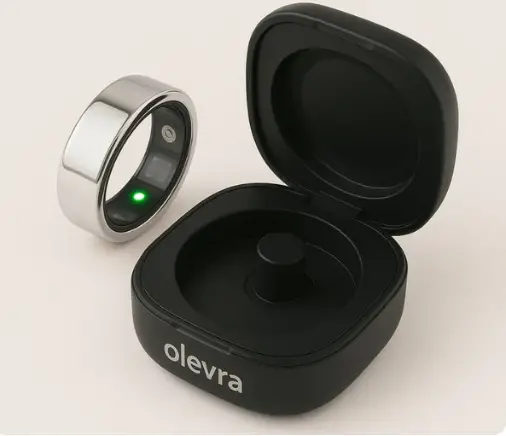
The Olevra Smart Ring is a wear-on-finger fitness and health tracker. Like most smart rings, it supposedly uses optical sensors (such as PPG) and motion detection to read biometric data. The company claims it tracks sleep, heart rate, blood oxygen (SpO₂), steps, calories, and other health indicators, then syncs this information via a smartphone app to provide insights into wellness patterns, recovery, sleep quality, and overall activity.
The idea is simple: tighten the gap between wearable tech and everyday convenience by embedding sensors in a ring, small, stylish, and unobtrusive.
How It Claims to Work
According to the Olevra Smart Ring’s promotional materials, the device uses built-in sensors to read subtle changes in blood flow and motion. By interpreting that data through its companion app, it claims to generate metrics that help users monitor sleep quality, active vs. resting heart rate, oxygen saturation, and other wellness indicators.
The implication is that the ring accurately captures meaningful health data without bulky wearables… a claim that sounds appealing but requires precise hardware and highly sophisticated algorithms to achieve.
Claims vs. Reality
The general concept, using a ring to track biometric data, is possible. Premium wearables like the Oura Ring and certain medical-grade sensors succeed because they use high-quality, validated sensors plus advanced algorithms refined through extensive testing.
However, the real question is not whether a ring can collect data at all… It’s whether Olevra’s hardware and software can do so accurately and reliably.
Unlike established brands with transparent sensor specifications and published validation studies, Olevra does not provide clear documentation on sensor type, sampling frequency, calibration, or independent accuracy testing. Without that, claims about accurate sleep stages, blood oxygen levels, or other nuanced metrics remain unverified… merely marketing language rather than scientifically demonstrated results.
Red Flags to Consider
Lack of Independent Accuracy Testing
Credible wearables undergo third-party validation or publish data comparing their readings to clinical standards. Olevra provides no such evidence, a major red flag for any device claiming health metrics.
Vague Sensor Information
Terms like “advanced sensors” or “smart detection” are used, but the exact sensor models, technologies, and their scientific performance characteristics are not disclosed.
Feature List Without Supporting Detail
The marketing emphasizes wide coverage (sleep, heart rate, SpO₂, activity) but does not explain how each metric is measured, what sampling intervals are used, or how data reliability is assured, common transparency issues in budget wearables.
Lifestyle Messaging Over Technical Proof
The brand leans heavily on aesthetic appeal and “data for life” language rather than detailed technical documentation, which suggests emphasis on style and brand image over robust performance.
Inconsistent Early User Feedback
Community feedback and early reviews note discrepancies between Olevra readings and other validated devices. Inaccurate or inconsistent data, especially for sleep stages or blood oxygen, undermines the core value proposition of a health tracker.
Is the Olevra Smart Ring a Scam?
Not necessarily in the strictest sense… you are likely to receive a physical product that attempts to function as advertised. But it does exhibit several characteristics common to overhyped consumer tech products, particularly in the wearable space:
It promises robust health tracking without transparent validation. It leans on broad claims without providing scientific backing. And while it may collect some form of data, the accuracy and usefulness of that data are questionable.
This puts Olevra in the category of questionable or overpromised technology rather than a proven health device.
Does It Really Work?
The short answer is: It depends on your expectations. If you’re looking for basic step counting and rough heart rate trends, Olevra may serve as a casual tracker. Many low-cost wearables achieve similar coarse metrics.
But if you’re seeking accurate sleep staging, dependable blood oxygen measurement, recovery trends, or fitness insights you can act on, Olevra’s claims fall short of the evidence required to trust such data.
Without calibration against validated devices (like medical pulse oximeters or clinically validated sleep trackers), the metrics must be taken with skepticism.
User Experience & Feedback
Real-world feedback on the Olevra Smart Ring is mixed and inconsistent. Some users report that the ring feels comfortable, its app is easy to navigate, and basic step/count metrics sync reasonably.
However, there are repeated accounts of:
- Discrepancies between Olevra’s sleep metrics and other trackers
- Heart rate readings that don’t match chest straps or wrist wearables
- Difficulty in maintaining app connectivity or Bluetooth stability
- Features that look polished on paper but don’t translate into actionable accuracy
These patterns are typical of budget wearables that prioritize broad feature lists without ensuring reliable data quality.
Alternatives Worth Considering
If you want a smart ring with proven accuracy and science-backed metrics, options from established brands like Oura or Whoop (with ring or band) have transparent validation and dependable algorithms. While pricier, they offer data you can trust for lifestyle or health decisions.
For basic health tracking, mid-range wrist wearables (Fitbit, Garmin, Apple Watch) provide a well-tested platform with clear performance records.
What to Do If You Already Bought It
- Use it as a lifestyle tracker, not a medical device.
- Compare its readings with a validated wearable if possible, so you know how it differs.
- Avoid making health decisions based solely on its data.
- Track trends over time rather than individual metric values.
- Review the return/refund policy if accuracy matters to you.
Conclusion
The Olevra Smart Ring is an intriguing entry in the crowded wearable market, offering multiple health and activity metrics in a compact form. But while the concept is sound and the design likely comfortable, the product lacks transparent validation, credible accuracy testing, and sensor disclosure, all necessary to justify its health tracking claims.
Verdict: It is not a scam in the sense of non-delivery, but it does promise more than it can reliably deliver. Expect basic tracking at best and treat data with caution.
Also read – I Tried Fixapro on My Car Scratches — Here’s My Honest Review of It