

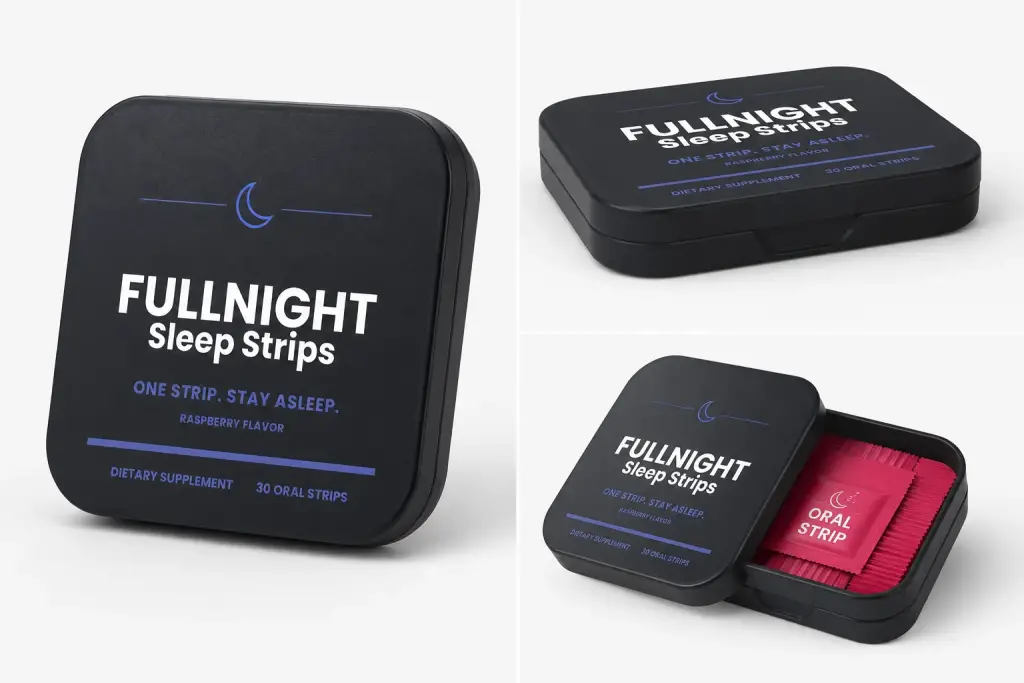
Sleep strips and patches have become popular among people looking for an easier alternative to traditional sleep supplements. FullNight Sleep Strips are marketed as a convenient nighttime product intended to help users fall asleep faster, stay asleep longer, and wake up feeling more refreshed.
However, I ran into a problem while researching this one: I couldn’t find a reliable official product page or enough verifiable information to establish exactly what FullNight Sleep Strips contain. That makes it difficult to assess the product on the same level as a supplement with a clearly published ingredient label.
Key Takeaways
- FullNight Sleep Strips are marketed as a nighttime sleep-support product.
- I couldn’t locate a reliable official website or authoritative ingredient list for the product.
- There is no readily identifiable clinical research testing FullNight Sleep Strips as a finished product.
- The effectiveness of sleep strips depends heavily on what active ingredients they actually contain and in what amounts.
- The lack of verifiable product information is itself a significant concern.
What Are FullNight Sleep Strips?
FullNight Sleep Strips appear to be marketed as an overnight sleep-support product, presumably using a dissolvable oral strip format.
This type of product is designed to be placed in the mouth rather than swallowed like a capsule. Sleep strips commonly contain ingredients such as melatonin, L-theanine, magnesium, GABA, or botanical extracts, depending on the brand.
For FullNight specifically, however, I couldn’t verify a trustworthy ingredient panel or manufacturer information from the sources available to me.
How Do FullNight Sleep Strips Claim to Work?
The general concept behind sleep strips is straightforward: the product delivers sleep-support ingredients through a thin dissolvable strip, allowing the ingredients to dissolve in the mouth.
If FullNight contains ingredients such as melatonin, its intended mechanism would be supporting the body’s sleep-wake cycle. Other common sleep ingredients may promote relaxation or reduce the time needed to fall asleep.
But without a verified formulation, it would be irresponsible to attribute specific effects to FullNight.
What Does the Evidence Say?
There is evidence for some individual sleep-support ingredients, particularly melatonin, which can be useful for certain sleep-timing problems and jet lag. Its effectiveness isn’t universal, though, and it isn’t simply a general-purpose sedative.
Other commonly used ingredients such as L-theanine, magnesium, and certain herbal extracts have varying levels of evidence, but their effects depend heavily on the dose and the specific preparation.
The important distinction here is that evidence for an ingredient isn’t evidence for FullNight Sleep Strips.
I couldn’t find a published clinical trial testing FullNight Sleep Strips as a finished product.
Red Flags To Consider
The Product Is Difficult to Verify
This is the biggest issue I encountered. Searches for the exact product name did not produce a reliable official manufacturer page or a sufficiently detailed product listing that I could independently verify.
For an ingestible sleep product, consumers should be able to identify who makes it, what is in it, how much of each active ingredient it contains, and where it is manufactured.
No Verifiable Ingredient Doses
Even if FullNight contains legitimate sleep-support ingredients, knowing the ingredient names isn’t enough.
A product containing 1 mg of an ingredient and one containing 100 mg can have very different effects. Without a complete Supplement Facts panel and dosages, there’s no meaningful way to compare FullNight with the scientific literature.
No Product-Specific Clinical Evidence
I couldn’t identify clinical research testing FullNight Sleep Strips themselves.
That means any claims about falling asleep faster, sleeping more deeply, or waking up refreshed remain marketing claims rather than demonstrated effects of the finished product.
Sleep Problems Can Have Underlying Causes
Persistent insomnia isn’t necessarily a problem that a supplement can solve.
Stress, anxiety, medications, caffeine, alcohol, sleep apnea, restless legs syndrome, irregular schedules, and other conditions can all interfere with sleep. Treating the underlying cause is considerably more useful than masking the symptoms with a sleep aid.
Ingredients
I could not verify a complete ingredient list for FullNight Sleep Strips.
I would not fill this section with ingredients attributed to similarly named sleep strips because that could result in reviewing the wrong product.
If you have the packaging or a screenshot of the product’s Supplement Facts panel, that’s the best way to establish the exact formulation.
Do FullNight Sleep Strips Actually Work?
At this point, there isn’t enough reliable evidence to say that they do.
The strip delivery format itself isn’t evidence that a sleep product works better than a capsule, gummy, tea, or tablet. What matters is the active ingredient, dose, absorption, and whether the ingredient actually improves the particular sleep problem being treated.
Until the FullNight formulation can be independently verified, I’d be reluctant to recommend it.
Potential Side Effects
Potential side effects depend entirely on the ingredients in the strips.
For example, melatonin can cause drowsiness, headache, dizziness, or vivid dreams in some people. Other sleep-support ingredients can also cause sedation or interact with medications.
Because the FullNight formulation isn’t sufficiently verifiable, its potential side effects can’t be responsibly assessed from the product name alone.
Pricing and Availability
I couldn’t establish a reliable current price from a verifiable official source.
I’d be particularly cautious about purchasing the product from a social-media advertisement or unfamiliar storefront without first confirming the manufacturer, ingredient label, return policy, and contact information.
Alternatives
For occasional sleep difficulties, better-supported approaches include maintaining a consistent sleep schedule, limiting caffeine later in the day, reducing evening light exposure, keeping the bedroom cool and dark, and addressing factors that may be disrupting sleep.
For persistent insomnia, cognitive behavioral therapy for insomnia (CBT-I) has considerably stronger evidence than most over-the-counter sleep supplements.
What To Do If You Were Scammed
If you purchased FullNight Sleep Strips and the product never arrived, arrived damaged, or doesn’t match the advertisement, contact the seller and request a refund.
Keep your order confirmation, receipt, screenshots of the advertisement, product photographs, and any communication with the seller. If the seller doesn’t resolve the problem, contact your payment provider.
Conclusion
FullNight Sleep Strips are difficult to evaluate because I couldn’t verify a reliable official product source or a complete ingredient-and-dosage profile. That is a much bigger problem than simply finding that the product lacks clinical trials.
There are legitimate sleep-support ingredients that can be useful in the right circumstances, but without knowing what FullNight actually contains and how much, there’s no sound basis for saying that the strips improve sleep.
For now, I’d classify FullNight as unverified rather than proven ineffective. The lack of transparency is enough that I would not recommend buying it until the manufacturer and formulation can be independently established.
Also read – ViveLab Rosemary & Multi-Peptide Hair Growth Serum Review: My Honest Thoughts