

MindWake is marketed as a nootropic supplement for memory, focus, mental clarity and everyday cognitive performance. At first glance, the formula looks reasonably sophisticated, with ingredients such as Alpha-GPC, Bacopa monnieri and Huperzine A.
But there is a much bigger problem once you start comparing the different MindWake websites. The ingredient lists don’t agree, the exact dosages are not consistently disclosed, and the product is surrounded by the kind of aggressive sales tactics I usually like to investigate more closely. So, is MindWake legit? Let’s take a closer look.
Key Takeaways
- MindWake is marketed for memory, focus and mental clarity.
- Different MindWake websites list different ingredient formulas, which is a major red flag.
- Several ingredients have legitimate research behind them, but there is no clinical trial proving the finished MindWake formula works as advertised.
- The exact dosages of several key ingredients are difficult to verify.
- I would be cautious about buying it until the company can explain the formula discrepancies.
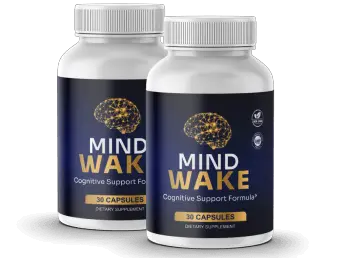
What Is MindWake?
MindWake is a dietary supplement marketed as a daily cognitive-support formula for adults experiencing brain fog, poor concentration, memory lapses or a general decline in mental sharpness.
The current sales material describes it as a once-daily capsule intended to support memory, focus, mental clarity and overall cognitive performance. One MindWake website says the formula contains Ginkgo biloba, phosphatidylserine, N-acetyl-L-carnitine HCl, Bacopa monnieri, L-glutamine and Alpha-GPC. Another MindWake website lists an entirely different formula containing Alpha-GPC, Huperzine A, Bacopa, Rhodiola, L-tyrosine, theobromine, green coffee bean extract, pterostilbene, magnesium citrate and B vitamins.
That distinction becomes important later because these aren’t small changes to the same formula. We’re talking about substantially different ingredient combinations being sold under the same MindWake name.
How It Claims to Work
MindWake’s basic theory is that several ingredients can work together to support the systems involved in memory, attention and mental performance.
Alpha-GPC is included for its relationship to acetylcholine, while Bacopa is marketed around memory and learning. Huperzine A is another ingredient associated with the cholinergic system, while ingredients such as magnesium and B vitamins are positioned as nutritional support for normal nervous-system function. On the alternate MindWake formula, Ginkgo and phosphatidylserine take a much more prominent role.
There is some legitimate science behind the general concept. A systematic review of dietary supplements marketed for cognitive performance found human research on ingredients including Bacopa, choline, Ginkgo and other common nootropics, but concluded that the overall certainty of evidence remains limited and that uncertainty about the actual contents and doses of commercial supplements makes it difficult to determine whether the products live up to their claims.
That’s a pretty important distinction here.
Reality vs. Claims
MindWake isn’t relying entirely on ingredients nobody has ever studied. Bacopa, for example, has actually been investigated in randomized human trials.
A systematic review of Bacopa trials found some evidence for improvement in memory free recall, with the studies using standardized extracts at 300–450 mg per day for 12 weeks. A more recent 2026 network meta-analysis also found promising effects for Bacopa on some memory measures in healthy adults, although the results varied by dose and cognitive outcome.
But that doesn’t prove MindWake works.
The important question is whether the MindWake capsule contains the same type and quantity of Bacopa used in those studies. That’s where the product information becomes much less helpful.
I couldn’t find a published clinical trial testing the finished MindWake formula itself. The evidence being used to sell it comes from research on individual ingredients rather than clinical testing of the actual product.
That means I would be very careful with statements suggesting that MindWake itself has been “clinically proven” to improve memory or focus.
Let’s Look at the Listed Ingredients
And this is where things get messy. One MindWake website lists Ginkgo biloba, phosphatidylserine, N-acetyl-L-carnitine HCl, Bacopa monnieri, L-glutamine and Alpha-GPC.
Another lists Alpha-GPC, Huperzine A, Bacopa monnieri, Rhodiola root, L-tyrosine, theobromine, green coffee bean extract, pterostilbene, magnesium citrate and B vitamins.
Those are two very different formulas.
There is also a third version of the MindWake sales material that describes the 10-ingredient formula while emphasizing a 30-capsule bottle and one capsule per day.
The ingredients themselves aren’t necessarily the problem. The lack of consistency is. If I’m buying a supplement, I should not have to visit three different websites to figure out whether I’m buying Ginkgo and phosphatidylserine or Huperzine A and Rhodiola.
More importantly, the publicly available product information doesn’t consistently give enough detail about the amount of each active ingredient to determine whether the formula resembles the doses used in clinical research.
Red Flags to Consider
The MindWake Formula Changes Depending on the Website
This is the biggest issue I found. One MindWake website tells customers that the product contains six ingredients. Another says it contains ten. The actual ingredients differ substantially between those versions.
If these are different formulations, the company should clearly identify them as different versions, explain why they differ and show which version customers are currently purchasing.
Instead, they are all presented as MindWake. That makes it impossible to confidently evaluate the product without knowing exactly which bottle a customer is going to receive.
The Dosage Information Is Not Clear Enough
Ingredient names are only half the story with supplements. Take Bacopa. Research showing potential cognitive benefits has generally involved specific standardized extracts and defined doses, with some of the reviewed trials using 300–450 mg daily over 12 weeks.
If a website simply tells me that Bacopa is in the capsule without giving me enough information about the amount and extract standardization, I can’t reasonably assume that the capsule reproduces those study conditions.
The same problem is even more important for ingredients that are used in relatively small amounts. A long ingredient list can look impressive while telling a customer surprisingly little about how much of each ingredient they’re actually getting.
Ginkgo Isn’t the Cognitive Miracle the Marketing Might Suggest
The version of MindWake sold through MindWake.store contains Ginkgo biloba and presents it as an ingredient supporting cognitive performance and memory.
Ginkgo certainly has a substantial research history, but that doesn’t mean the evidence is conclusive.
The National Center for Complementary and Integrative Health says there is no conclusive evidence that Ginkgo prevents or slows dementia or cognitive decline, and it remains uncertain whether Ginkgo meaningfully improves cognitive performance in healthy people.
So if someone sees “Ginkgo biloba” on a MindWake label and assumes that automatically means better memory, that’s not what the research actually establishes.
Huperzine A Deserves More Attention
The alternate MindWake formula contains Huperzine A, which is particularly interesting because it isn’t simply a generic vitamin or plant extract thrown into the capsule. It affects acetylcholine metabolism.
That makes the ingredient potentially relevant to cognition, but it also means I wouldn’t casually describe a Huperzine A-containing supplement as suitable for absolutely everyone.
The issue becomes even more obvious when the company doesn’t make the exact amount of Huperzine A particularly easy to verify.
For me, that’s another reason the dosage transparency matters more than the sheer number of ingredients listed on the label.
“Clinically Studied” Doesn’t Mean MindWake Is Clinically Proven
MindWake repeatedly leans on the fact that its ingredients have been studied.
That’s technically meaningful, but it can also create a misleading impression.
Bacopa has human research. Ginkgo has human research. Choline-related compounds have been investigated. That does not mean the specific MindWake combination has undergone a clinical trial and produced the same results.
This distinction is especially important because systematic reviews of cognitive supplements have found that the evidence varies considerably by ingredient, dose, formulation and population.
So I wouldn’t call MindWake “clinically proven” based simply on the fact that several ingredients have appeared in scientific studies.
The Sales Page Uses Heavy Urgency Marketing
The official-looking MindWake sales page advertises a limited-time $49-per-bottle price, a 72% discount, savings of up to $780 and a 60-day money-back guarantee.
That isn’t evidence of fraud on its own, but it is the kind of marketing tactic that makes me slow down rather than speed up. The larger bundle offers are particularly worth thinking about. A customer who has never tried MindWake is encouraged to purchase multiple bottles in order to get the lowest per-bottle price.
I wouldn’t buy six months of an unproven cognitive supplement simply because the website tells me I’m getting a bigger discount.
The Website Contains Some Odd Recycled Material
There are also signs that the marketing infrastructure isn’t particularly polished. One MindWake page contains an image referring to “Cognicare Pro” even though the product being sold is MindWake. The same page claims the product is made in a U.S. facility that is FDA-registered and GMP-certified.
An FDA-registered facility is not the same thing as an FDA-approved supplement, so that wording shouldn’t be interpreted as regulatory approval of MindWake.
The website itself acknowledges that its claims have not been evaluated by the FDA.
The stray Cognicare Pro reference is more concerning from a quality-control perspective because it suggests that some of the sales material may have been recycled from another supplement funnel.
There Are Multiple MindWake Domains
The existence of several MindWake websites would not automatically bother me if they clearly represented the same company and formula. But in this case, the different domains are associated with different product descriptions.
For example, MindWake.store promotes the six-ingredient Ginkgo/Bacopa/Alpha-GPC formula, while MindWake.org promotes the ten-ingredient Huperzine/Rhodiola/Bacopa formula. That makes it difficult for a buyer to know which website represents the actual manufacturer or whether all of these sites are authorized sellers.
One third-party review of MindWake’s current offer also notes that the public sales page does not provide enough dosage information to properly assess the formula against published studies.
Efficacy
There is enough legitimate science around some MindWake ingredients that I wouldn’t dismiss the entire concept. Bacopa is probably the strongest example. Human research has found potential benefits for aspects of memory, although the evidence isn’t strong enough to treat it as a guaranteed cognitive enhancer.
Ginkgo is much less convincing for healthy people, with NCCIH describing the evidence for cognitive performance as uncertain. The bigger problem is that ingredient research cannot substitute for finished-product research.
I found no clinical trial demonstrating that MindWake itself improves memory, focus or mental clarity. I also can’t confidently compare its formula with the research when the websites don’t agree about what the formula actually contains.
So while MindWake could potentially provide some benefit to an individual, there simply isn’t enough evidence for me to say that the product delivers the dramatic cognitive improvements implied by its marketing.
And I definitely wouldn’t expect an immediate transformation after taking a capsule. The Bacopa research, for example, generally involved weeks of continued use rather than an overnight effect.
Pricing and Where to Buy
The current MindWake sales pages advertise different package deals, with one official-looking page promoting the product at $49 per bottle and larger packages offering progressively greater discounts.
Another current MindWake sales page promotes multi-bottle packages and a 60-day satisfaction guarantee.
Because several websites are currently using the MindWake name and displaying different formulas, I would be especially careful about ordering from an unfamiliar domain.
Before purchasing, I would make sure the website provides a clear Supplement Facts label, identifiable company information and a formula that matches the bottle you are actually being sold.
What To Do If You Already Bought MindWake
If you’ve already purchased MindWake, don’t automatically assume you’ve been scammed.
The first thing I’d do is compare the physical bottle with the website you ordered from. Check the Supplement Facts panel, serving size, ingredient list, lot number and expiration date.
If the bottle contains a formula that doesn’t match the website’s description, save screenshots of the original sales page and your order confirmation before contacting customer service.
I’d also avoid combining a cognitive supplement containing ingredients such as Huperzine A with prescription medications without checking with a pharmacist or doctor first.
And if you’re experiencing significant or worsening memory problems, don’t assume they’re simply something a nootropic can fix. Persistent cognitive symptoms deserve proper medical evaluation rather than being treated indefinitely with supplements.
Conclusion
MindWake isn’t a product I would dismiss simply because it’s a nootropic supplement. Some of the ingredients have legitimate research behind them, and Bacopa in particular has shown some promising results in human studies.
But the formula inconsistency is a serious problem. One MindWake website lists Ginkgo, phosphatidylserine, N-acetyl-L-carnitine, Bacopa, L-glutamine and Alpha-GPC. Another lists Alpha-GPC, Huperzine A, Bacopa, Rhodiola, L-tyrosine, theobromine, green coffee bean extract, pterostilbene, magnesium and B vitamins.
Those aren’t minor variations. They are different products being presented under the same name. Add the lack of a finished-product clinical trial, unclear dosage information, aggressive bundle marketing and recycled-looking sales material, and I don’t think there is enough transparency here for me to recommend buying it.
My conclusion: MindWake may contain legitimate cognitive-support ingredients, but I would skip it until the company clearly explains the different formulas and provides a verifiable Supplement Facts panel for the exact product being sold.
Also read – Delorien Recovery Foundation Capsules Review: Legit or Scam? Find Out