

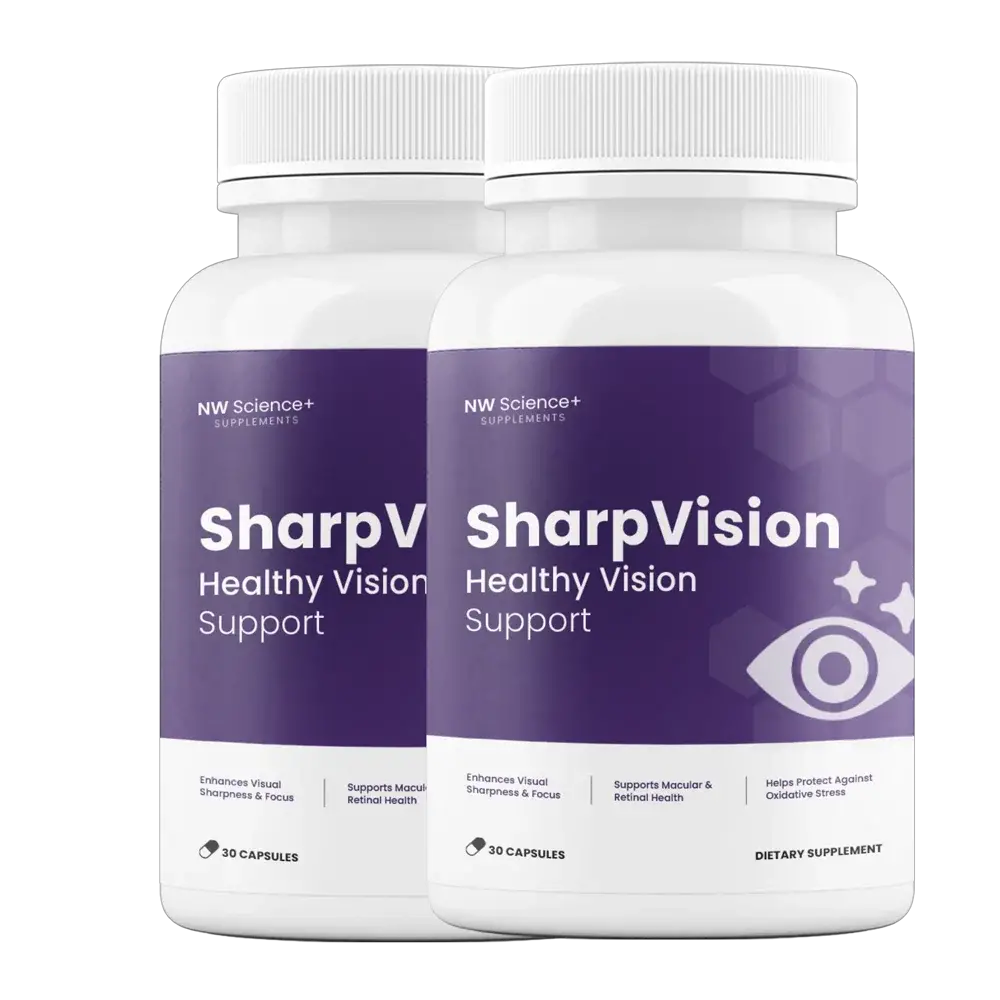
SharpVision Healthy Vision Support is marketed as a dietary supplement for clearer vision, eye strain, retinal health and long-term eye protection. On the surface, it looks like a fairly typical eye-health formula, with ingredients such as lutein, zeaxanthin, bilberry and antioxidant vitamins.
But the bottle shown in the advertising raises an immediate problem. It says Saffron Extract, Ginger Extract, Magnesium and Inositol, while the current SharpVision website lists an entirely different eight-ingredient formula containing lutein, zeaxanthin, bilberry, eyebright, vitamin A, zinc, vitamin C and vitamin E. It also makes claims about reducing hair loss and being “safe with all medications,” which makes me question exactly what product is actually being sold. So, is SharpVision legit? Let’s take a closer look.
Key Takeaways
- The SharpVision bottle shown in the advertisement does not match the current formula listed on the brand’s website.
- The product makes broad claims about clearer vision, night vision and eye protection, but SharpVision itself has not been clinically tested as a finished product.
- Some of its ingredients, particularly lutein and zeaxanthin, have legitimate research behind them, although the strongest evidence applies to specific eye conditions and specific formulations.
- The image also claims SharpVision can reduce hair loss and is safe with all medications, neither of which is adequately supported.
- I would not buy this version until the manufacturer can explain the formula discrepancy.
What Is SharpVision Healthy Vision Support?
SharpVision is sold as a daily eye-health supplement by NW Science+ Supplements. The current official website describes it as a twice-daily capsule intended to support visual clarity, macular health, eye comfort and protection against oxidative stress. Each bottle contains 60 capsules, providing a 30-day supply.
The current website promotes SharpVision primarily toward people who spend long periods looking at screens, experience eye fatigue or are concerned about age-related changes in vision. It says the formula is designed to support the macular pigment, antioxidant defenses and general visual function rather than act as a treatment for an eye disease.
That is a much more reasonable description than some of the claims appearing in SharpVision advertising. The problem is that the bottle being advertised doesn’t appear to contain the same formula.
How It Claims to Work
The current SharpVision formula is built around lutein and zeaxanthin, two carotenoids found in the retina. The company says these ingredients help support macular pigment, while bilberry and eyebright are included for eye comfort and the remaining vitamins and minerals provide antioxidant and nutritional support.
The company also claims the formula can help with clearer vision, reduced eye strain, better night vision and protection against blue-light-related oxidative stress.
There is a legitimate scientific basis for some of this. The National Eye Institute’s AREDS2 research found that a specific combination containing lutein, zeaxanthin, vitamin C, vitamin E, zinc and copper can slow the progression of intermediate to advanced age-related macular degeneration. However, the benefit was demonstrated in people with specific stages of AMD, not as a general vision-sharpening treatment for healthy people.
That’s an important distinction because “supports eye health” and “improves your eyesight” are not interchangeable claims.
Reality vs. Claims
SharpVision has some legitimate ingredients behind it, but the marketing stretches considerably beyond what the evidence establishes.
Lutein and zeaxanthin are probably the strongest part of the formula. They are naturally concentrated in the retina, and the AREDS2 research provides genuine evidence that a specific supplement containing these carotenoids can help people with intermediate AMD.
But that does not mean taking SharpVision will correct blurry vision, eliminate the need for glasses or reverse ordinary age-related eyesight changes.
The National Eye Institute specifically says AREDS/AREDS2 supplements do not prevent AMD from developing and don’t benefit people who don’t have AMD or who only have early AMD.
So when SharpVision talks about improving visual clarity and night vision, I would treat those as supplement-marketing claims rather than established outcomes for this particular product.
And there is another problem: the formula shown in the advertisement isn’t even the formula on which these claims appear to be based.
Let’s Look at the Listed Ingredients
The current SharpVision website lists eight active ingredients: lutein, zeaxanthin, bilberry extract, eyebright herb, vitamin A as beta-carotene, zinc, vitamin C and vitamin E.
The bottle shown in the image supplied for this investigation, however, prominently displays Saffron Extract, Ginger Extract, and Magnesium and Inositol on the front.
That is not a minor labeling variation.
The current SharpVision formula contains no saffron, ginger, magnesium or inositol in its published eight-ingredient formula.
Conversely, the current formula contains lutein, zeaxanthin, bilberry, eyebright, vitamin A, zinc, vitamin C and vitamin E, which are not the three featured ingredients shown on the bottle in the image.
I could not establish from the available information whether the pictured bottle represents an older formula, a different SharpVision product, an unauthorized version or simply an inaccurate advertising image.
And that’s precisely why I wouldn’t be comfortable ordering it.
Red Flags to Consider
The Bottle and Website Don’t Match
This is the biggest red flag. The advertisement shows a bottle labeled “SharpVision Healthy Vision Support” with Saffron Extract, Ginger Extract, and Magnesium and Inositol highlighted on the front.
The current official SharpVision formula says it contains eight active ingredients, none of which are ginger, magnesium, inositol or saffron. The brand even makes a point of saying that SharpVision uses a deliberately short formula and that there are eight active ingredients.
So either the product has undergone a significant formula change without adequate explanation, or the image is showing a different product. Either way, the customer deserves to know which formula they’re actually purchasing.
“Reduce Hair Loss” Makes No Sense for This Product
The bottle image also claims:
“Reduce Hair Loss.”
That immediately stood out to me because SharpVision is supposed to be an eye-health supplement. There is no hair-loss claim on the current official SharpVision website, and the published formula is presented specifically around macular pigment, eye comfort and antioxidant protection.
That doesn’t mean nutrients can never play a role in hair health. It means the claim is completely out of place on an eye supplement unless the company can explain exactly why it is making it. It also makes me wonder whether this advertising image has been recycled from another supplement funnel.
“Safe With All Medications” Is Far Too Broad
The image claims SharpVision is “Safe with all medications.” That’s another statement I would not accept at face value. Interestingly, the current SharpVision website itself says that people who are taking medication or managing a health condition should speak with their physician before using the product.
That is much more responsible wording. The National Eye Institute also warns that high-dose eye supplements can affect how the body handles other medicines and recommends discussing supplements with a doctor.
So I would trust the cautious disclaimer over the sweeping statement on the promotional image.
The Formula Doesn’t Match the Strongest Eye-Supplement Evidence
SharpVision prominently promotes lutein and zeaxanthin, which makes sense because these ingredients have genuine research behind them.
But the evidence people often associate with these nutrients comes largely from the AREDS2 formula, which contains 10 mg lutein and 2 mg zeaxanthin alongside high doses of vitamin C, vitamin E, zinc and copper.
SharpVision is not presented as an AREDS2 supplement. That matters because simply containing some of the same ingredients does not make a product equivalent to a clinically tested formula.
The National Eye Institute specifically advises consumers to check whether an eye supplement contains the exact ingredients and amounts used in AREDS2 when that treatment is appropriate.
Bilberry Isn’t as Proven as the Marketing Suggests
Bilberry sounds impressive in eye-health advertising because of the famous stories about pilots supposedly using it for night vision. The actual evidence is much less exciting.
The National Center for Complementary and Integrative Health says research on bilberry has generally been limited, with many studies having methodological weaknesses or small sample sizes. It specifically notes that rigorous studies have not found bilberry effective for improving night vision in healthy people.
So I wouldn’t buy SharpVision because I expect bilberry to suddenly make night driving easier.
The Product Has a Very Large Marketing Footprint
Another thing I noticed is the sheer number of SharpVision websites and promotional pages online. There are several domains presenting themselves as official SharpVision websites, including pages with different wording, different marketing layouts and, in some cases, different ingredient descriptions.
One SharpVision sales page claims the product is sold through ClickBank and advertises an 85% discount, with a regular price of $294 reduced to $49.
Another current SharpVision site lists $79 for one bottle, $59 per bottle for three and $49 per bottle for six. That doesn’t prove anything sinister by itself, but when the product already has a formula discrepancy, having multiple sales sites with changing prices makes the purchasing trail harder to follow.
The “85% Off” Offer Is Particularly Questionable
One sales page claims SharpVision normally costs $294 per bottle but is currently available for $49, supposedly an 85% discount. The current SharpVision official site I found instead lists a single bottle at $79, three bottles at $59 each and six bottles at $49 each.
Those prices don’t line up particularly well with the dramatic “$294 regular price” used in the other sales funnel.
Again, this isn’t proof that the product is fake. But it makes the discount appear more like a sales tactic than a reliable representation of the product’s normal market price.
The Reviews Are Seller-Controlled
SharpVision’s websites display thousands of positive reviews, including claims about improved clarity, reduced eye strain and better night vision. One current sales page claims more than 17,000 reviews, while another displays 2,174 ratings.
Those numbers sound impressive, but they are on the company’s own sales pages. I wouldn’t treat seller-hosted testimonials as equivalent to independently verified clinical evidence.
There is also an amusing quality-control issue on one SharpVision sales page: some of the review images are labeled “Gluco6”, even though the page is selling SharpVision.
That is exactly the sort of recycled sales-page material that makes me question how carefully these pages are being maintained.
Efficacy
There is a real argument for getting adequate lutein and zeaxanthin through diet or supplementation, particularly for people whose dietary intake is low. The AREDS2 research provides strong evidence for a specific high-dose formula in people with intermediate or advanced AMD.
But that is not the same thing as proving SharpVision will sharpen normal vision.
I found no published clinical trial demonstrating that the finished SharpVision product improves visual acuity, eliminates blurry vision, reverses eye strain or improves night vision.
The company itself acknowledges that its claims have not been evaluated by the FDA and says SharpVision is not intended to diagnose, treat, cure or prevent disease.
That disclaimer is appropriate, but it also means the impressive claims on the sales pages shouldn’t be mistaken for established medical outcomes. And if someone already has blurry vision, worsening night vision, eye pain, flashes, floaters or other significant visual changes, I would absolutely not try to solve that with SharpVision. Those symptoms warrant an eye examination.
Pricing and Where to Buy
The current SharpVision website lists the product at $79 for one bottle, $177 for three bottles, or $294 for six bottles, with the multi-bottle packages receiving free shipping. Each bottle contains 60 capsules and is marketed as a 30-day supply.
Another SharpVision sales page advertises a much more dramatic $49 single-bottle price after an alleged 85% discount. The company advertises a 60-day money-back guarantee.
Because there are multiple SharpVision domains circulating, I would be extremely careful about ordering from third-party marketplaces or unfamiliar websites. The company itself has warned about counterfeit SharpVision products appearing through unauthorized sellers.
What To Do If You Already Bought SharpVision
If you already purchased SharpVision, the first thing I’d do is look at the actual bottle rather than the advertisement. Check the Supplement Facts panel and compare it with the website you ordered from. If your bottle contains saffron, ginger, magnesium and inositol like the image shown here, save photographs of the label and screenshots of the page where the product was advertised.
If the formula doesn’t match what you were promised, contact the seller and request clarification before continuing to take it.
And if you’re taking prescription medication, don’t rely on the advertisement’s “safe with all medications” statement. The manufacturer’s own current website recommends speaking with a physician if you’re taking medication, and that is the safer advice to follow.
Conclusion
SharpVision is a particularly interesting case because the underlying concept isn’t completely ridiculous. Lutein and zeaxanthin are legitimate eye-health nutrients, and the AREDS2 research provides strong evidence that a specific combination of nutrients can slow the progression of intermediate to advanced AMD.
But the product being advertised raises too many questions. The bottle shown in the promotion says Saffron Extract, Ginger Extract, Magnesium and Inositol, while the current SharpVision website describes an eight-ingredient formula containing lutein, zeaxanthin, bilberry, eyebright, vitamin A, zinc, vitamin C and vitamin E.
Then there’s the bizarre hair-loss claim, the “safe with all medications” statement, multiple SharpVision sales domains, wildly different pricing presentations and seller-controlled testimonials that even appear to contain recycled references to another supplement.
I can’t confidently say that SharpVision itself is a scam. But I absolutely would not order the product shown in this particular advertisement without first verifying the actual manufacturer, Supplement Facts panel and formula.
My conclusion: SharpVision has some legitimate eye-health ingredients, but the formula discrepancy is a major red flag. Until the company explains why the advertised bottle doesn’t match its published formula, I would skip it.
Also read – MindWake Nootropic Review: Does It Really Improve Memory? Claims and Red Flags