

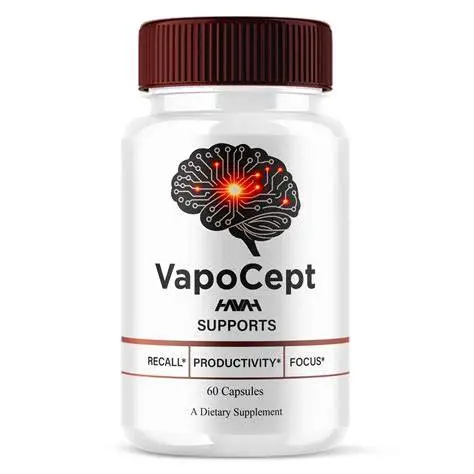
VapoCept is marketed as a daily brain-health supplement for memory, focus, mental clarity and cognitive performance. Its sales pages present the formula as a way to support cerebral blood flow, neuronal energy and protection against age-related cognitive decline.
But the more I looked into VapoCept, the more the product itself started to look confusing. Different websites claiming to be official list different formulas; the dosage information has changed depending on the version, and the actual ingredients look much more like a circulation and exercise-support formula than a targeted memory supplement. So, is VapoCept legit? Let’s take a closer look.
Key Takeaways
- VapoCept is marketed for memory, focus, mental clarity and brain health.
- Different VapoCept websites describe different formulas, including different numbers of ingredients.
- The main ingredients have legitimate research behind some uses, particularly circulation and exercise performance, but not strong evidence for improving memory.
- There is no published clinical trial showing that the finished VapoCept formula improves cognition.
- I would skip VapoCept until the company provides one consistent formula and clearer evidence for its brain-health claims.
What Is VapoCept?
VapoCept is a once-daily capsule marketed as a cognitive-support supplement. The main formula currently promoted contains several forms of arginine and citrulline, along with niacin and beta-alanine. The sales pitch is based on a fairly simple theory: increasing nitric oxide and blood flow could improve circulation to the brain, while niacin supports cellular energy and beta-alanine supposedly provides antioxidant protection.
That sounds scientifically polished, but there is an important question underneath it: does improving these underlying processes actually make a healthy person’s memory or thinking better?
The answer is considerably less convincing than the advertising suggests.
How It Claims to Work
VapoCept’s central mechanism is nitric oxide. L-arginine and L-citrulline can contribute to nitric oxide production, which plays an important role in blood-vessel dilation and circulation. The company then takes that mechanism and connects it to cerebral blood flow, suggesting that better circulation can support memory, focus and mental clarity.
Niacin is included because the body uses vitamin B3 to make NAD and other molecules involved in energy metabolism. Beta-alanine can increase muscle carnosine levels, which is why it is commonly found in sports and pre-workout supplements.
None of those facts is particularly controversial. The leap happens when the product turns them into a memory-restoration formula.
Reality vs. Claims
The ingredients aren’t fake. The problem is that the strongest evidence for them doesn’t match what VapoCept is selling. L-citrulline has legitimate human research behind its effects on blood flow and exercise performance. Beta-alanine is also well established for increasing muscle carnosine and supporting certain types of physical performance.
But neither of those things establishes that taking a small amount of either ingredient improves memory or reverses cognitive decline. The same problem applies to arginine. It is a genuine nitric oxide precursor, but oral arginine has limitations because much of it is broken down before reaching systemic circulation. There is no established evidence that taking arginine in a VapoCept capsule improves memory in otherwise healthy adults.
And niacin is certainly important for normal cellular energy production, but that doesn’t mean adding a modest amount of niacin to a supplement will make a person more focused or mentally sharp if they already get enough vitamin B3.
The company is taking real biochemistry and building a much bigger cognitive story around it.
Let’s Look at the Listed Ingredients
The formula most consistently described by the newer VapoCept pages contains L-Arginine, L-Arginine AKG 2:1 Extract, L-Citrulline HCl, L-Citrulline Malate, Beta-Alanine, Niacin and Calcium.
A newer label disclosure gives the amounts as 200 mg L-Arginine, 200 mg L-Arginine AKG, 100 mg L-Citrulline HCl, 100 mg L-Citrulline Malate, 40 mg Beta-Alanine, 7.5 mg niacin and 18 mg calcium per capsule.
Those numbers actually make the cognitive claims even harder to get excited about. For comparison, human research on citrulline commonly uses doses in the gram range, while beta-alanine studies generally use several grams per day. VapoCept provides only 200 mg total across its two citrulline forms and 40 mg of beta-alanine.
So even if those ingredients have useful effects at research doses, VapoCept isn’t obviously providing those amounts. And there’s another problem: other VapoCept websites still describe a six-ingredient formula and don’t publish individual quantities at all.
Red Flags to Consider
There Isn’t One Consistent VapoCept Formula
This is the biggest issue. One VapoCept website says the product contains six ingredients: L-Arginine, L-Arginine AKG, L-Citrulline HCl, L-Citrulline Malate, niacin and beta-alanine.
Another, newer disclosure lists seven active ingredients, adding calcium. Other VapoCept pages have described completely different formulas involving things such as green tea extract, fibre blends and probiotics, while still using the VapoCept name.
That isn’t a minor formatting issue. A customer should be able to visit the brand’s official website and see one identifiable formula.
The Product Looks More Like a Circulation Formula Than a Nootropic
This is probably the most interesting thing about VapoCept. Arginine, citrulline and beta-alanine are extremely common in pre-workout and sports-performance supplements. They are not classic memory-support ingredients.
There is nothing wrong with using them. But calling this a “clinical memory restoration” formula makes the positioning sound much more specialized than the actual ingredient selection suggests.
The company’s own more detailed ingredient information essentially acknowledges that the strongest evidence for several ingredients concerns circulation or physical performance rather than cognition.
The Doses Are Tiny Compared With Common Research Doses
The newer label gives 100 mg each of two citrulline forms and only 40 mg beta-alanine. That is worth paying attention to. If a study uses several grams of an ingredient, you can’t simply point to the presence of that ingredient in a 100 mg capsule and assume the same result applies.
The company may have its own reasoning for the formulation, but I haven’t seen a clinical trial demonstrating that these particular doses improve memory.
There Is No Finished-Product Clinical Trial
This is another important distinction… There are studies on arginine, there are studies on citrulline, there are studies on beta-alanine, and there is plenty of research on niacin. But I couldn’t find a published randomized clinical trial testing VapoCept itself for memory, focus or cognitive decline.
That means the product’s evidence is largely built by stacking together individual ingredient research rather than demonstrating that the finished formula actually works.
The “Clinical Memory Restoration” Positioning Is Too Strong
The phrase “clinical memory restoration” makes this sound almost like a therapeutic intervention. But VapoCept is a dietary supplement, not a treatment for dementia or another neurological disease. Its own disclaimer says its claims have not been evaluated by the FDA.
That distinction matters because genuine memory loss is not something I would recommend self-treating with a supplement based on a nitric-oxide theory.
There Are Multiple “Official” Websites
I found several VapoCept domains presenting themselves as official or authoritative sources. That’s already confusing, but it becomes a much bigger problem because those websites don’t consistently agree about the formula, dosage, pricing or even the product format.
One site describes a simple six-ingredient capsule. Another presents seven individually dosed ingredients. Other sites appear to describe completely different products under the same name.
I would want the company to explain that before putting money down.
The Website Is Very New
The main VapoCept.com domain was registered in June 2026, making it only a few months old. Again, a new website isn’t proof of a scam. But when a relatively new supplement brand is already presenting itself with extensive reviews, aggressive bundle offers and “clinical” cognitive positioning, I want more independent history before taking those claims at face value.
Efficacy
This is where I would separate plausibility from proof. There is a plausible biological reason why arginine and citrulline could influence circulation. There is also solid evidence that beta-alanine can increase muscle carnosine, and niacin is an essential nutrient involved in cellular metabolism.
But the actual question is whether VapoCept improves memory. I don’t see convincing evidence for that. There is no finished-product clinical trial demonstrating improved recall, focus, cognitive processing or reversal of cognitive decline. And the doses in the newer formula don’t obviously correspond to the gram-level amounts commonly studied for citrulline or beta-alanine.
So I wouldn’t call VapoCept completely unsupported. I would call the brain-health claims significantly ahead of the evidence.
Pricing and Where to Buy
The common VapoCept offer is around $79 per bottle when buying two, $69 per bottle for three and $49 per bottle for six, with the larger packages generally promoted with free shipping and bonuses.
The six-bottle package is a particularly aggressive offer because you’re being encouraged to commit to six months of a product before knowing whether it will do anything noticeable for you.
There are also conflicting guarantee terms across the different VapoCept websites. Some pages advertise a 60-day money-back guarantee, while others mention a 180-day guarantee or additional conditions attached to the refund period.
I’d save screenshots of the exact offer and refund terms before ordering.
What To Do If You Already Bought It
If you’ve already purchased VapoCept, keep your order confirmation, receipt and a screenshot of the product page you ordered from.
When it arrives, check the physical Supplement Facts panel and compare it with the formula advertised when you purchased it. With this particular product, that’s worth doing because the online formulas aren’t consistent.
And if you’re experiencing genuine memory loss, confusion or worsening cognitive symptoms, don’t assume a supplement is the answer. Those symptoms can have many causes and may need proper medical evaluation.
Conclusion
VapoCept is not a case where I can say the ingredients are fake. They’re real ingredients with legitimate uses. The problem is that the strongest evidence for those ingredients doesn’t line up neatly with what VapoCept is promising. Arginine and citrulline are primarily circulation-related ingredients; beta-alanine is much more established in exercise performance; and niacin is an essential vitamin. Turning that combination into a “clinical memory restoration” formula requires a much bigger evidentiary leap than the marketing acknowledges.
Then there is the formula confusion. Different websites describe different versions of VapoCept, the doses have not always been disclosed, and there is no clinical trial on the finished product demonstrating the advertised cognitive benefits.
My conclusion: I would skip VapoCept for now. If the company wants to position this as a serious memory supplement, it needs to do more than explain why nitric oxide is important. I want one consistent formula, meaningful doses and actual clinical evidence showing that the finished product improves cognition.
Also read – BRYN Grill Rolling Basket Review: My Experience Using It on the Grill