

DentaTonic is marketed as a once-daily oral health supplement that promises to strengthen teeth, support healthy gums, fight plaque and even protect against cavities. Its unusual selling point is that it supposedly boosts the natural enzymes in your saliva to create a healthier mouth.
There is some legitimate science behind the enzyme system DentaTonic is built around, but the product’s marketing takes that science much further than the evidence supports. The doses are hidden in a proprietary blend, the websites don’t consistently disclose the same formula, and some of the biggest claims are difficult to substantiate. So, is DentaTonic legit? Let’s take a closer look.
Key Takeaways
- DentaTonic is a real oral-health tablet sold through established payment processors.
- Its enzyme-based concept has some legitimate scientific background.
- The individual ingredient doses are hidden inside a 400 mg proprietary blend.
- The finished DentaTonic product has not been shown in a robust clinical trial to prevent cavities or regenerate teeth.
- The “FDA approved” and “dental filtration breakthrough” marketing makes the product sound much more proven than it is.
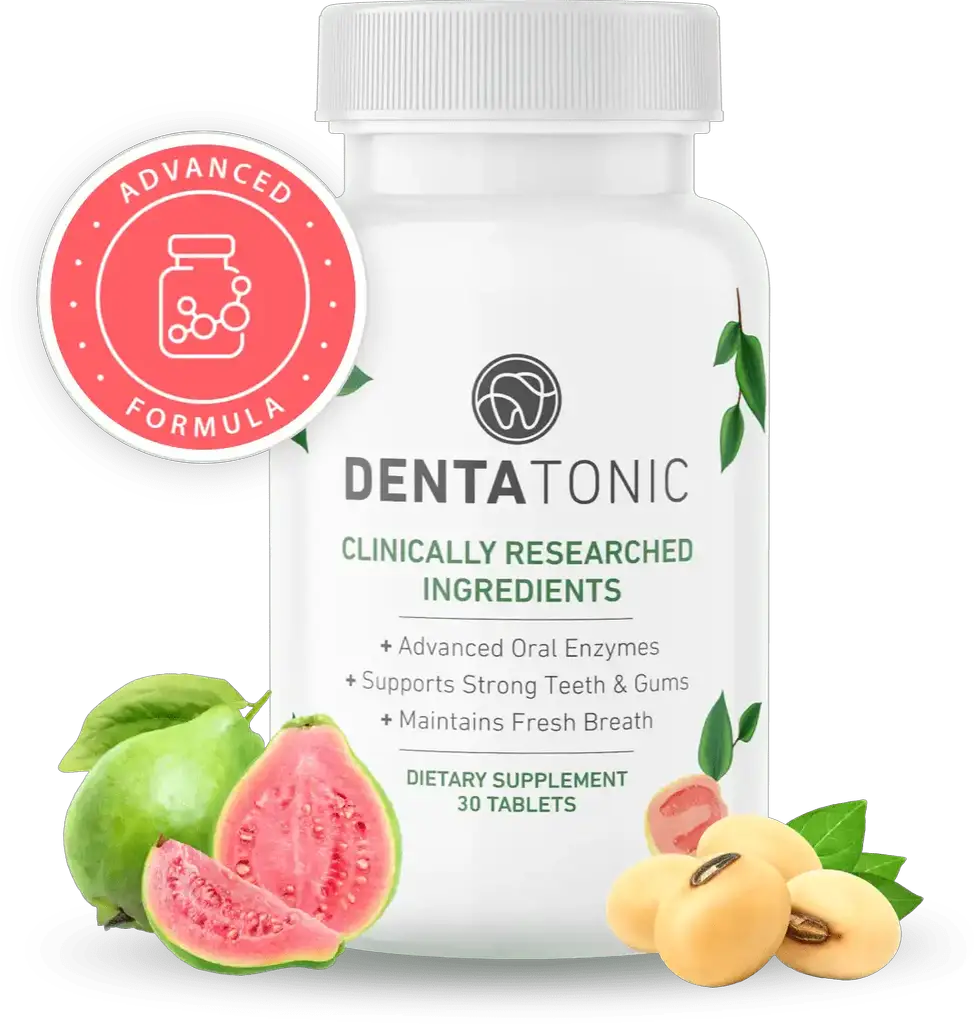
What Is DentaTonic?
DentaTonic is a once-daily tablet marketed as an alternative or addition to conventional oral hygiene. The company says it works from inside the mouth by supporting the natural protective enzyme system found in saliva.
The main sales pitch revolves around lactoperoxidase, an enzyme naturally present in saliva that participates in the mouth’s antimicrobial defense system.
DentaTonic claims that restoring or increasing this enzyme activity can help protect against harmful bacteria, plaque, cavities, gum irritation, bad breath and tooth sensitivity. The product is supposed to be taken once a day with water.
That’s an interesting concept, because the underlying enzyme system isn’t made up. The problem is what DentaTonic claims that system can accomplish in this particular supplement.
How It Claims to Work
The company’s explanation is essentially that saliva already contains a natural defense system, but modern diets, toxins and oral problems can interfere with it.
DentaTonic supposedly replenishes the enzymes involved in that system, particularly lactoperoxidase, and helps the mouth fight bacteria and plaque more effectively.
The formula includes lactoperoxidase, lysozyme and lactoferrin, alongside enzymes such as dextranase and beta-glucanase. Microcrystalline hydroxyapatite is also included and is marketed as an enamel-strengthening ingredient.
There is legitimate biology behind several of these ingredients. Lactoperoxidase can participate in an antimicrobial system involving thiocyanate and hydrogen peroxide. Lactoferrin and lysozyme also have antimicrobial properties, and enzyme-containing oral-care products have been studied. But that doesn’t automatically establish that swallowing one DentaTonic tablet per day will prevent cavities, repair enamel or reverse gum disease.
Reality vs. Claims
This is where I think DentaTonic deserves a more nuanced assessment than simply calling it a scam. The enzyme concept has real scientific precedent. Lactoperoxidase, lactoferrin, lysozyme and glucose oxidase have been used in oral-care products, particularly products aimed at people with dry mouth. There are also clinical studies of enzyme-containing toothpastes and mouthwashes. So the company isn’t simply inventing the existence of these enzymes.
The problem is that DentaTonic’s evidence appears to come primarily from research on individual ingredients, enzyme systems and other oral-care products rather than from a properly designed clinical trial of DentaTonic itself.
That distinction matters.
A study showing that an enzyme-containing toothpaste improves gum health does not prove that an oral supplement containing some of the same enzymes will produce the same result.
Let’s Look at the Listed Ingredients
The more detailed label describes a 400 mg proprietary blend containing guava fruit powder, microcrystalline hydroxyapatite complex, beta-glucanase, dextranase, amylase, lactoperoxidase, glucose oxidase, amyloglucosidase, lysozyme and lactoferrin.
The sales page, however, highlights only seven of those ingredients: lactoperoxidase, dextranase, lysozyme, lactoferrin, microcrystalline hydroxyapatite, beta-glucanase and amylase.
The important problem is that the individual quantities aren’t disclosed. So although the company calls the blend “perfectly dosed,” I cannot actually see how much lactoperoxidase, lactoferrin, hydroxyapatite or any of the other active ingredients I’m getting.
That’s especially relevant when the company uses research on individual ingredients to support its marketing.
Red Flags to Consider
The 400 mg Proprietary Blend
This is my biggest issue with the formula. Ten active ingredients are grouped into a single 400 mg blend, meaning the company doesn’t tell customers how much of each ingredient is actually present.
If DentaTonic contains lactoperoxidase, that’s interesting. If it contains a clinically meaningful amount of lactoperoxidase, that’s considerably more interesting. But I can’t establish the latter from the label.
The same problem applies to microcrystalline hydroxyapatite. The company markets it as something that can strengthen and rebuild enamel, but without knowing the quantity, I can’t meaningfully compare the product with research involving hydroxyapatite.
The Product Is Not Clinically Proven
I couldn’t find a robust, peer-reviewed clinical trial testing DentaTonic itself and demonstrating that it prevents cavities, reverses gum disease, regenerates enamel or eliminates tooth decay.
The scientific material surrounding the product includes research on oral enzymes and other dental products, but that isn’t the same thing as testing the finished DentaTonic formula.
The company therefore has a reasonable scientific concept, but a much weaker case for saying that the actual product has been clinically proven.
The “Hydrogen Cyanide” Claim
This is one of the stranger parts of the marketing. DentaTonic repeatedly says its enzyme system can combat or neutralize harmful hydrogen cyanide in the mouth. There is research examining hydrogen cyanide in oral fluid and breath, so the chemical itself isn’t imaginary.
But the sales funnel takes that fairly niche piece of research and turns it into a major explanation for dental problems, suggesting that this hidden toxin is something consumers need DentaTonic to eliminate.
That’s a very different proposition from saying that certain oral enzymes participate in antimicrobial activity. I wouldn’t use the hydrogen-cyanide story as a reason to buy the product.
“FDA Approved” Is Not What It Sounds Like
DentaTonic’s sales pages prominently display “FDA Approved” imagery and repeatedly mention an FDA-approved or FDA-registered facility.
But the FAQ itself eventually acknowledges something much more important: the FDA does not review dietary supplements for approval in the way the marketing language might suggest.
The site’s legal disclaimer also says its statements have not been evaluated by the FDA. So the FDA language should not be interpreted as FDA approval of DentaTonic’s effectiveness.
Being manufactured in an FDA-registered facility and having the product itself approved by the FDA are two entirely different things.
The Review Count Is Hard to Take at Face Value
One current sales page claims more than 92,100 reviews, while another version of the site says it has more than 67,800 customers. Those numbers are presented directly by the seller, rather than through an independently verified review platform.
That doesn’t mean the customers don’t exist. It means I wouldn’t use those numbers as evidence that 92,000 people have independently confirmed that DentaTonic works.
The affiliate program also encourages people to promote DentaTonic through ClickBank, which means there is a substantial financial incentive for affiliates to drive sales.
That’s normal for ClickBank products, but it is another reason to distinguish affiliate testimonials from independent dental evidence.
The Scientific References Don’t Always Match the Product
This one is particularly interesting. The product’s sales material presents itself as heavily science-backed, but the reference material associated with some DentaTonic pages includes studies concerning things such as skincare, hyaluronic acid and photoaged skin.
Those studies aren’t evidence that DentaTonic improves teeth or gums. There are legitimate dental studies referenced elsewhere around enzymes, oral biofilm and gum health, but mixing unrelated scientific references into the same sales ecosystem makes the “clinically proven” presentation considerably less convincing.
Is DentaTonic Effective?
I wouldn’t dismiss the formula completely. The lactoperoxidase, lysozyme and lactoferrin system has a legitimate history in oral-care products, particularly products designed to support people with dry mouth. There is also evidence that certain enzyme-containing oral-care products can affect oral bacteria and gum health.
But DentaTonic is being sold as something considerably broader. The marketing suggests it can prevent cavities, strengthen enamel, improve gum health, eliminate harmful toxins, reduce sensitivity and maintain long-term dental health.
That’s a lot to expect from one 400 mg proprietary blend.
And because the individual doses are hidden, I can’t determine whether the formula actually contains enough of its ingredients to reproduce the effects seen in research.
My assessment is therefore: DentaTonic has a plausible scientific concept, but the finished product is not adequately proven for the broad dental claims being made.
Pricing and Where to Buy
The current DentaTonic offer is structured around:
- One bottle: $69
- Three bottles: $59 per bottle
- Six bottles: $49 per bottle
The company advertises free U.S. shipping and a 60-day money-back guarantee.
The six-bottle package is pushed particularly hard, with the website saying that most customers choose six bottles and encouraging buyers to stock up.
The “regular” price is also presented as $99 per bottle on some pages, making the discounted price look substantially more dramatic. I wouldn’t let that discount structure pressure me into buying six months of an unproven dental supplement.
What To Do If You Already Bought DentaTonic
If you’ve already purchased DentaTonic, keep the bottle and take a photograph of the Supplement Facts panel so you have a record of the exact formula you received.
If you’re using it as an oral-health supplement, don’t stop brushing, flossing or seeing your dentist simply because the sales page says the tablet works from within.
And if you have tooth pain, bleeding gums, cavities, loose teeth, swelling or significant sensitivity, don’t attempt to treat the underlying problem with DentaTonic alone.
A supplement cannot replace dental treatment for an existing cavity or gum disease. If you decide the product isn’t worth the money, use the 60-day guarantee and keep your order confirmation and refund correspondence.
Conclusion
DentaTonic is more interesting than some of the completely implausible dental supplements I’ve come across. Its core enzyme concept has a legitimate scientific basis, and ingredients such as lactoperoxidase, lysozyme and lactoferrin aren’t random substances invented for a sales page.
But the marketing stretches that science considerably. The 400 mg proprietary blend hides the individual doses; there is no strong clinical trial of the finished DentaTonic product; the hydrogen-cyanide story is overblown, and the repeated FDA imagery can give consumers an impression of regulatory approval that the company’s own disclaimer contradicts.
My conclusion: I wouldn’t call DentaTonic an outright scam, but I wouldn’t rely on it as a dental treatment either. At best, it is an oral-health supplement built around a legitimate enzyme concept that hasn’t been adequately proven in this particular formulation. For cavities, gum disease or damaged teeth, I’d put my money toward actual dental care before spending $49–$69 on a bottle of DentaTonic.
Also read – Is Meowzle.com a Trustworthy Online Fashion Store? Find Out Here!