

CinnaShield is marketed as a concentrated Ceylon cinnamon supplement that supposedly restores insulin sensitivity, stabilizes blood sugar, stops sugar cravings and brings glucose readings back into the normal range. But the more I looked into the product, the more the marketing claims started to run far ahead of the actual evidence.
The website also has some serious inconsistencies around its reviews, guarantee, domains, seller identity and recurring billing. So, is CinnaShield legit? Let’s take a closer look.
Key Takeaways
- CinnaShield contains concentrated Ceylon cinnamon extract and MCT oil.
- The company makes much stronger blood-sugar claims than the available evidence supports.
- The website claims 17,000+ reviews, while another section says 193 reviews and the underlying product data shows only six.
- The advertised 90-day guarantee conflicts with a 60-day refund policy.
- The checkout reportedly includes recurring 30-day refills, while the seller’s identity is not clearly established.
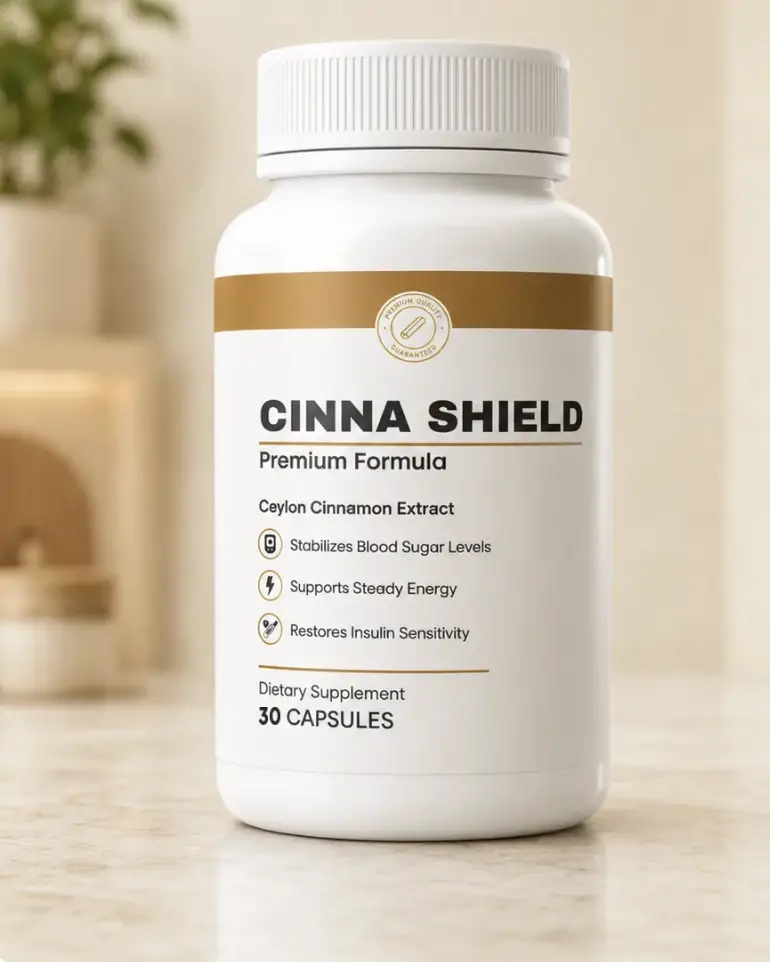
What Is CinnaShield?
CinnaShield is a dietary supplement sold in capsule form and marketed primarily toward people concerned about blood sugar, insulin resistance and sugar cravings. The product contains a concentrated Ceylon cinnamon extract, which the company says is DNA-verified and produced at a 12:1 concentration. It also contains MCT oil, which the company describes as a carrier intended to improve absorption.
On the surface, this sounds considerably simpler than many blood-sugar supplements that throw ten or twenty herbs into one capsule. The problem is what the company claims that capsule can actually do.
CinnaShield says it can restore insulin sensitivity, bring blood sugar back into the normal range, stop post-meal glucose spikes, eliminate sugar cravings, improve energy and support healthy blood pressure. Those are not small wellness claims. They move into territory that requires serious clinical evidence.
How It Claims to Work
The central story behind CinnaShield revolves around MHCP, a compound associated with cinnamon. The company describes insulin as a key and your cells as a locked door, then claims that MHCP helps “open” that door so glucose can move from the bloodstream into the cells more efficiently.
That is an attractive explanation because insulin sensitivity is a real physiological concept. The problem is that a simple explanation does not establish that taking CinnaShield will restore insulin sensitivity in a person with insulin resistance. The website goes even further, saying that users can see lower glucose readings within weeks and describing a week-by-week progression in which cravings disappear, fasting glucose falls, post-meal spikes flatten and waist size starts decreasing.
Those timelines are presented with far more confidence than the available evidence justifies.
Reality vs. Claims
Cinnamon has actually been studied in relation to blood glucose and diabetes, so CinnaShield is not built around a completely imaginary ingredient.
But the evidence is inconsistent. Studies have used different species of cinnamon, different extracts, different doses and different treatment periods. That makes it difficult to determine whether cinnamon as a whole has a meaningful effect on blood glucose, let alone whether a particular branded cinnamon capsule can produce the dramatic changes advertised.
The company’s claim that CinnaShield will restore insulin sensitivity is therefore much stronger than simply saying that cinnamon may support healthy glucose metabolism. There is another major issue: there is no verified clinical trial showing that CinnaShield itself produces the advertised 92%, 81% or 89% improvements. The website presents those percentages as customer feedback from an NPS survey, not as results from a controlled clinical study.
That distinction is enormous. A customer survey cannot establish that a supplement lowered someone’s A1C, restored insulin sensitivity or prevented post-meal glucose spikes.
Let’s Look at the Listed Ingredients
The formula is surprisingly simple.
Ceylon Cinnamon Extract
The company says the product uses a 12:1 concentrated extract of Ceylon cinnamon and that one capsule provides the equivalent of 7,200 mg of raw cinnamon bark.
Ceylon cinnamon generally contains much less coumarin than Cassia cinnamon, which is a legitimate distinction when discussing long-term cinnamon consumption.
However, saying that an extract is “12:1” does not automatically tell us how much of the biologically relevant compounds are present or whether the finished product has been clinically tested.
MCT Oil
MCT oil is included as a carrier for the cinnamon extract. The company says this improves absorption because the active compounds are fat-soluble. That is a marketing claim that needs to be distinguished from demonstrated clinical benefit.
MCT oil itself does not turn cinnamon into a proven blood-sugar treatment.
The formula is therefore not necessarily suspicious because it contains only two listed ingredients. The bigger issue is that the company makes very large medical-style claims from a very simple formula without providing comparable product-specific evidence.
Red Flags to Consider
The Review Numbers Do Not Match
This is one of the clearest inconsistencies on the website. The top of the sales page claims 4.8 stars from more than 17,012 reviews. Further down, another section says the product is based on 193 reviews. The underlying product information associated with the page contains only six detailed reviews.
Those numbers do not explain themselves. The reviews may come from different systems, but the website does not clearly explain why a visitor sees three completely different figures. And because all of the reviews are presented by the seller, they should not be treated as independent evidence that the product works.
The 90-Day Guarantee Conflicts With the Refund Policy
The sales page repeatedly promotes a 90-day money-back guarantee, even saying customers can return empty bottles for a full refund. But the linked refund policy reportedly provides a 60-day refund period from the date of shipping and requires the product to be returned.
That is a significant difference. If a company advertises 90 days but its legal refund policy says 60 days, I would not assume the more generous promise will automatically apply.
The Domains Are Extremely New
The main marketing domain, cinnashiield.com, uses an unusual spelling with two consecutive “i” characters and was registered in September 2026. The checkout domain, cinnashield.com, was registered shortly before that.
A new domain does not prove that a company is fraudulent. New businesses launch websites every day. But it becomes much more difficult to reconcile a brand-new web presence with claims of more than 17,000 reviews and the impression that CinnaShield is a well-established product with a substantial history of customers.
The Company Behind It Is Unclear
The website refers to CinnaShield as “the Company,” but does not clearly identify a complete legal business entity responsible for the sale. The terms also contain a reference to American Health Daily, without clearly explaining its relationship to CinnaShield.
That is not enough transparency for a supplement making claims about blood sugar and insulin sensitivity. If I am being asked to put a health-related product into my body, I want to know exactly who manufactured it, who is selling it and who is legally responsible for the transaction.
Recurring Refills
The checkout has reportedly included language stating that refills ship every 30 days. That matters because the sales page heavily promotes discounted multi-bottle packages, while recurring billing can create a completely different total cost over time.
A subscription itself is not automatically a scam. The problem is whether the recurring charge is obvious, whether the renewal price is clearly displayed and whether cancellation is straightforward. Anyone ordering should check the final checkout page rather than assuming the purchase is a single payment.
“FDA-Registered Facility” Is Not FDA Approval
CinnaShield says it is manufactured in a U.S. facility that is FDA registered and GMP certified. That sounds impressive, but it does not mean that the FDA approved CinnaShield or verified its blood-sugar claims.
Dietary supplements are not FDA-approved for effectiveness before being marketed in the same way prescription medicines are. The company itself includes the required disclaimer that its claims have not been evaluated by the FDA.
“DNA-Verified” Sounds More Impressive Than It Is
The website repeatedly emphasises “DNA-verified Ceylon cinnamon.” That may refer to botanical authentication, which can be a legitimate quality-control technique for distinguishing plant species.
But authentic Ceylon cinnamon is not automatically effective for treating insulin resistance. Verifying what plant is in the capsule and proving that the capsule produces a particular medical outcome are two completely different things.
The Week-by-Week Results Are Far Too Specific
CinnaShield gives consumers a detailed timeline: Week 1 supposedly brings lower readings and fewer cravings. Weeks 2–4 supposedly bring further reductions in fasting glucose and post-meal spikes. Weeks 4–8 supposedly bring normalized numbers and a shrinking waist.
That is a very specific sequence of biological outcomes for a supplement without a published clinical trial demonstrating that progression. It reads like a results script rather than an established clinical expectation.
Is CinnaShield Effective?
I would not consider CinnaShield a proven blood-sugar supplement. The underlying ingredient deserves more credit than the marketing does. Cinnamon has been studied in humans, and Ceylon cinnamon is a legitimate form of cinnamon with lower coumarin content than Cassia.
But the research does not establish that CinnaShield will restore insulin sensitivity, normalize blood glucose, eliminate sugar cravings or reduce waist size according to the company’s week-by-week schedule.
The company also has not demonstrated those outcomes in a clinical trial of the finished CinnaShield product. The 92%, 81% and 89% figures on the website are customer-survey claims, not clinical trial results. That means I would not use CinnaShield as evidence-based treatment for diabetes, prediabetes or insulin resistance.
Possible Safety Concerns
Cinnamon is not automatically harmless simply because it is a spice. The type and amount matter, particularly because Cassia cinnamon can contain significant amounts of coumarin. Ceylon cinnamon generally contains much less, which is one reason the distinction is relevant.
More importantly, anyone taking medication that lowers blood glucose should be cautious with a supplement marketed specifically for glucose control. Combining a supplement that may affect blood sugar with diabetes medication could potentially contribute to excessively low glucose in some people.
The company itself advises people taking insulin or sulfonylureas, blood thinners or those with liver disease to speak with their doctor before use. I would take that warning seriously. And absolutely do not reduce or stop prescribed diabetes medication because CinnaShield makes your glucose readings look better.
Pricing and Where to Buy
CinnaShield is sold through its own direct-response websites rather than through a conventional pharmacy network. The sales funnel promotes large discounts, including a Buy Two, Get One Free offer and larger multi-bottle packages.
The exact price can change depending on the promotional page, which is another reason to look at the final checkout rather than relying on the headline discount.
Before paying, check:
- The exact number of bottles
- The final amount charged
- Shipping costs
- Whether the order is one-time or recurring
- The renewal price if applicable
- The actual refund deadline
- The return requirements
- The legal seller shown on the checkout
Save screenshots of the offer and checkout page.
What To Do If You Already Bought
If you already purchased CinnaShield, check your bank or card statement for the exact charge and watch for another charge approximately 30 days later. Look at your confirmation email to determine whether you enrolled in recurring refills.
Keep screenshots of the advertisement, checkout page, guarantee and refund policy. This is particularly important because the sales page and refund policy appear to give different guarantee periods. Check the bottle itself for the Supplement Facts panel, manufacturer information, lot number and expiration date.
If you have diabetes or take medication that affects blood sugar, speak with your doctor or pharmacist before adding CinnaShield to your routine. Do not stop prescribed medication because the sales page claims that CinnaShield can make it unnecessary.
Conclusion
CinnaShield is not simply a bottle of random herbs. It contains Ceylon cinnamon, an ingredient that has genuinely been studied for possible effects on blood glucose.
But the marketing takes that limited evidence and stretches it into claims about restoring insulin sensitivity, normalizing blood sugar, eliminating cravings, flattening glucose spikes and reducing waist size.
The website’s own numbers also raise questions. More than 17,000 claimed reviews, 193 reviews in another section and six detailed reviews in the underlying product data are difficult to reconcile. The advertised 90-day guarantee conflicts with a 60-day refund policy, the domains are extremely new, the legal seller is not clearly identified, and recurring refill language appears at checkout.
My conclusion: I would skip CinnaShield. Not because Ceylon cinnamon is fake, but because the product’s medical-style promises are much stronger than the evidence, while the company’s transparency and sales practices leave too many questions unanswered.
If someone wants to use cinnamon as part of their diet, that is a completely different proposition from buying a supplement that claims to restore insulin sensitivity and bring blood sugar back to normal. CinnaShield has not demonstrated that level of effectiveness.
Also read – Tide Ocean Mist Light Review: Is It Worth the Price? I Bought It