

Sabel Ethiopian Black Seed Oil Softgels are marketed as a potent black seed supplement designed to support gut health, immunity and overall wellness. But the product makes some big claims about parasites and biofilm that deserve a closer look.
The company also emphasizes its 5% thymoquinone concentration, but that doesn’t necessarily mean the product can deliver the health effects being promised. So, is Sabel Black Seed Oil legit? Let’s take a closer look.
Key Takeaways
- Sabel Life sells Ethiopian black seed oil standardized to a claimed 5% thymoquinone.
- Black seed oil and thymoquinone are legitimate subjects of scientific research, but that does not prove Sabel’s parasite or biofilm claims.
- The company’s biggest marketing claim comes from laboratory research, not evidence that Sabel removes parasites or treats gut infections in humans.
- Sabel Life’s website is very new, and customer reviews include both positive experiences and complaints about subscriptions, delivery and product quality.
- The product may be a real black seed oil supplement, but I would not buy it for the parasite cleanse claims.
What Is Sabel Ethiopian Black Seed Oil?
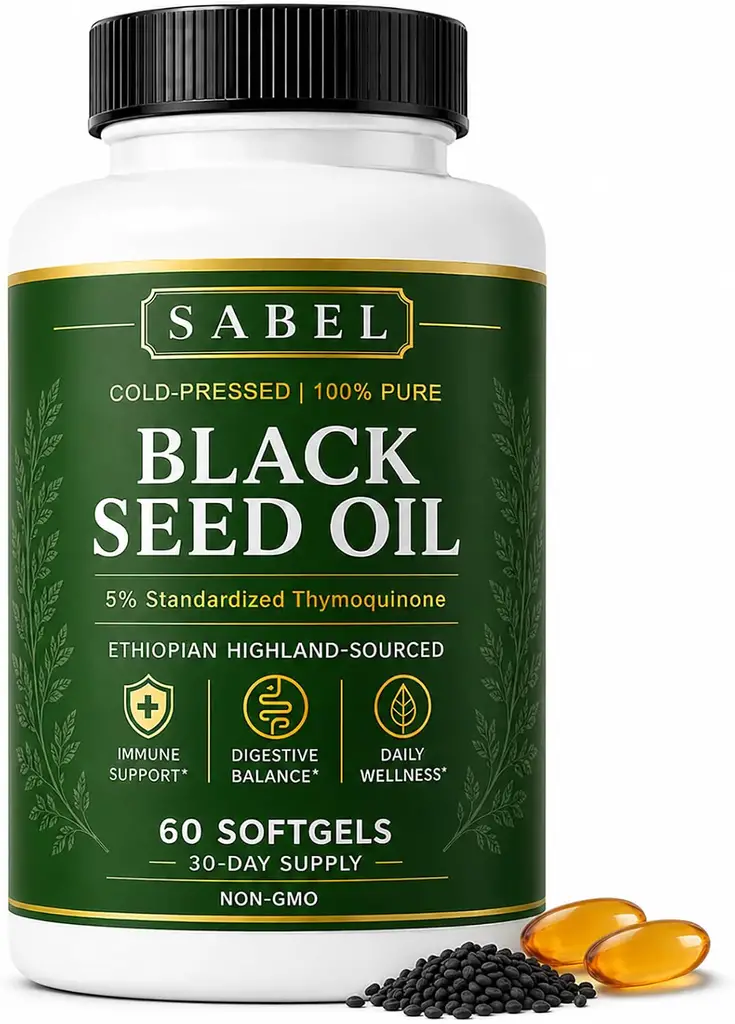
Sabel Life’s Ethiopian Black Seed Oil is a softgel supplement made from Nigella sativa, commonly called black seed or black cumin. The company says its oil is cold-pressed and sourced from the Ethiopian Highlands, where it claims the plants are grown at elevations above 8,000 feet. The main selling point is the standardised 5% thymoquinone concentration.
Each bottle contains 60 softgels, with two softgels recommended per day, making one bottle a 30-day supply. The current advertised price is around $39.99 per bottle, although Sabel frequently promotes Buy One Get One and larger bundle offers.
Black seed oil itself is not some invented supplement. It has a long history of traditional use and has been investigated in human studies for several areas of health. The problem is that Sabel Life isn’t simply selling it as general wellness support.
The company’s sales funnel has built an elaborate story around parasites hiding behind biofilm in the gut, and that is where the marketing starts getting much harder to defend.
How It Claims to Work
The entire Sabel pitch revolves around thymoquinone, or TQ. The company argues that ordinary black seed oil contains too little TQ to produce meaningful effects, while its 5% standardized formula provides enough of the compound to break through the protective biofilm supposedly surrounding parasites, fungi and harmful bacteria in the digestive tract.
According to the sales pages, this biofilm acts almost like a physical shield. Parasites supposedly hide behind it, allowing them to remain in the gut, contribute to bloating and digestive problems, and continue releasing toxins.
Sabel then positions thymoquinone as the solution. Break the biofilm, expose the organisms, and your body can supposedly eliminate what has been trapped there.
It is a very effective sales story because it gives people who have unexplained bloating, constipation, fatigue or digestive discomfort a single explanation for all of their symptoms. But a compelling story is not the same thing as a demonstrated medical mechanism in humans.
Reality vs. Claims
There is a real scientific basis underneath the thymoquinone discussion. Thymoquinone is one of the major bioactive compounds in Nigella sativa, and researchers have investigated its antioxidant, anti-inflammatory and antimicrobial properties.
There are also laboratory studies showing that thymoquinone can interfere with bacterial biofilms. One study tested TQ against several bacterial species in laboratory conditions and found inhibition of biofilm formation. That is interesting research, but it does not establish that taking a 5% black seed oil softgel will break apart a parasite biofilm inside a person’s intestines.
That distinction matters enormously. A substance demonstrating antibiofilm activity against bacteria in a laboratory is not the same as demonstrating that it can find parasites inside the human gastrointestinal tract, penetrate their protective structures, eliminate them and resolve the symptoms Sabel attributes to them.
I found no clinical trial showing that Sabel Life itself removes intestinal parasites or treats a supposed gut biofilm condition. The company is taking genuine laboratory research and applying it to a much broader human-health story.
Red Flags to Consider
The Parasite Story Is the Biggest Problem
Sabel’s sales pages repeatedly tell customers that parasites, fungi and harmful bacteria are hiding behind a protective biofilm in their gut. One sales page describes the supposed biofilm as a “sticky dam” that keeps waste attached to the colon wall and makes organisms dramatically harder to eliminate.
Another claims that the biofilm becomes thicker over time and that the organisms underneath continue multiplying while releasing toxins. This is far more specific than saying black seed oil has antimicrobial properties. The company is essentially offering an explanation for a wide range of digestive symptoms and then presenting its product as the missing solution.
I would be very cautious with that narrative. Bloating, constipation, fatigue and digestive discomfort can have many causes. They are not evidence, by themselves, that someone has parasites hiding behind intestinal biofilm.
Laboratory Biofilm Research Is Being Turned Into a Human Treatment Claim
This is one of the most important distinctions in the entire review. Yes, thymoquinone has demonstrated antibiofilm activity in laboratory research. But Sabel’s marketing makes the leap from that research to a story about breaking down a biofilm in the human gut so that parasites can be flushed out.
Those are not equivalent. The published research I found does not establish that taking Sabel softgels performs this process in humans. The company’s statement that TQ can disrupt biofilm by up to 98% is therefore particularly misleading without explaining exactly what organism, experimental conditions, concentration, and model produced that number.
A percentage from a laboratory experiment cannot be presented as though it represents the percentage of intestinal parasites a customer can expect the product to eliminate.
The 5% Claim Needs Better Documentation
Sabel says every batch is standardised to 5% thymoquinone and third-party tested for purity, potency and heavy metals. That would be useful quality information if the company actually made the supporting laboratory reports readily available.
One Trustpilot reviewer specifically complained that they asked Sabel for the third-party lab results and did not receive them. That is a customer allegation, not proof that testing does not occur.
But if a company repeatedly uses “third-party tested” as one of its major selling points, making the corresponding certificates of analysis easy to verify would make the claim considerably more convincing.
The Website Is Very Young
The Sabel Life domain was registered on February 22, 2026. That doesn’t prove anything sinister. New companies can be perfectly legitimate. But it does mean that the brand does not have the long operating history that some of its marketing presentations might lead a buyer to assume.
This becomes more relevant because the homepage currently advertises 20,239+ customers, while the product page displays more than 3,700 reviews. Those figures are controlled by the company itself and cannot be treated as independent evidence of product effectiveness.
“Sold Out 12 Times” and Low-Stock Messaging
The product page repeatedly uses urgency messaging. It says the product has sold out multiple times and warns customers about low stock, while encouraging them to subscribe so they do not miss future shipments.
That kind of scarcity marketing is common in direct-response supplement funnels. It does not prove fraud, but it can pressure people into buying before they have properly investigated the product.
I would ignore the countdowns and stock warnings and evaluate the product on its actual evidence.
Subscription Complaints
Sabel offers subscriptions and actively encourages customers to subscribe for continued use. There are Trustpilot complaints from customers who say they were charged through a subscription they did not expect or had difficulty dealing with order cancellation.
There are also positive reviews where customers say Sabel’s support team resolved order problems quickly. So the picture is mixed.
I would not claim that Sabel secretly charges everyone or that every subscription complaint is valid. But if you order, you should make absolutely sure the checkout clearly shows whether you are buying once or enrolling in recurring shipments.
Customer Reviews Are Extremely Mixed
The company displays highly enthusiastic testimonials describing dramatic changes in bloating, energy, brain fog, joint stiffness and digestion. Some testimonials even describe the product as producing major changes within three to six weeks.
Those are testimonials, not clinical evidence. Outside the company’s website, the picture is considerably less uniform. Trustpilot contains positive reviews, but also complaints alleging non-delivery, unexpected subscriptions, lack of refunds and concerns about the product itself.
One customer reported that a softgel broke open and contained bright orange liquid that did not resemble the black seed oil they expected. Sabel responded by asking for the order and batch information and offered to investigate.
That response is important because the company did not simply ignore the complaint. But the existence of these conflicting reports is another reason I would not use testimonials as proof that the product works.
The Ethiopian Origin Story Is Doing a Lot of Marketing Work
Sabel repeatedly emphasizes that its black seed comes from Ethiopian highlands above 8,000 feet and suggests that the harsh environment causes the plant to produce dramatically higher levels of protective compounds.
The company also cites research comparing thymoquinone levels among black seed samples from different countries. There may be legitimate botanical variation between plants grown in different environments. But the important question for the buyer is not simply where the seed was grown.
It is whether the finished Sabel product actually contains the stated 5% TQ concentration, whether that concentration is stable throughout shelf life and whether it produces the claimed health outcomes.
Those are separate questions.
Is Sabel Ethiopian Black Seed Oil Effective?
I would divide this into two completely different questions. Is black seed oil biologically active? Yes. There is legitimate research on Nigella sativa and thymoquinone, including human studies.
Has Sabel demonstrated that its particular softgels eliminate parasites, break down intestinal biofilm or permanently resolve bloating and digestive problems?
No. That evidence is missing. There is a human safety study of a different 5% TQ black cumin oil formulation, and broader reviews of Nigella sativa have found potentially useful effects in areas such as metabolic and inflammatory health. But researchers have also pointed out limitations in the existing clinical literature, including differences in preparations, doses and study quality.
So this is not a situation where I would say the ingredient is fake. The problem is that Sabel has taken a real botanical with real research behind it and built a much more specific treatment story around it than the evidence currently supports.
Safety
Black seed oil is not automatically dangerous, but it is still a biologically active supplement. Human research has generally reported reasonable short-term tolerability, although nausea, bloating and burning sensations have been reported in some studies. There are also case reports of allergic reactions.
More importantly, black seed may affect blood sugar and blood pressure, which matters if someone is already taking medication for either condition. Anyone taking prescription medication, pregnant or breastfeeding, or dealing with an existing medical condition should speak with a healthcare professional before using it.
And I would not use Sabel as a substitute for proper testing or treatment if you genuinely suspect a parasite infection. A suspected parasite infection should be diagnosed rather than assumed from symptoms like bloating or fatigue.
Pricing and Where to Buy
Sabel currently lists the 60-softgel bottle at about $39.99, reduced from a claimed $65 regular price. The company also heavily promotes multi-bottle bundles, including Buy One Get One Free and Buy Two Get Three Free offers.
It offers a 30-day money-back guarantee. The company says customers can contact support within the guarantee period for a refund, although customer reports online suggest that some people have experienced difficulty with refunds or order issues.
If you decide to purchase, I would take screenshots of the exact offer and checkout page, especially if you choose a subscription.
What To Do If You Already Bought
If you already purchased Sabel, check your confirmation email and make sure you know whether you selected a one-time order or subscription. Check your card statement for unexpected recurring charges.
Keep the bottle, packaging, lot number and expiration date until you have decided whether you are keeping the product.
If you want to verify the company’s 5% TQ claim, ask Sabel for the certificate of analysis for your specific batch rather than relying solely on the words “third-party tested” on the website.
And if you bought it because you believe you have parasites, don’t rely on the supplement to diagnose or eliminate them. Get appropriate medical testing instead.
Conclusion
Sabel Ethiopian Black Seed Oil Softgels are not obviously a fake product. The company appears to be selling an actual black seed oil supplement, and the 5% thymoquinone concept is not inherently ridiculous. Black seed and thymoquinone have genuine scientific literature behind them, including human research.
The problem is the marketing. Sabel has built its sales funnel around a dramatic parasite-and-biofilm explanation for bloating, constipation, fatigue and other digestive complaints. Laboratory research showing that thymoquinone can interfere with bacterial biofilms does not prove that these softgels break down intestinal biofilm and eliminate parasites in humans.
Then there are the newer-brand concerns, aggressive scarcity messaging, subscription complaints, conflicting customer experiences and the fact that the company says its batches are independently tested without making those test results especially easy to verify.
Also read – Sensica SensiLight Mini 100 Review: Is It Worth Buying? I Tried It