

I bought the Sensica SensiLight Mini 100 because I was tired of the constant cycle of shaving and dealing with hair growing back almost immediately. The idea of having an at-home device that could actually reduce hair growth long term sounded much more appealing than continually buying razors or booking hair-removal treatments.
The device itself is easy to handle, and the whole idea of doing treatments at home is convenient. But there is one issue I could not ignore once I looked closely at the device specifications: the SensiLight Mini 100 is not suitable for every skin tone, and that completely changes how I feel about recommending it.
Key Takeaways
- Uses IPL-based RPL technology for long-term hair reduction.
- Has three energy levels.
- Uses skin-tone and skin-contact sensors before flashing.
- Has a high-capacity lamp rated for up to 100,000 flashes.
- Can be used on areas including the legs, arms, underarms, bikini line, and permitted facial areas.
- Works best when there is enough contrast between the hair and skin.
- Treatment is considerably easier than repeatedly shaving or waxing.
- Results require multiple treatments rather than one or two sessions.
- The device is corded rather than cordless.
- The skin-tone limitation is a serious consideration, not a minor detail.
- I would not buy it without first confirming that my skin tone and hair colour are actually compatible with IPL.
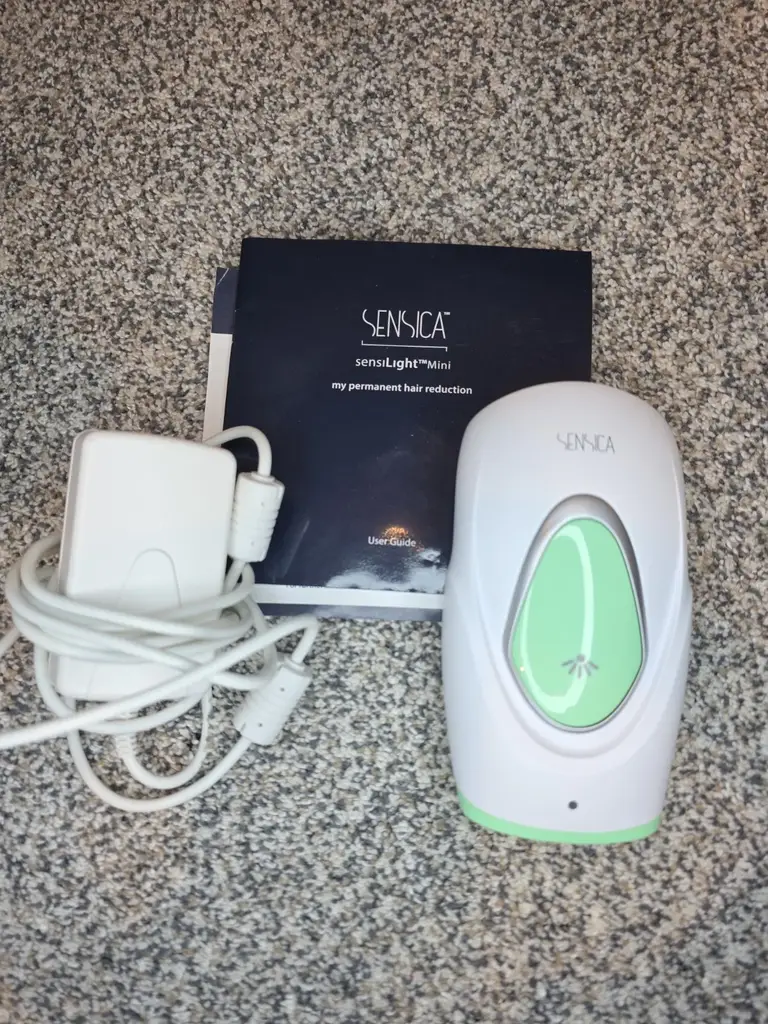
What Is the Sensica SensiLight Mini 100?
The Sensica SensiLight Mini 100 is an at-home IPL hair-removal device designed to reduce unwanted hair growth over time. Sensica calls its technology RPL, or Reactive Pulsed Light, which combines IPL with sensors designed to read the skin before each pulse. The Mini 100 has a high-capacity lamp rated for up to 100,000 flashes, three energy levels, and two treatment modes. It is designed for areas such as the legs, arms, underarms, bikini line, back, shoulders, chest, and stomach, with certain facial areas also permitted.
The idea is straightforward. Light is absorbed by melanin in the hair, producing heat that damages the hair follicle and reduces future growth. It is not the same thing as shaving, where you are simply cutting the hair at the surface.
Why I Tried It
The main reason I wanted the SensiLight Mini 100 was convenience. Shaving is quick, but the results do not last very long. Waxing lasts longer, but I do not particularly enjoy the process. Professional laser treatments can also become expensive when you are treating several areas over a long period.
An at-home IPL device seemed like a middle ground. I could do treatments whenever I wanted without making appointments or continually paying for individual sessions.
The 100,000-flash lamp also appealed to me because I did not want to buy an expensive device only to discover that I would eventually need replacement cartridges.
My Experience With the Sensica SensiLight Mini 100
The device is fairly straightforward to operate. It is shaped like a small handheld hair-removal device, and the treatment head sits against the skin before the flash is released. The skin sensor is one of the features I appreciated because the device is not supposed to simply flash indiscriminately. It checks the treatment area before allowing the pulse, and that is particularly important with IPL because the light is attracted to melanin.
The actual treatment sensation was manageable. I felt warmth and a mild snapping sensation with the flashes rather than anything I would describe as unbearable pain. That made the process much easier for me to tolerate than waxing.
The bigger issue was patience. IPL is not an instant hair-removal method. You still have to shave the area beforehand, then treat it according to the recommended schedule and wait for the hair-growth cycle to do its part. The SensiLight Mini 100 recommends treatments every two weeks initially, followed by monthly maintenance.
That means the first few sessions are really about consistency. I did notice that the process was easier than constantly shaving because I was working toward reducing future growth rather than simply removing what was already visible. But I would not describe the results as immediate.
The difference becomes more noticeable over time. Some hairs become slower to return, while other areas can be more stubborn. That makes sense because IPL targets hairs during their active growth phase, so not every hair is going to respond at exactly the same time.
The device also takes some planning. I could not just decide at the last minute that I wanted completely hair-free legs and expect the device to take care of everything immediately. I had to shave, make sure the skin was clean and dry, treat the areas systematically, and stick to the schedule.
For smaller areas such as the underarms, the process was much less tedious. Larger areas took considerably more patience because I had to work my way across the skin rather than simply holding the device in one place.
The cord was another small annoyance. The SensiLight Mini 100 is not cordless, so I had to stay close enough to a power source while using it. That is not a deal-breaker, but it does make the device less convenient than some newer cordless IPL options.
The biggest issue, however, was not the cord or the treatment time… It was the skin-tone limitation.
The Skin-Tone Issue I Would Not Ignore
This is where I think people need to pay very close attention before buying the SensiLight Mini 100.
The device is designed for Fitzpatrick skin types I through IV. Sensica’s own user documentation warns against using the device on very dark skin, including Fitzpatrick type VI. The reason is that IPL relies on melanin as part of its targeting mechanism. When there is a lot of melanin in the skin itself, the light can be absorbed by the skin as well as the hair, increasing the risk of burns and other adverse effects.
That means the little skin sensor does not magically make the device suitable for every complexion. I would not look at the sensor and assume that it makes the device safe for very dark skin. If your natural skin tone falls outside the device’s approved range, I would not use it simply because the machine allows you to turn it on.
That is a major limitation for this product, and something I think should be considered before the excitement about permanent hair reduction.
What About Hair Colour?
The other side of the equation is hair colour. IPL works by targeting melanin in the hair, so dark hair generally responds better. The SensiLight Mini 100 is designed primarily for dark blonde, brown, or black hair on compatible skin tones.
Very light blonde, grey, white, and red hair can be much less responsive because there is less of the pigment the light is trying to target. So someone can have the right skin tone but still get disappointing results if their hair does not contain enough pigment.
That is one reason I would not buy this device simply because someone else got great results from it. Skin tone and hair colour make a huge difference.
Is It Really Permanent Hair Removal?
This wording deserves some attention. Sensica describes the device as providing a permanent reduction in hair regrowth, rather than promising that every single hair will disappear forever. The company’s documentation defines permanent reduction as a long-term, stable reduction in the number of hairs that regrow after treatment.
I would not buy an IPL device expecting to use it a few times and never see a hair again. The realistic goal is significantly slower and reduced regrowth, followed by maintenance treatments.
That is still useful. I would much rather deal with sparse, slower-growing hair than shave constantly. But calling it simply “permanent hair removal” can make the process sound more final than it actually is.
What I Liked
- Easy to understand and operate.
- Three energy levels.
- Skin-contact and skin-tone sensors.
- High-capacity 100,000-flash lamp.
- No replacement cartridge needed during the rated lamp life.
- Treatment is manageable compared with waxing.
- Smaller areas are relatively quick to treat.
- Can reduce the frequency of shaving over time.
- Suitable for several body areas when the user’s skin and hair are compatible.
What I Didn’t Like
- It is corded rather than cordless.
- Results take time and consistency.
- Larger areas take patience to treat.
- It does not work equally well on every hair colour.
- It is not suitable for very dark skin tones.
- The phrase “permanent hair removal” can create unrealistic expectations.
- Maintenance treatments are still necessary.
- It is an expensive purchase if you later discover that your skin tone or hair colour is incompatible.
Sensica SensiLight Mini 100 Claims vs Reality
Claim: Permanent hair reduction.
Reality: The goal is long-term reduction in regrowth, not literally removing every hair permanently after a handful of treatments. You need an initial treatment schedule and ongoing maintenance.
Claim: Safe treatment with intelligent sensors.
Reality: The sensors are useful, but they do not override the device’s skin-tone limitations. The manufacturer’s instructions specifically exclude very dark skin tones.
Claim: Salon-quality results at home.
Reality: The convenience is real, but using the device still requires consistency, shaving beforehand, proper positioning, and patience. It is not equivalent to pressing a button and instantly getting salon results.
Claim: Up to 100,000 flashes.
Reality: The high-capacity lamp is useful because you are unlikely to run through the rated number of flashes during ordinary personal use. The bigger question is whether the device is actually compatible with your skin and hair.
Claim: Virtually painless hair removal.
Reality: The sensation was manageable for me. I felt warmth and mild snapping rather than severe pain, although sensitivity can vary depending on the person and treatment area.
Is the Sensica SensiLight Mini 100 Worth the Price?
If your skin tone and hair colour are compatible, I can understand the appeal. You are paying for a device that can potentially reduce the amount of shaving or waxing you need to do over a long period, and the high flash count means the lamp is not something I would expect to replace frequently.
But I would not spend the money until I had confirmed compatibility. That is the first question I would ask before worrying about flash count, energy settings, or how quickly it works. If the device is not appropriate for your skin tone, none of those features matters.
And if your hair is very light, I would also think twice because the treatment depends on having enough pigment in the hair to respond to the light.
Who Might Like It?
The SensiLight Mini 100 may suit you if you:
- Have a compatible Fitzpatrick I-IV skin tone.
- Have dark blonde, brown, or black hair.
- Want to reduce shaving or waxing.
- Prefer treating unwanted hair at home.
- Are willing to follow a treatment schedule.
- Want a device with a high-capacity lamp.
- Do not mind using a corded device.
Who Should Skip It?
I would skip this device if you:
- Have very dark skin that falls outside the approved range.
- Have grey, white, or very light hair.
- Have recently tanned skin.
- Want instant hair removal.
- Do not want to maintain a treatment schedule.
- Expect every hair to disappear permanently.
- Want a cordless device.
- Have tattoos, dark moles, or other areas that the manufacturer says should not be treated.
Alternatives
- Sensica SensiLight Pro
- Philips Lumea IPL
- Braun Silk-expert Pro 5
- Ulike Air 10
Conclusion
The Sensica SensiLight Mini 100 is an interesting at-home hair-removal device, and I like the idea of being able to reduce hair growth without constantly shaving or booking appointments. The device is easy enough to use, the flashes are manageable, and the high-capacity lamp is convenient. With consistent treatments, compatible hair and skin can respond with reduced regrowth over time.
But the skin-tone limitation is a major issue, and I would not brush past it. The device is not suitable for every complexion, and the built-in sensors do not change that. Hair colour also matters because IPL depends on pigment in the hair.
For someone who is a good candidate, it could be a useful long-term hair-reduction tool. For someone outside the recommended skin-tone or hair-colour range, it is simply the wrong device.
Would I buy it again?
Only after confirming that my skin tone and hair colour fall within the manufacturer’s approved range.
Would I recommend it?
Yes, but only to someone who is genuinely compatible with IPL and understands that the goal is long-term reduction in regrowth, not instant or absolute hair removal.
The biggest mistake would be buying it because the advertising makes permanent hair removal sound universal. It isn’t. Your skin and hair have to be compatible with the technology first.
Also read my similar review of the NUVI IPL Hair Lasering