

Visivra is marketed as a daily eye-health supplement that supposedly supports clearer vision, reduces screen-related eye strain and protects the retina as you age. The formula contains several legitimate eye-health nutrients, so this isn’t a case where the entire concept is built around obviously fake ingredients.
The problem is that Visivra makes those ingredients sound much more conclusive than the evidence actually is. I also found multiple websites selling Visivra with different presentations, while the main U.S. site is only a few months old and does not publish the actual amounts of its six active ingredients. So, is Visivra legit? Let’s take a closer look.
Key Takeaways
- Visivra is a real eye-health supplement being sold online, but its finished-product effectiveness has not been established in a clinical trial.
- The formula centers on lutein, zeaxanthin, bilberry, astaxanthin, zinc and vitamin A.
- Lutein and zeaxanthin have legitimate evidence for specific eye-health applications, but Visivra is not the same thing as the AREDS2 formula used for certain people with age-related macular degeneration.
- The company does not publish the actual dosages of its six core ingredients on the public formula page.
- The main U.S. domain was registered in May 2026, so this is still a relatively new brand.
- I would not call Visivra an outright scam, but I would not buy it expecting it to restore eyesight or replace glasses or professional eye care.
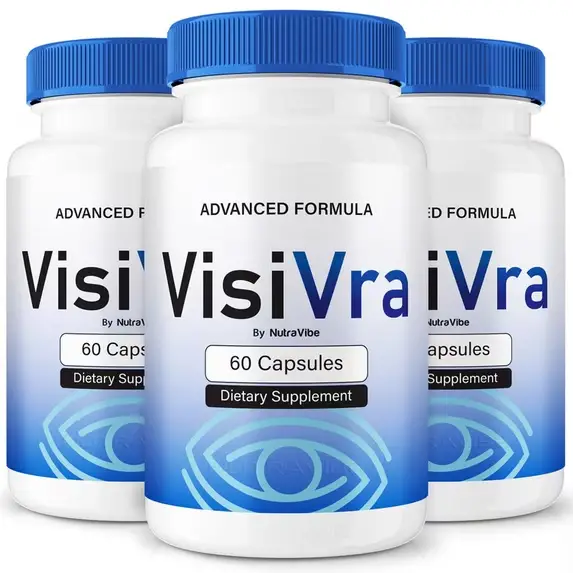
What Is Visivra?
Visivra is a once-daily capsule marketed for adults who spend a lot of time looking at screens, experience tired eyes or want to support their eyesight as they age.
The company’s U.S. site says the product contains six core ingredients: lutein, zeaxanthin, bilberry extract, astaxanthin, zinc and vitamin A. It recommends one capsule daily with food and markets the formula around visual clarity, contrast, eye comfort and retinal protection.
The company also offers a 60-day money-back guarantee. At face value, this sounds like a fairly ordinary eye-health supplement. The interesting questions start when I look at what the formula is actually proven to do.
How Visivra Claims to Work
Visivra’s explanation is that its carotenoids and antioxidants help protect the retina from oxidative stress while supporting the macular pigment that contributes to visual function. The company also says the formula can help with screen-related eye fatigue, visual sharpness, focus and even night or low-light vision. There is legitimate biology behind some of this.
Lutein and zeaxanthin are found in the retina and can absorb certain high-energy wavelengths of light. Vitamin A is also essential to normal vision. But that does not mean taking these nutrients will correct refractive errors, reverse an eye disease or restore deteriorating eyesight.
That distinction becomes important because Visivra’s marketing sometimes blurs the line between supporting eye nutrition and improving vision itself.
The Formula Isn’t the Biggest Problem, But Transparency Is
Visivra’s six-ingredient concept is actually fairly straightforward. Lutein and zeaxanthin are the most recognizable eye-health nutrients here, while astaxanthin, bilberry, zinc and vitamin A are included as supporting ingredients.
I don’t have a problem with that ingredient selection by itself. What I do have a problem with is that the public formula page tells customers to look at the physical bottle for the exact milligram amounts.
That makes it impossible to compare the product properly with the doses actually studied in clinical research. And that matters because “contains lutein and zeaxanthin” is not enough. The amount matters.
The AREDS2 Comparison Needs a Reality Check
This is probably the most important scientific distinction in the entire Visivra investigation. Visivra references the same general eye-health research that has made lutein and zeaxanthin famous, including the National Eye Institute’s AREDS2 research. But Visivra is not the AREDS2 formula.
AREDS2 was a very specific high-dose combination containing vitamin C, vitamin E, zinc, copper, lutein and zeaxanthin. The National Eye Institute specifically states that the formulation was studied in people with intermediate AMD or certain combinations of intermediate and advanced AMD.
The original AREDS research found that the appropriate formulation reduced the risk of progression to advanced AMD by about 25% over five years.
That does not mean that any supplement containing lutein and zeaxanthin provides the same protection. In fact, the NEI explicitly says AREDS2 does not benefit people with no AMD or early AMD.
So when Visivra uses this research to support its general eye-health positioning, I would consider that reasonable background evidence for the ingredients, but not proof that Visivra itself prevents vision loss.
What About Bilberry and Night Vision?
This is one claim where the evidence is particularly unimpressive. Bilberry has been associated with night vision for decades, partly because of the famous World War II story about British pilots supposedly eating bilberry jam.
The National Center for Complementary and Integrative Health says the evidence is much less exciting. Studies have produced conflicting results, many were poorly designed, and the most rigorous studies have not shown bilberry to improve night vision in healthy people.
So I would not buy Visivra because I expect bilberry to suddenly make night driving dramatically easier.
Can Visivra Reduce Screen Eye Strain?
This is more plausible, but still needs to be put in perspective. People absolutely can experience digital eye strain from prolonged screen use. But that doesn’t necessarily mean they’re developing nutritional deficiencies that need to be corrected with a capsule.
The American Academy of Ophthalmology and other eye-health guidance generally emphasizes practical measures such as taking breaks, blinking regularly and addressing dry eye or uncorrected vision problems.
Visivra may provide nutritional support, but I would be skeptical of any suggestion that swallowing the capsule somehow neutralizes the effects of spending eight hours staring at a screen. If your eyes hurt because you’ve been staring at your MacBook for ten hours, taking a capsule isn’t a substitute for looking away from the screen.
The Multiple Websites Are Worth Noticing
This is one of the things that made me more cautious about Visivra. I found numerous domains selling products under the Visivra name, including:
- getvisivra.com
- visivra.org
- visivra.net
- visivra-us.com
- visivra-visivra.com
- thevisivra.com
- myvisivra.com
Some use essentially the same six-ingredient formula, but the branding, claims, review counts and presentation vary substantially. That does not automatically mean they are different companies or that the product is counterfeit. But it does make the official identity of the brand harder to establish than I would like.
The current getvisivra.com domain was registered on May 29, 2026, according to its WHOIS information. ScamAdviser also notes that the WHOIS ownership information is hidden and gives the domain a relatively low-confidence profile, although it does not establish that the website is fraudulent.
In other words, this is a young online supplement brand, not a long-established eye-care company.
The Review Numbers Don’t Tell Me Much
Some Visivra websites advertise thousands or even tens of thousands of reviews. One site claims 16,540+ verified customers, while another advertises thousands of five-star reviews.
I would not put much weight on those numbers. The reviews are primarily displayed on the sellers’ own websites, and the brand is new enough that some of these enormous numbers are difficult to reconcile with the publicly visible history of the company.
That doesn’t prove the reviews are fabricated. It simply means I wouldn’t use “16,540 verified customers” as evidence that the supplement works.
Is Visivra FDA Approved?
No. Some Visivra websites use language such as “FDA approved facility” or “FDA certified facility.” That wording can easily give consumers the impression that the FDA has evaluated and approved the supplement. The more cautious official U.S. site itself uses the more appropriate language that the product is a dietary supplement and that its statements have not been evaluated by the FDA.
A facility being registered with the FDA is not the same thing as the FDA approving the supplement. So, I would not give Visivra any special credibility simply because an advertisement contains an FDA-related badge.
Is Visivra Effective?
This is where I land somewhere in the middle. The ingredients are plausible. Lutein and zeaxanthin have meaningful research behind them, particularly in the context of AMD. Vitamin A and zinc also have established biological roles in normal eye function.
But there is no convincing evidence that the finished Visivra product:
- restores lost vision
- corrects nearsightedness or farsightedness
- eliminates the need for glasses
- reverses cataracts
- treats glaucoma
- prevents all age-related vision loss
- dramatically improves night vision
And I did not find a randomized controlled clinical trial on Visivra itself demonstrating those outcomes. So, I would describe Visivra as a plausible nutritional eye supplement, not a clinically proven vision-restoration product.
Is Visivra a Scam?
I wouldn’t label Visivra a scam based on what I found. There is a recognisable product, a disclosed list of core ingredients, a functioning sales operation, customer support information and a money-back guarantee. The official site also explicitly acknowledges that Visivra is not a treatment or replacement for professional eye care.
However, I also wouldn’t give it a clean bill of health. The young domain, numerous similarly branded websites, lack of publicly disclosed ingredient dosages and aggressive interpretation of eye-health research all make me cautious. My bigger objection is to the expectations that marketing can create.
If someone thinks they’re buying a supplement that will sharpen blurry vision or reverse age-related eye problems, they’re expecting something the evidence doesn’t establish.
What I Would Do
If I wanted a general eye-health supplement, I wouldn’t automatically reject Visivra. But I would first want to see the actual Supplement Facts label, including the amounts of lutein, zeaxanthin, astaxanthin, bilberry, zinc and vitamin A.
If I had diagnosed AMD, I would not substitute Visivra for an evidence-based AREDS2 formulation without discussing it with my eye doctor. AREDS2 is a very specific formulation that was actually tested in thousands of people with particular stages of AMD.
And if my vision was getting worse, I would get my eyes examined rather than assuming I simply needed more antioxidants.
Conclusion
Visivra is not the worst eye supplement I’ve investigated, and I don’t think the formula itself is inherently ridiculous. Lutein, zeaxanthin, vitamin A and zinc are legitimate eye-health nutrients, and there is genuine clinical research behind some of them. The problem is the gap between that evidence and what a consumer might think Visivra can actually do.
The AREDS2 research does not prove that Visivra prevents general vision loss, bilberry has not been convincingly shown to improve night vision, and there is no clinical trial demonstrating that Visivra itself restores eyesight.
The multiple Visivra websites and young domain also make the brand harder to evaluate than an established eye-health company. So, my verdict is not an outright scam, but definitely not a proven vision-restoration supplement.
If I were buying it, I would only consider it as a general nutritional eye supplement after checking the actual label and understanding exactly what I’m paying for. I would not buy it because an advertisement makes it sound like my blurry vision is going to disappear.
Also read – Claimbeautyreward.com Review: Legit Sephora Gift Card Giveaway? Find Out