

Black seed oil has been around for centuries, so I wasn’t surprised to find another supplement brand promoting its benefits. What caught my attention about Purely Nutrient, however, was its claim that its Ethiopian black seed oil contains up to 4.64% thymoquinone, supposedly making it several times more potent than ordinary black seed oil.
That’s a pretty specific claim, and the company uses it to position its product as something considerably more powerful than the alternatives. But is Ethiopian black seed oil genuinely that superior? Does Purely Nutrient have the testing to prove its advertised concentration? And are its promises about energy, digestion, inflammation and overall health backed by evidence?
I looked into the product, and while black seed oil itself is a legitimate ingredient with some interesting research behind it, I have reservations about this particular brand’s marketing and transparency.
Key Takeaways
- Purely Nutrient sells Ethiopian black seed oil in softgel form, advertising a single-ingredient formula.
- The company claims its oil contains up to 4.64% thymoquinone, but I couldn’t independently verify this concentration through a publicly accessible laboratory report.
- Black seed oil has been studied for several health applications, but evidence is still limited and does not establish that this particular product delivers the advertised results.
- The website makes broad claims about detoxification, inflammation, digestion, energy and cardiovascular health that go beyond what the available evidence can establish.
- Its product pages contain inconsistencies about serving information, nutritional composition and refund terms.
- My verdict: black seed oil is a reasonable ingredient to investigate, but I wouldn’t pay a premium for Purely Nutrient based on its potency claims alone.
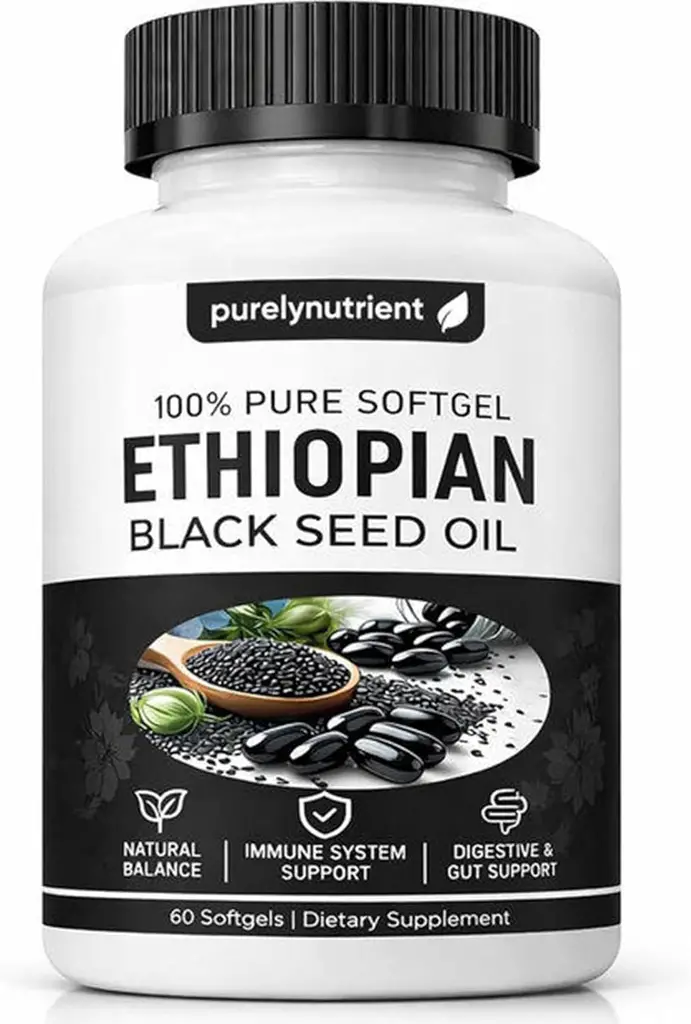
What Is Purely Nutrient Ethiopian Black Seed Oil?
Purely Nutrient Ethiopian Black Seed Oil is a dietary supplement made from the seeds of Nigella sativa, commonly known as black seed or black cumin. The company says it sources its seeds from farms in the Ethiopian highlands, approximately 8,000 feet above sea level. It describes the oil as cold-pressed and claims to use a single ingredient without fillers, preservatives or artificial additives.
The product is marketed for general wellness, with particular emphasis on:
- Immune support
- Digestive health
- Healthy inflammatory responses
- Energy and mental clarity
- Cardiovascular health
- Skin and hair health
The suggested routine is two softgels daily, preferably before bed. Unlike some supplements that combine ten or more ingredients, the basic idea here is relatively simple: provide black seed oil and allow its naturally occurring compounds to do the work.
That isn’t inherently a bad approach. The question is whether Purely Nutrient has demonstrated that its particular oil is as concentrated and effective as its advertising suggests.
The 4.64% Thymoquinone Claim: Is Ethiopian Black Seed Oil Really More Potent?
This is the main selling point. Purely Nutrient claims that its Ethiopian black seed oil contains up to 4.64% thymoquinone, compared with approximately:
| Black seed oil origin | Advertised thymoquinone concentration |
|---|---|
| Egyptian | 0.7% |
| Indian | 1% |
| Turkish | 1.2% |
| Ethiopian | 4.64% |
The company uses these figures to argue that its oil can be up to five times more potent than ordinary black seed oil. Thymoquinone is a naturally occurring compound in Nigella sativa and one of the main substances researchers investigate when studying black seed oil’s antioxidant and anti-inflammatory properties.
So the focus on thymoquinone isn’t entirely arbitrary. It is a relevant compound when assessing black seed oil. However, I couldn’t independently verify the 4.64% figure for Purely Nutrient’s finished product. The website says the oil is third-party tested, but I couldn’t locate a publicly accessible certificate of analysis showing the measured thymoquinone concentration, laboratory name, testing method and batch number.
That information matters. A company claiming an unusually high concentration should be able to demonstrate it with a laboratory report. Ideally, that report should identify the specific batch being sold rather than simply provide a general statement about the product.
I also wouldn’t accept the company’s comparisons between Ethiopian, Egyptian, Indian and Turkish oils as universal figures. Thymoquinone concentration can vary with seed variety, growing conditions, processing and storage. Country of origin alone does not guarantee a particular concentration.
My position: 4.64% may be a genuine measurement for some Ethiopian black seed oils, but Purely Nutrient hasn’t provided enough publicly verifiable evidence for me to treat that number as an established fact about every bottle it sells.
What Does Black Seed Oil Actually Do?
Black seed oil has a longer history of traditional use than many trendy supplements. It has also attracted scientific interest because of its thymoquinone content and other naturally occurring compounds.
However, there is an important difference between an ingredient showing promise in preliminary research and a finished supplement being proven to deliver meaningful health improvements.
Inflammation and Antioxidant Support
Thymoquinone has demonstrated antioxidant and anti-inflammatory activity in laboratory and animal research. Human studies have also investigated black seed preparations for inflammatory and metabolic markers, but the findings are not sufficient to establish black seed oil as a treatment for chronic inflammation or inflammatory diseases.
Purely Nutrient’s marketing goes further, suggesting that its oil can shut down inflammation at the cellular level and help protect the body from ongoing damage.
I would consider that language exaggerated. Research into biological mechanisms does not establish that taking this particular supplement will produce those results in everyday users.
Blood Sugar and Metabolic Health
Black seed has been investigated for possible effects on blood glucose and metabolic markers. Some clinical studies and reviews suggest potential benefits, but the evidence is not strong enough to recommend it as a replacement for diabetes treatment or prescribed medication.
Purely Nutrient suggests that its oil can support insulin sensitivity and healthy glucose metabolism. That is a claim worth scrutinising, particularly for anyone taking medication that lowers blood sugar. Combining supplements with glucose-lowering medication may require professional guidance to avoid unwanted effects.
Digestive Health and Bloating
The company also promotes black seed oil for digestive comfort, gut balance and bloating. There is some research into black seed and gastrointestinal health, but I couldn’t find convincing evidence establishing that Purely Nutrient’s formula reliably eliminates bloating or resolves digestive problems.
One of the website’s testimonials describes a customer whose bloating supposedly disappeared within two weeks. That is a personal testimonial, not proof that the supplement caused the improvement.
Bloating can have numerous causes, including food intolerances, constipation, digestive disorders and other medical conditions. A supplement that appears to help one person may do nothing for another.
Energy and Mental Clarity
Purely Nutrient promises sustained energy without crashes or jitters, alongside improved focus and mental clarity. I couldn’t find convincing clinical evidence showing that this product produces those effects.
Black seed oil isn’t a stimulant, and its presence in a supplement doesn’t automatically mean users will experience a noticeable energy boost. If someone is constantly fatigued, it is worth investigating possible causes rather than assuming they need an antioxidant supplement.
Cardiovascular Health
Black seed has also been studied for possible effects on blood pressure, cholesterol and other cardiovascular markers. Some findings are promising, but they do not establish that black seed oil prevents heart disease or replaces conventional cardiovascular treatment.
Purely Nutrient’s suggestions about supporting circulation, arterial function and blood pressure should therefore be interpreted cautiously.
Overall, black seed oil is an interesting ingredient, but the evidence is not strong enough to support the sweeping health claims used in this product’s marketing.
I Found Some Inconsistencies in Purely Nutrient’s Own Website
This is where my confidence in the brand starts to weaken. The main product page repeatedly describes the supplement as containing one ingredient only: 100% Ethiopian black seed oil.
That is consistent with the FAQ on the same page. However, another contact and information page lists additional nutritional components, including vitamins B1, B2 and B3, calcium, folate, iron, copper, zinc and phosphorus.
These descriptions don’t establish whether the product is simply black seed oil or whether the company is claiming that its finished product contains a broader nutritional profile. Naturally occurring compounds in black seed oil are one thing. Presenting a list of vitamins and minerals as part of the product’s nutritional profile is another. I would want a proper nutritional analysis to establish what quantities are actually present.
There is also a difference in how the company describes its quality assurance. Some pages say the product is third-party tested, while another directs customers to contact the company for specific testing concerns. I couldn’t locate the actual laboratory report.
None of these inconsistencies independently proves that the oil is fake or unsafe. But a company selling a premium, high-potency supplement should be able to provide consistent product information.
Purely Nutrient Pricing: Is It Worth the Money?
The brand advertises several bundle promotions, including:
- Buy one bottle
- Buy two, get one free
- Buy three, get two free
Another promotional page advertises a buy-one-get-one-free offer, with free shipping and additional wellness guides. A separate storefront lists a bottle at approximately $29. These offers make it difficult to establish one consistent retail price, particularly because the promotional pages do not all display the same purchasing information.
I would also be careful about judging the value of the product based on the number of bottles included in a bundle. A discount is only useful if the product itself is worth buying. Paying for multiple bottles of an oil with an unverified potency claim doesn’t automatically become a good deal because the seller offers additional bottles for free.
What About the Money-Back Guarantee?
Purely Nutrient advertises a 30-day money-back guarantee. However, I found different descriptions of the guarantee across its pages. One promises a refund within 30 days of delivery, while another says customers can contact the company within one year of purchase.
I would want the company to clarify which policy applies to the actual checkout before ordering. The website also advertises subscription management, including the ability to pause or cancel recurring orders.
That isn’t necessarily a red flag by itself, but customers should confirm whether they are making a one-time purchase or enrolling in a subscription.
What About Customer Reviews?
Purely Nutrient displays impressive review figures on its promotional pages. One page advertises a 4.8/5 rating based on 4,463 reviews, while another storefront claims more than 50,000 reviews.
Those numbers are substantial, but I couldn’t independently establish that they represent verified purchases of the same product from the same seller. I would not automatically treat a large review count displayed on a sales page as proof of product effectiveness.
The testimonials also make some dramatic claims, including improvements in joint pain, bloating, fatigue, brain fog and skin appearance. Those experiences may be genuine, but they cannot establish that the supplement caused the improvements.
I would prefer to see independent reviews with verifiable purchases and a consistent record of customer experiences rather than relying heavily on testimonials selected by the company.
Is Purely Nutrient FDA Approved?
I found no evidence that Purely Nutrient’s black seed oil is FDA-approved as a treatment for any medical condition. That distinction matters because dietary supplements are not approved by the FDA for safety and effectiveness before being marketed in the same way prescription medicines are.
The company says its products are manufactured in GMP-certified facilities in the United States. However, GMP-related manufacturing claims do not establish that a product has been independently verified to contain 4.64% thymoquinone.
I would also want to see the company’s actual quality documentation rather than relying on a statement that testing takes place.
Is Black Seed Oil Safe?
Black seed oil is generally tolerated by many adults, but natural does not automatically mean risk-free. Possible side effects include digestive discomfort, nausea and allergic reactions.
There are also potential medication considerations. Black seed may affect blood pressure and blood glucose, and there is some concern about interactions with medications processed by certain liver enzymes. Anyone taking medication for diabetes, hypertension or another ongoing condition should discuss regular black seed oil use with a healthcare professional.
I would be particularly cautious about using it as a substitute for prescribed medication. The product website also suggests that it is suitable for children as young as five. I would not accept that recommendation without appropriate paediatric guidance. A supplement being marketed to adults does not automatically make it suitable for children.
What Would I Recommend Instead?
If you’re interested in black seed oil, I would focus on the quality of the actual oil rather than assuming that Ethiopian origin automatically makes one brand superior.
Look for:
- A complete ingredient label identifying Nigella sativa oil.
- A clearly stated serving size and amount of oil per serving.
- A batch-specific certificate of analysis.
- A laboratory result identifying the thymoquinone concentration.
- Testing for heavy metals, pesticides and microbial contamination.
- A clearly identified manufacturer and seller.
- Transparent refund and subscription terms.
There are other established supplement brands offering black seed oil, including NOW Foods and Amazing Herbs. Their products should still be assessed individually for their labels, sourcing and testing, but I would rather start with a clearly identified product than pay extra for a potency claim that I cannot verify.
Conclusion: Is Purely Nutrient Ethiopian Black Seed Oil Legit?
I wouldn’t call Purely Nutrient a confirmed scam. The underlying ingredient is legitimate, and black seed oil has a reasonable history of traditional use alongside an interesting, although still limited, body of scientific research. However, I am not convinced that Purely Nutrient has established what makes its product worth paying a premium for.
The 4.64% thymoquinone claim is central to its marketing, yet I couldn’t independently verify it. Its health claims are also considerably broader than the available evidence supports, and the company’s product information and refund descriptions are inconsistent.
For me, that is enough reason not to rush into buying it.
Bottom line: Black seed oil may be worth exploring, but I wouldn’t spend extra on Purely Nutrient simply because it claims to be Ethiopian and five times more potent. Until the company provides a verifiable laboratory report and clearer product information, I would choose a more transparent brand or skip the purchase altogether.
Also read – EGO Power+ Cordless Electric Leaf Blower Review: Is It Worth It? I Bought It