

Cardio Charge is marketed as a daily heart-health drink that can support circulation, healthy blood pressure, energy and overall cardiovascular function. Instead of another bottle of capsules, it comes as a pomegranate-flavoured powder that you mix with water once a day.
The formula actually caught my attention because it contains ingredients that have been studied for cardiovascular health, particularly hibiscus and minerals like magnesium and potassium. But some of the marketing goes considerably further than the evidence on the finished product. I also found some things about the seller that made me want to look a little closer. So, is Cardio Charge legit? Let’s take a closer look.
Key Takeaways
- Cardio Charge is a real dietary supplement sold by Simple Promise, not a completely unidentified product.
- Its formula contains D-ribose, magnesium, potassium, sodium, glycine, hibiscus extract and Hytolive olive extract.
- Hibiscus has some legitimate evidence for modest blood-pressure reductions, but that does not mean Cardio Charge treats hypertension or heart disease.
- I couldn’t find a clinical trial testing Cardio Charge itself, which means the finished product hasn’t been proven to deliver the cardiovascular results being advertised.
- The company behind it has a mixed customer-service history, including complaints about billing, shipping and other Simple Promise products.
- I wouldn’t call Cardio Charge a scam, but I also wouldn’t buy it expecting it to replace actual blood-pressure or heart medication.
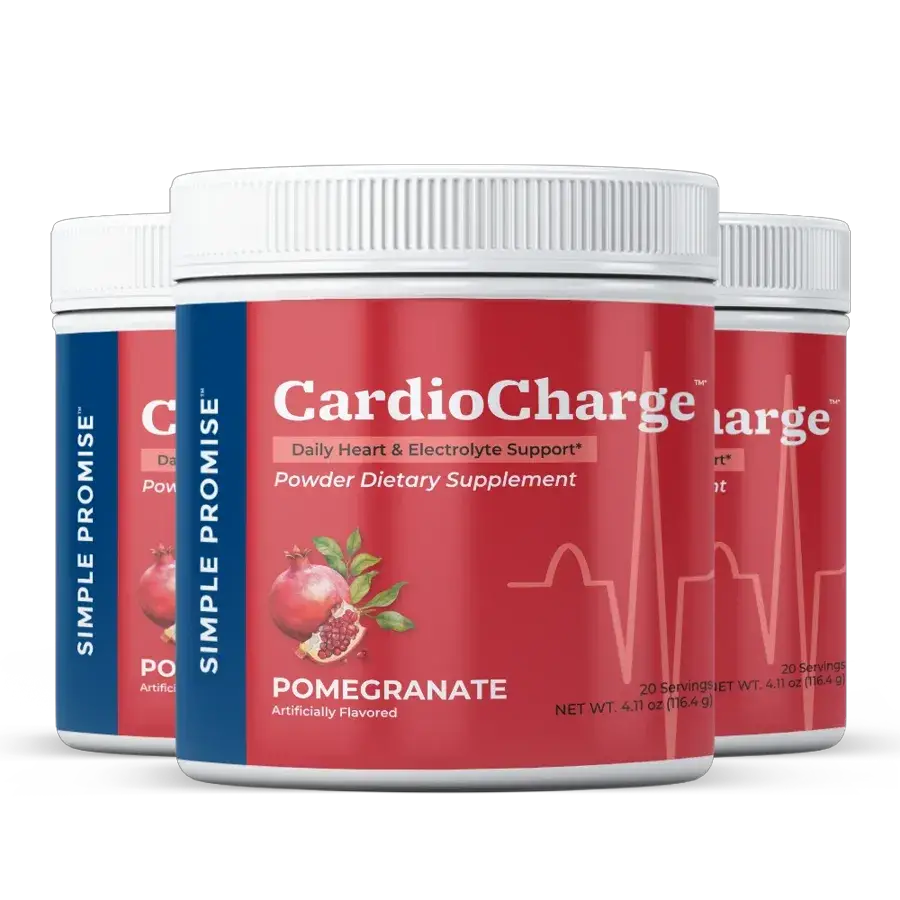
What Is Cardio Charge?
Cardio Charge is a pomegranate-flavored powdered supplement from Simple Promise. The current product page recommends one scoop mixed with water each day and positions the formula around heart health, circulation, arterial function, energy and electrolyte balance.
The current label lists seven active ingredients: 190 mg of magnesium, 140 mg of sodium, 380 mg of potassium, 3,000 mg of D-ribose, 1,000 mg of L-glycine, 470 mg of hibiscus flower extract and 30 mg of Hytolive olive fruit extract. That is actually useful information because at least we’re not dealing with a proprietary blend where everything is thrown together under one mystery number.
The product is currently listed at $49 for one jar, $129 for three or $198 for six, with a 365-day money-back guarantee advertised by the seller.
Why I Looked Into Cardio Charge
I wanted to know whether this was another supplement using the word “heart” to make a collection of ordinary ingredients sound like cardiovascular medicine. And the answer is a little more complicated.
Some of the ingredients do have legitimate research behind them. Hibiscus, in particular, has been studied in randomized trials for blood pressure. A 2025 review and dose-response meta-analysis covering 26 randomized trials and 1,797 participants found that hibiscus supplementation reduced systolic and diastolic blood pressure compared with controls, although the researchers still called for more work on dosing and long-term use.
So I can’t fairly say the formula is nonsense. The question is whether that evidence actually proves Cardio Charge works. It doesn’t.
My Experience With Cardio Charge
I didn’t personally take Cardio Charge long enough to claim that it lowered my blood pressure or improved my circulation, so I’m not going to invent an experience for the sake of this review. Instead, I looked at what someone is actually getting in one scoop and compared that with the claims being made.
And this is where I became a lot more cautious. The formula is reasonable as a nutritional supplement. Magnesium and potassium are important electrolytes, and hibiscus has some cardiovascular research behind it. D-ribose has also been investigated in people with heart conditions, although that research is nowhere near the same as proving that a general consumer supplement improves cardiovascular health.
What I don’t see is a clinical trial showing that this particular combination of seven ingredients improves blood pressure, arterial flexibility or cardiovascular outcomes. That’s a pretty important distinction.
The Hibiscus Actually Has Some Science Behind It
This is probably the ingredient I would give the most credit to. A 2022 systematic review and meta-analysis looked at 17 randomized chronic trials and found that hibiscus reduced systolic blood pressure by about 7.1 mmHg compared with controls. However, the studies were quite heterogeneous, and the authors specifically said more research was needed to establish an effective dose and treatment duration.
A separate meta-analysis of 13 randomized trials involving 1,205 people with mild-to-moderate hypertension found reductions in both systolic and diastolic blood pressure compared with placebo, but hibiscus was not significantly better than actual antihypertensive drugs.
So yes, there is something here. But notice what those studies were actually testing. They were testing hibiscus interventions, not Cardio Charge. That distinction gets lost very easily in supplement marketing.
What About the Rest of the Formula?
The other ingredients make sense from a nutritional standpoint, but I don’t think the marketing should make them sound more powerful than they are.
Magnesium and potassium are essential for normal muscle and nerve function, including the cardiovascular system. But getting those minerals from a supplement doesn’t automatically mean your arteries are going to become more flexible or that your cardiovascular risk is going to disappear.
D-ribose is another interesting one. It’s involved in cellular energy production and has been studied in people with heart failure and other cardiovascular conditions. But evidence from studies of isolated D-ribose in specific patient populations cannot simply be transferred to a seven-ingredient drink powder being sold to generally healthy adults.
The same problem applies to glycine and Hytolive olive extract. They may be interesting ingredients. That doesn’t mean Cardio Charge has been clinically proven to produce the sweeping heart-health benefits being suggested.
The “Clinically Studied” Wording Is Doing Some Work Here
This was one of the things I noticed. The company describes Cardio Charge as containing “clinically-studied ingredients.” Technically, that’s not the same statement as saying Cardio Charge has been clinically studied. And that difference matters.
An ingredient can have ten studies behind it while the finished supplement has zero clinical trials. You can’t automatically combine the results of those studies and say the finished product has been proven to work.
That’s essentially what I think shoppers need to understand here.
There’s Also a Formula Consistency Issue
This is something I would pay attention to before buying. The current Simple Promise product page describes Cardio Charge as a seven-ingredient formula built around D-ribose, hibiscus, magnesium, potassium, sodium, glycine and Hytolive.
But there are other Cardio Charge websites currently presenting themselves as official and advertising substantially different formulas, including versions listing ingredients such as CoQ10, pomegranate extract, beetroot, vitamin D3 and hawthorn.
That doesn’t necessarily mean Simple Promise itself is selling different formulas. It could simply be unrelated or unauthorized websites using the Cardio Charge name.
Either way, it creates a very simple rule for me: I would only buy the product from the actual Simple Promise storefront and would check the Supplement Facts label on the product I receive. I wouldn’t trust a random “official Cardio Charge” website just because it has the product name in the domain.
The “No Artificial Ingredients” Claim Also Doesn’t Quite Match
This was probably my favourite little inconsistency. Simple Promise markets Cardio Charge as having no artificial ingredients. But the Supplement Facts information reviewed from the product label lists artificial pomegranate flavor among the other ingredients.
That doesn’t make the supplement dangerous. Artificial flavouring is not some smoking gun. But if you’re going to put “No Artificial Ingredients” prominently on the sales page, I expect the label to support that statement.
It doesn’t completely.
What About the Company Behind Cardio Charge?
This is where I wouldn’t completely ignore the seller’s history. Simple Promise has an established online storefront and sells multiple supplements, so this isn’t an anonymous website that appeared yesterday. But its customer feedback is mixed.
Trustpilot currently shows about 30 reviews for the Simple Promise website, with a 3.1 rating and a large proportion of one-star reviews. Some complaints involve billing or shipping problems with other Simple Promise products, including one customer who said an order was duplicated and another who said a canceled order was still delivered.
There are also BBB customer reviews raising concerns about manufacturing claims and product sourcing. I wouldn’t use complaints about unrelated products to claim that Cardio Charge itself is fraudulent.
But if I’m deciding whether to hand over $198 for six tubs, the company’s broader customer-service history absolutely becomes part of my decision.
Is Cardio Charge Effective?
I think the answer depends on what you’re expecting it to do. If you’re looking for a caffeine-free drink containing useful minerals and some plant compounds with cardiovascular research behind them, the formula is reasonable. If you’re expecting it to lower your blood pressure, improve arterial flexibility, protect your heart or reverse cardiovascular problems, the evidence isn’t strong enough for me to make that recommendation.
The hibiscus research is the strongest argument in its favor, but even there, researchers are studying specific preparations, doses and populations. That doesn’t establish that Cardio Charge produces the same results.
And there is no finished-product clinical trial demonstrating that Cardio Charge itself improves cardiovascular outcomes.
Is Cardio Charge a Scam?
I wouldn’t call it a scam. The product exists. The ingredients are identifiable. The current label provides individual amounts, and Simple Promise is an identifiable supplement seller with an actual storefront and customer-service infrastructure. But I also wouldn’t call it a clinically proven heart-health supplement.
The marketing is more impressive than the actual evidence behind the finished product, and the existence of multiple websites using the Cardio Charge name makes it even more important to make sure you’re buying the correct product. For me, this lands somewhere in the middle.
Real product? Yes. Interesting formula? Yes. Clinically proven to deliver the cardiovascular benefits being marketed? No.
Pricing and Where to Buy
The current Simple Promise storefront lists Cardio Charge at $49 for one jar, $129 for three and $198 for six. The company advertises a 365-day money-back guarantee.
Personally, I wouldn’t jump straight into the six-jar package. A year-long guarantee sounds reassuring, but a guarantee doesn’t make an unproven supplement effective. And given the company’s mixed customer-service history, I’d rather start with the smallest purchase if I were determined to try it.
Who Might Like Cardio Charge?
I could see this appealing to someone who wants a caffeine-free drink mix and likes the idea of getting magnesium, potassium and plant extracts in one daily serving. The formula is also more transparent than many of the proprietary-blend supplements I investigate because the individual active amounts are disclosed.
That’s something I actually give the company credit for.
Who Should Skip It?
I’d skip it if you’re looking for something to actually treat high blood pressure or heart disease. I’d also skip it if you’re taking cardiovascular medication and are thinking about replacing it with Cardio Charge. This is a dietary supplement, not a substitute for prescribed treatment.
And if you take medications that affect potassium, magnesium or blood pressure, I’d check with your doctor or pharmacist before adding it. The product itself tells customers to consult a healthcare professional when taking medication.
Conclusion
Cardio Charge is more legitimate than some of the heart-health supplements I’ve looked into. The formula isn’t ridiculous, the ingredients are real, and hibiscus in particular has legitimate human research suggesting it may modestly lower blood pressure. But that’s not enough for me to call Cardio Charge a proven cardiovascular supplement.
The finished product hasn’t been shown in a clinical trial to deliver the heart-health results being advertised. I also don’t love the “no artificial ingredients” claim when the label lists artificial pomegranate flavor, and the existence of multiple websites promoting different Cardio Charge formulas makes me want to be careful about where I purchase it.
My verdict: Cardio Charge is not an obvious scam, but I would be cautious about buying it.
If I wanted a daily electrolyte powder with some potentially useful cardiovascular ingredients, I could understand trying it. But if I were buying it because I genuinely had high blood pressure or a heart condition, I’d spend my money on proven medical care instead.
Also read – Nowhousefurniture.com Review: Fake or Legit Online Shopping Site?
[…] Also read – Cardio Charge Reviews: Does It Really Support Heart Health? Find Out […]