

PureSup Antarctic Krill Oil is marketed as a premium omega-3 supplement that supports heart health, joint comfort and eye health. More recently, the company has placed considerable emphasis on dry-eye relief, suggesting that its krill oil can help people experiencing gritty, burning and uncomfortable eyes.
The product sounds promising, particularly because krill oil contains omega-3 fatty acids and naturally occurring astaxanthin. However, I found some inconsistencies in the company’s product information that make me less confident about what customers are actually getting.
Key Takeaways
- PureSup contains Antarctic krill oil, a source of EPA, DHA, phospholipids and naturally occurring astaxanthin.
- Its product pages disagree on the recommended dosage, with one recommending one capsule daily and another recommending four softgels.
- The newer product page lists 180mg of omega-3 fatty acids per two-softgel serving, including just 80mg EPA and 40mg DHA.
- Krill oil has some research behind it, but the evidence does not establish that PureSup relieves dry eyes or provides superior health benefits to conventional fish oil.
- The company advertises third-party testing and a 90-day money-back guarantee, but I couldn’t independently verify the batch-specific laboratory results.
- My verdict: The ingredient itself has some nutritional merit, but PureSup needs better transparency before I’d recommend paying its premium price.
What Is PureSup Antarctic Krill Oil?
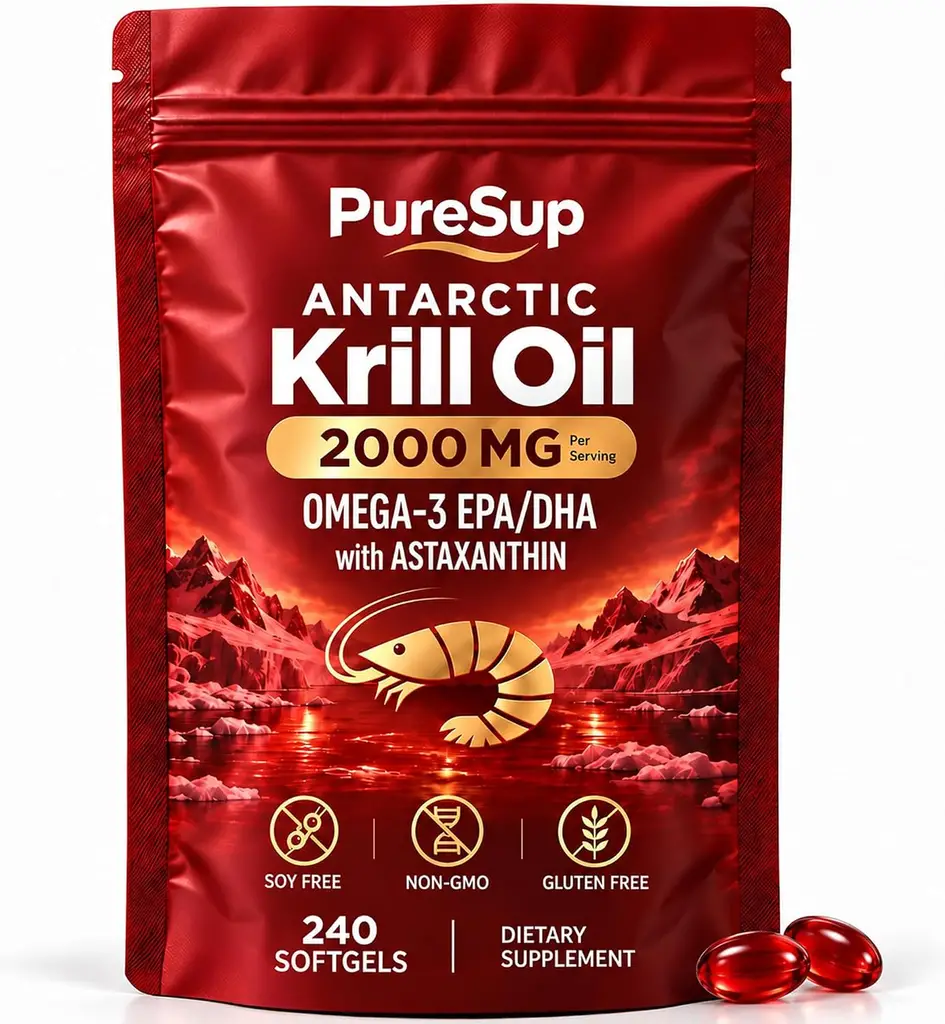
PureSup Antarctic Krill Oil is a dietary supplement made from Antarctic krill, tiny shrimp-like crustaceans found in the Southern Ocean. Krill oil naturally contains omega-3 fatty acids, particularly EPA (eicosapentaenoic acid) and DHA (docosahexaenoic acid). Unlike most conventional fish oil, which contains omega-3s primarily in triglyceride or ethyl ester forms, krill oil contains a proportion of its omega-3s attached to phospholipids.
It also naturally contains astaxanthin, a carotenoid antioxidant responsible for its reddish colour. PureSup markets these characteristics as advantages over ordinary fish oil. The company promotes its product for heart health, healthy triglycerides, joint support, eye comfort and general wellness.
Its newer product page also advertises 2,000mg of Antarctic krill oil per serving, 600mcg of astaxanthin and 120 softgels per pouch.
What Is Actually in the Formula?
The newer product page provides a supplement facts panel that is more useful than the general marketing descriptions. For two softgels, the company lists:
- Antarctic krill oil: 2,000mg
- Total omega-3 fatty acids: 180mg
- EPA: 80mg
- DHA: 40mg
- Astaxanthin: 600mcg
The recommended daily intake is four softgels, divided into two servings. That means the advertised daily intake provides 4,000mg of krill oil, 360mg of total omega-3 fatty acids, 160mg of EPA, 80mg of DHA and 1,200mcg of astaxanthin. There’s an important distinction here: 2,000mg of krill oil does not mean 2,000mg of omega-3 fatty acids. The actual EPA and DHA quantities are considerably lower.
I would pay more attention to the EPA and DHA figures when comparing this product with other omega-3 supplements. A large headline number for total oil can make a product appear more concentrated than it really is.
Does Krill Oil Actually Work?
Krill oil isn’t a completely unproven ingredient. There is research suggesting that it can increase omega-3 levels in the blood, and some studies have investigated its potential effects on triglycerides and other health markers.
A randomised study involving 24 healthy adults found that krill oil increased certain omega-3 levels in the blood and red blood cells. However, it did not produce changes in triglycerides or HDL cholesterol during the study. Other research has found reductions in triglycerides among people with elevated levels, although results depend on the specific formulation, dosage and population being studied.
This is where I think PureSup’s marketing needs some perspective. Research involving a particular krill oil preparation does not automatically establish that every krill oil supplement produces the same results.
The NIH’s Office of Dietary Supplements also notes that omega-3 supplementation does not consistently reduce the risk of most cardiovascular events. For people with high triglycerides, prescription omega-3 preparations are used under medical supervision, and their doses and formulations should not be confused with ordinary retail supplements.
Does PureSup Help With Dry Eyes?
This is one of PureSup’s biggest selling points. The company explains that dry eyes can occur when the oily outer layer of the tear film is insufficient or unstable, causing tears to evaporate too quickly. It then presents krill oil as a way to support that oily layer from within.
There is some scientific reasoning behind investigating omega-3s for dry-eye disease. A small 2017 clinical trial compared krill oil, fish oil and placebo in 60 people with mild-to-moderate dry eyes. Both omega-3 groups showed improvements in certain tear-film measurements, while the krill oil group also showed improvements in some reported symptoms. However, that study used substantially higher EPA and DHA doses than PureSup provides in its advertised daily serving.
More importantly, the wider evidence is mixed. The large NIH-sponsored DREAM study involving 535 people with moderate-to-severe dry-eye disease found that omega-3 supplementation was no more effective than placebo after one year. The NIH’s current review of the evidence concludes that there is no consistent relationship between omega-3 supplementation and dry-eye disease.
PureSup’s claim that its krill oil can relieve gritty, burning eyes may therefore be appealing, but it hasn’t been established for this particular product.
The Problem With PureSup’s Dosage Instructions
One of the more noticeable issues I found is that PureSup’s own product pages don’t agree on how customers should take the supplement.
The dry-eye-focused product page recommends one capsule daily. The newer Antarctic Krill Oil page recommends two softgels twice daily, giving a total of four softgels per day. It also describes the pouch of 120 softgels as a 30-day supply. These are substantially different instructions. The newer page also promotes a much more detailed formula, including 2,000mg of krill oil per two-softgel serving.
I couldn’t establish whether the one-capsule recommendation belongs to an older formulation, a different product variant or an outdated sales page. This isn’t a trivial detail. Customers should be able to find one clear serving size and consistent supplement facts before purchasing.
What Are Customers Saying?
PureSup displays a 4.7-star rating based on 1,423 reviews on its dry-eye-focused product page. The newer product page and homepage also feature testimonials describing improvements in eye comfort, joint stiffness and triglyceride readings.
Some customers say they experience fewer gritty sensations, reduced burning and less dependence on artificial tears. Others describe improvements in their blood test results after several months of use. These are encouraging individual experiences, but they don’t establish that the supplement caused the improvements.
I also noticed that some of the testimonials contain fairly specific medical-sounding claims, including changes in triglyceride readings. Those claims would be more convincing if the company provided independently verifiable clinical data rather than relying on customer stories.
The website identifies these reviews as individual experiences and acknowledges that results aren’t guaranteed. That’s an appropriate qualification, but it doesn’t resolve the question of whether the advertised benefits are representative.
How Much Does PureSup Cost?
PureSup’s product collection currently lists the krill oil at $49.90, discounted from $79.90. The company advertises 120 softgels per pouch, which it describes as a 30-day supply based on four softgels daily.
At the discounted price, that works out to approximately $49.90 per month. That’s a fairly premium price, especially when the daily serving provides only 160mg EPA and 80mg DHA. Customers should compare the actual EPA and DHA content rather than the headline 2,000mg krill oil figure. There are other omega-3 products available that provide substantially more EPA and DHA for a similar or lower cost.
PureSup also promotes subscription savings, with delivery options every four, eight or twelve weeks. The company says subscriptions can be skipped, changed or cancelled.
Red Flags I Found
The biggest concern is the inconsistent product information. One page recommends one capsule daily, while another recommends four. The company should update or remove outdated product information so customers aren’t left guessing which instructions apply.
The second concern is the way the product’s potency is presented. The 2,000mg headline sounds impressive, but the actual EPA and DHA content is only 120mg per two-softgel serving. That’s a much more useful figure when assessing its omega-3 value.
PureSup also claims that every batch is third-party tested. However, I couldn’t locate a publicly accessible, batch-specific certificate of analysis showing the actual results for the product being sold. The claim may be genuine, but customers should be able to inspect the relevant documentation.
Finally, the company’s comparison with ordinary fish oil is somewhat overstated. Krill oil’s phospholipid structure is an interesting difference, and some research suggests it may influence omega-3 absorption. But that doesn’t prove that every krill oil supplement is automatically superior to every fish oil product.
Is PureSup Safe?
Krill oil is generally tolerated by many people, but it isn’t suitable for everyone. The most obvious concern is shellfish allergy. Krill are crustaceans, and PureSup explicitly states that its product contains shellfish. Anyone with a shellfish allergy should avoid it.
People taking anticoagulant or antiplatelet medication should also speak with a healthcare professional before starting omega-3 supplements, particularly at higher doses. Omega-3s can affect blood clotting, and medication interactions need to be considered. Common side effects of omega-3 supplements include stomach discomfort, nausea, heartburn and diarrhoea.
Pregnant or breastfeeding individuals and people with existing medical conditions should also seek appropriate medical advice before using the product.
Conclusion: Is PureSup Antarctic Krill Oil Worth Buying?
I wouldn’t call PureSup Antarctic Krill Oil a scam. Krill oil is a legitimate source of omega-3 fatty acids, and there is research supporting some of its nutritional benefits. However, I don’t think PureSup has made a convincing case for its premium pricing.
The advertised 2,000mg of krill oil sounds substantial until you examine the actual EPA and DHA quantities. Its dry-eye marketing also goes further than the available evidence, and the conflicting dosage instructions make the product information unnecessarily confusing. I would also want to see the company’s actual third-party laboratory reports before accepting its testing claims.
My recommendation: I’d compare other krill oil and fish oil supplements before buying PureSup. It isn’t necessarily a bad product, but I don’t see enough evidence to justify paying nearly $50 a month for it, particularly when the company still needs to improve its ingredient transparency and consistency.
Also read – Jwisi.com Review: 5 Solid Reasons Why You Should Approach Cautiously