

When I came across Quiet Nerves, I wanted to know whether it was a worthwhile supplement for people experiencing nerve discomfort or another product relying on health concerns to sell an expensive bottle of capsules. The supplement is marketed for nerve health, daily comfort, and circulation, with ingredients that sound promising on paper. But as I dug deeper, I found something more concerning than the usual questions about whether a supplement works: multiple websites selling products under the same name, conflicting ingredient lists, and very little transparency about how much of each ingredient customers are actually getting. So I decided to investigate what Quiet Nerves contains, what the science says, and whether the product deserves the confidence its marketing asks buyers to place in it.
Key Takeaways
- The product identity is inconsistent across websites. Several sites sell Quiet Nerves using different ingredient lists. One version lists magnesium glycinate, alpha-lipoic acid, butcher’s broom, L-carnitine, turmeric, and CoQ10, while another advertises corydalis, prickly pear, and California poppy.
- The ingredient quantities are a major concern. The six-ingredient version does not provide enough information to establish the individual amounts of its ingredients, making it difficult to compare the formula with the doses studied in clinical research.
- The marketing targets people concerned about nerve symptoms. Although some ingredients have been studied for specific health applications, that does not establish that Quiet Nerves treats neuropathy, nerve damage, or persistent nerve pain.
- The sales prices encourage bulk purchases. Packages are advertised at $158 for two bottles, $207 for three, and $294 for six on one sales site. The larger packages reduce the cost per bottle, but they also require customers to spend more upfront on a product whose exact formulation and effectiveness remain uncertain.
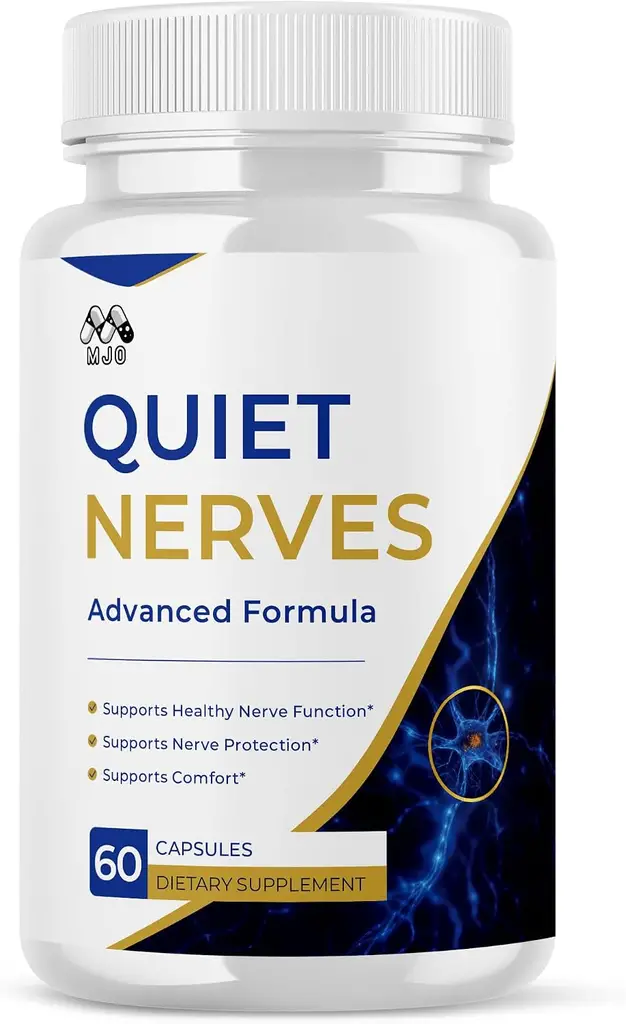
What Is Quiet Nerves?
Quiet Nerves is a dietary supplement marketed for nerve health and everyday comfort. Depending on the website, it is described as supporting healthy nerve function, circulation, cellular energy, and general well-being. The product is sold in capsule form, with promotional pages encouraging customers to purchase multiple bottles rather than a single month’s supply.
The difficulty is that Quiet Nerves does not appear consistently described across the websites selling it.
One version lists six ingredients:
- Magnesium glycinate
- Alpha-lipoic acid
- Butcher’s broom
- L-carnitine
- Turmeric standardized to 95% curcuminoids
- Coenzyme Q10
Another website, quietnerves.org, advertises a different formula containing corydalis, prickly pear, and California poppy. These are not interchangeable ingredient lists. They describe materially different formulations, with different potential effects, safety considerations, and evidence bases.
I could not establish that the different websites are all operated by the same business or that their products come from the same manufacturer. That makes it important to identify the exact seller and formulation before drawing conclusions about Quiet Nerves as a product.
I Dug Deeper Into Quiet Nerves
The Problem With Multiple Quiet Nerves Websites
The first thing that caught my attention was the number of websites selling products under the Quiet Nerves name. Among the sites I found were quietnerves.com, quietnerves.org, nervesquiet.com, and several other similarly named domains.
The existence of multiple websites is not, by itself, evidence of fraud. A brand might use separate domains for different campaigns, work with affiliates, or operate different sales channels. However, the problem becomes more significant when those websites describe different formulas and provide inconsistent instructions.
For example, quietnerves.com promotes a six-ingredient formula containing magnesium glycinate, alpha-lipoic acid, butcher’s broom, L-carnitine, turmeric, and CoQ10. Meanwhile, quietnerves.org describes a product containing corydalis, prickly pear, and California poppy.
I could not independently verify the corporate relationship between these sellers, identify a common manufacturer, or establish that the products sold through these different websites are identical. That leaves a basic question unanswered: when a customer orders Quiet Nerves, which formulation are they actually receiving?
A trustworthy supplement listing should make it easy to identify the seller, manufacturer, ingredients, serving size, and product label. Customers should not have to compare multiple websites to work out which formula they are purchasing.
Who Actually Makes Quiet Nerves?
The six-ingredient version is promoted with claims such as being made in the United States and manufactured in a facility that follows Good Manufacturing Practices.
Those claims are worth checking, but they are not the same as identifying the manufacturer. I could not independently establish the legal identity of the manufacturer behind the six-ingredient product or verify the specific facility producing it from the information available.
The distinction matters because claims about American manufacturing, registered facilities, and GMP standards can sound reassuring without telling customers who is responsible for the product.
Good Manufacturing Practices concern manufacturing and quality controls. They do not establish that a supplement is clinically effective, and an FDA-registered facility does not mean the FDA has approved the finished supplement.
I would want the manufacturer or distributor’s legal name, a complete product label, and verifiable manufacturing information before treating those promotional statements as evidence of quality.
The Ingredient List Is Not as Transparent as It Looks
The six-ingredient version names its ingredients, which is a useful starting point. However, naming ingredients is only part of what a customer needs to know. The available product information does not consistently disclose the individual quantities of the ingredients in the formula.
That creates a substantial problem when assessing effectiveness. A clinical study might investigate alpha-lipoic acid at a particular daily dose, while another study examines acetyl-L-carnitine, a specific form of carnitine, at a substantially different dose. Without knowing how much alpha-lipoic acid or L-carnitine Quiet Nerves contains, customers cannot determine whether the product provides amounts comparable to those used in the relevant research.
The same problem applies to CoQ10 and turmeric extract. Knowing that an ingredient appears on the label does not tell us whether the quantity is meaningful for the purpose being advertised.
The formula’s transparency is therefore limited in an important way. It gives customers names to recognize, but not enough information to evaluate the finished product properly.
The Science Behind Quiet Nerves: Do the Ingredients Support the Claims?
Quiet Nerves uses ingredients with legitimate biological functions, and some have been investigated for specific health applications. The important question is whether that research supports the claims being made about this particular supplement.
Alpha-Lipoic Acid
Alpha-lipoic acid is an antioxidant that has been studied in people with diabetic neuropathy. Some clinical research has examined whether it can improve symptoms associated with nerve damage, although results and conclusions vary depending on the treatment, route of administration, and outcome being measured.
That does not automatically mean Quiet Nerves relieves neuropathy. The amount in the product is not clearly disclosed, and the finished formula has not been shown to produce the same results as an individually studied ingredient.
Magnesium Glycinate
Magnesium is essential for normal nerve and muscle function. However, the fact that magnesium is necessary for the body does not mean that everyone experiencing tingling, burning, or nerve discomfort has a magnesium deficiency.
Supplementation may be useful when someone has inadequate intake or a specific nutritional need, but it should not be assumed to resolve symptoms caused by diabetes, nerve compression, vitamin deficiencies, or other medical conditions.
Without a clear account of the amount supplied by Quiet Nerves, it is difficult to assess its nutritional contribution.
L-Carnitine
L-carnitine plays a role in cellular energy metabolism. A related form, acetyl-L-carnitine, has been studied in research involving peripheral neuropathy.
However, plain L-carnitine and acetyl-L-carnitine are different forms. Findings involving one form should not automatically be attributed to the other.
Quiet Nerves does not provide sufficient formulation information to establish how its L-carnitine content compares with the preparations used in nerve-related studies.
Butcher’s Broom
Butcher’s broom is a plant traditionally used in products intended to support circulation, particularly in relation to symptoms associated with certain vein conditions. That is different from demonstrating that it repairs damaged nerves or treats neuropathy.
I could not establish strong clinical evidence showing that butcher’s broom, in the form and quantity used in Quiet Nerves, produces the nerve-health benefits suggested by the product’s broader marketing.
Turmeric and CoQ10
Turmeric extracts containing curcuminoids have been studied for various potential health effects, while CoQ10 is involved in cellular energy production.
Both ingredients have scientific research behind them, but the existence of that research does not establish that they provide clinically meaningful relief from nerve symptoms when combined in Quiet Nerves.
The individual amounts are not adequately disclosed, and the finished product’s effectiveness has not been established through product-specific clinical evidence that I could verify.
Does Quiet Nerves Have Its Own Clinical Trial?
I could not verify a published clinical trial demonstrating that the finished six-ingredient Quiet Nerves formula effectively treats neuropathy or produces the broader nerve-health outcomes implied by its marketing.
A company can cite studies involving individual ingredients without having conducted a study of its own product. Those studies may provide background information, but they do not prove that the final formulation works.
Until the exact formula, ingredient quantities, and relevant clinical outcomes can be evaluated, the advertised benefits remain insufficiently substantiated.
Quiet Nerves Pricing: Is the Discount Really Worth It?
One sales website advertises the following packages:
- Two bottles: $158 total, or $79 per bottle.
- Three bottles: $207 total, or $69 per bottle.
- Six bottles: $294 total, or $49 per bottle.
The larger packages are presented as better value because they reduce the price per bottle. However, the savings are calculated against higher reference prices displayed on the sales page. I could not independently verify that those reference prices represent established, ordinary selling prices.
A displayed discount does not automatically mean a customer is getting a bargain. It only becomes meaningful when the comparison price reflects a genuine market price.
The other issue is that the larger packages require a considerable upfront commitment. Buying six bottles means spending $294 on a supplement whose precise ingredient quantities and product-specific effectiveness remain uncertain. I would not buy a six-month supply simply because the website labels it the best value. Before spending that amount, I would want the complete Supplement Facts panel, the manufacturer’s identity, and evidence supporting the product’s advertised purpose.
What Are Customers Saying About Quiet Nerves?
Customer feedback needs to be evaluated carefully because the product is sold through multiple websites. Some promotional pages display positive testimonials describing improvements in nerve comfort, circulation, or everyday well-being. However, I could not independently authenticate the overall review counts or establish that the testimonials represent a representative sample of customers who purchased the same formulation.
This is especially important when different websites advertise different ingredient lists. A review of one formula cannot automatically be treated as evidence about another product sold under the same name.
I also found third-party reports raising concerns about the transparency of some Quiet Nerves sales sites, including limited seller information and questionable promotional tactics. Those reports warrant caution, but they do not independently establish that every seller using the Quiet Nerves name is fraudulent.
I would place more weight on verifiable information about the exact product, manufacturer, label, and refund experience than on promotional star ratings or testimonials.
The Red Flags I Found
The first red flag is the inconsistent product identity. Multiple websites use the Quiet Nerves name while advertising different ingredient combinations. Without a clearly established relationship between the sellers and manufacturers, customers cannot confidently assume they are buying the same product.
The second is the limited ingredient transparency. The six-ingredient version does not provide enough information about the individual quantities to allow meaningful comparisons with clinical research.
The third is the gap between ingredient research and product claims. Several ingredients have been studied for particular purposes, but that does not demonstrate that Quiet Nerves treats neuropathy, repairs damaged nerves, or delivers the benefits implied by its marketing.
The fourth is the use of large reference prices and bulk discounts. The pricing encourages customers to buy several bottles at once, but the displayed savings do not establish that the product offers good value.
Finally, the uncertainty surrounding the manufacturer and the different websites makes it harder to determine who is accountable for the product’s quality and the customer’s purchase.
These concerns do not prove that every bottle of Quiet Nerves is fake or that every seller is deliberately misleading customers. They do, however, give me substantial reasons to avoid purchasing it until the identity and formulation of the specific product are verified.
What Are Better Alternatives to Quiet Nerves?
The best alternative depends on why someone is considering Quiet Nerves in the first place. For someone with persistent tingling, burning, numbness, or weakness, I would prioritize identifying the cause rather than trying a supplement marketed for nerve support. These symptoms can be associated with diabetes, vitamin deficiencies, medication effects, nerve compression, and other conditions that may require different treatments.
If a nutritional deficiency is identified, a healthcare professional can recommend an appropriate supplement with a clearly disclosed ingredient and dose. For someone specifically considering alpha-lipoic acid or another ingredient because of published research, I would look for a product with transparent labeling and a clearly stated quantity rather than a proprietary formula that makes meaningful comparisons difficult.
I would also ask a pharmacist to review possible interactions before starting a multi-ingredient supplement, especially if taking prescription medication.
The goal should be to choose something based on a defined need and reasonable evidence, rather than paying for a broad promise of nerve health without knowing exactly what the product contains.
What to Do If You’ve Already Bought Quiet Nerves
If you have already ordered Quiet Nerves, start by checking the order confirmation and identifying the exact website and seller you purchased from. Compare the product received with the listing. Check the ingredient list, serving size, capsule count, manufacturer information, and any other details printed on the bottle.
If the product differs from what was advertised, keep photographs of the packaging and copies of the order confirmation and listing. Contact the seller in writing and ask for clarification or a refund.
Some Quiet Nerves sales pages advertise a 60-day money-back guarantee. However, the applicable terms may differ between sellers, and some policies require customers to pay return shipping. Read the conditions attached to your specific order rather than assuming every website offers the same protection.
If you experience unexplained nerve symptoms, do not use the supplement as a substitute for medical evaluation. Seek prompt medical advice for new or worsening symptoms, and emergency care for sudden weakness or numbness, particularly when it affects one side of the body.
Conclusion: Is Quiet Nerves Legit or a Scam?
I would avoid purchasing Quiet Nerves until the exact product and its manufacturer can be verified. The biggest concern is the inconsistency between websites selling products under the same name. When the ingredient lists differ, the manufacturer is unclear, and the individual ingredient quantities are not adequately disclosed, customers have insufficient information to assess what they are buying.
The scientific marketing also needs to be put into perspective. Some ingredients have been studied for specific health applications, but that does not establish that the finished supplement treats neuropathy or provides the advertised nerve-health benefits.
I cannot conclude that every product sold as Quiet Nerves is fraudulent. The available evidence does not justify that blanket accusation. However, I also cannot establish enough transparency or product-specific evidence to recommend it confidently.
For a supplement intended to support nerve health, I would expect a clearly identifiable manufacturer, a consistent formulation, a complete ingredient label, and realistic claims supported by relevant evidence.
Until those questions are answered, I would keep my money and look for a better-documented alternative.
Also read – Pavoore.com Review: Unreliable Online Shopping Store – Approach Cautiously