

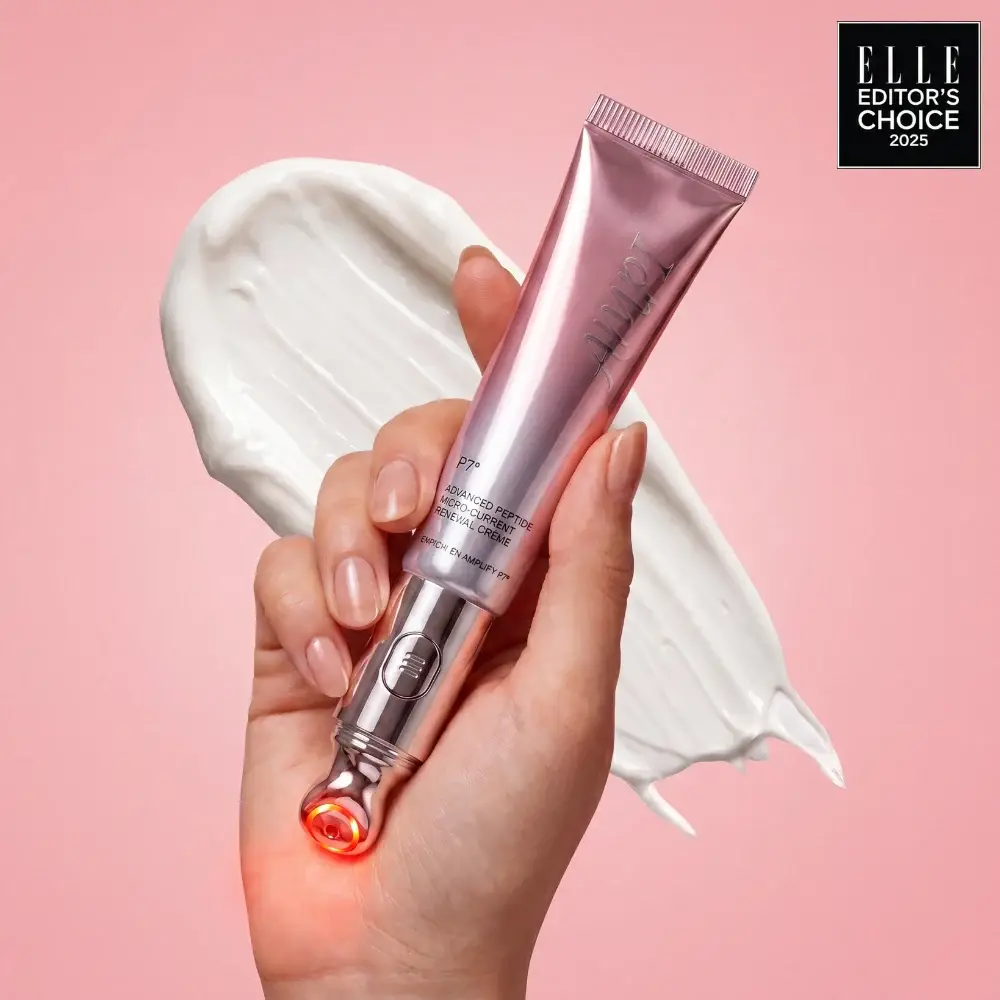
Ampiskin is marketed as a clinic-grade eye renewal pen that combines EMS microcurrent, 630nm red light and exosome-infused cream to firm, brighten and reduce puffiness around the eyes. But the more I looked into the product, the more problems I found with the story behind it.
The website makes some very specific claims about Shark Tank, dermatologist endorsements, clinical results and hundreds of thousands of customers, while the actual product pages contain some surprisingly obvious inconsistencies. So, is Ampiskin legit? Let’s take a closer look.
Key Takeaways
- Ampiskin sells the P7 Eye Renewal Pen for under-eye puffiness, fine lines, dark circles and firmness.
- The website claims Shark Tank exposure and a $1 million offer, but I could not independently verify that story.
- The product page contains leftover references to completely different brands, including BlueOrganics and PinkLabs.
- Exosomes and red-light therapy have some promising research, but that does not establish that Ampiskin itself works as advertised.
- I would skip Ampiskin for now, particularly because of the questionable marketing and inconsistent product information.
What Is Ampiskin?
Ampiskin, or AMPI, sells the P7 Eye Renewal Pen, a small electronic applicator designed for use around the eyes. The company says it combines EMS microcurrent, 630nm red light and an exosome-infused peptide cream in a three-minute routine. The current sales page lists retinol, hyaluronic acid, caffeine, niacinamide, vitamin C, adenosine, ceramides, squalane and allantoin alongside exosomes. It claims the pen can visibly firm and brighten the eye area, reduce puffiness and dark circles, and soften fine lines.
The website currently advertises the pen at roughly $39 to $50 depending on the offer, with free shipping and a subscription option. On paper, this sounds like a reasonable combination of established skincare ingredients and cosmetic technology. The problems start when you look past the headline claims.
How Ampiskin Claims to Work
There are three main pieces to the Ampiskin pitch. First, the EMS microcurrent supposedly sends electrical pulses through the applicator to firm and lift the muscles around the eye. Second, the 630nm red light is supposed to stimulate collagen production and improve the appearance of wrinkles. Third, Ampiskin says its exosomes act as an advanced delivery system that carries growth factors and other signaling molecules deep into the skin.
The company goes much further than simply saying these technologies may improve the appearance of aging skin. It claims the exosomes can cross the skin barrier, reach the dermis and deliver signals that tell skin cells to repair themselves and produce collagen.
That is a much bigger claim.
Reality vs. Claims
There is some legitimate science behind parts of this concept, but that is very different from proving Ampiskin works. Red-light photobiomodulation is not pseudoscience. Clinical research has found improvements in facial wrinkles using LED devices, including studies involving 630nm light. That means the general technology deserves consideration, although the results depend heavily on factors such as irradiance, treatment time and total energy delivered.
The same problem applies to exosomes. A 2026 scoping review of topical exosome research found only 18 studies evaluating topical exosomes for skin rejuvenation and concluded that human evidence remains limited, with major differences in exosome sources, preparation and delivery methods. A separate systematic review also found promising short-term results but substantial methodological limitations.
So, I am not saying exosomes are useless. I am saying that evidence for exosome-based skincare cannot automatically be transferred to one particular $40 pen. Most importantly, I could not find a published clinical trial testing the finished Ampiskin P7 product itself.
That distinction matters.
Let’s Look at the Listed Ingredients
The product page lists exosomes, 1% retinol, 3% hyaluronic acid, 5% caffeine, niacinamide, vitamin C, adenosine, ceramides, squalane and allantoin. Several of these are perfectly ordinary and useful skincare ingredients. Retinol has extensive evidence for improving photoaging, hyaluronic acid can hydrate and temporarily plump the skin; and niacinamide has established cosmetic benefits.
The unusual ingredient is the exosome component. Ampiskin says these are plant-derived exosomes, but it does not provide the kind of detailed sourcing, extraction, characterization or stability information that would allow me to independently assess what is actually in the formula.
There is also an odd contradiction in the page itself. One section calls the formula a four-active system consisting of exosomes, retinol, hyaluronic acid and caffeine, while another ingredient section lists ten active ingredients.
That is not automatically proof that the product is fake, but it is another sign that the sales page has not been carefully maintained.
The Biggest Red Flags
The Shark Tank Story
Ampiskin’s advertorial claims that founder Maya Chen appeared on Shark Tank, demonstrated the product, received a $1 million offer from an investor and turned it down. The same page says the company received more than 18,000 orders immediately after the episode and eventually shipped more than 300,000 pens.
That is an extraordinary origin story for a relatively new skincare brand. The problem is that I could not independently verify the claimed Shark Tank appearance from reliable sources. The company’s own marketing material is essentially the source for the entire story.
The page also uses “Shark Tank” branding prominently alongside a countdown timer, claims of limited stock and dramatic before-and-after results. That makes the alleged television appearance particularly important to verify before treating it as evidence of credibility.
The Dr. Rachel Adams Endorsement
The product page features a woman identified as “Dr. Rachel Adams, MD” and describes her as a board-certified dermatologist who recommends Ampiskin.
I could not independently verify a credible professional profile establishing that this person is a real dermatologist associated with Ampiskin.
That matters because using a named medical professional to support a skincare product is very different from simply saying that a product was dermatologist tested.
The BlueOrganics and PinkLabs Problem
This is probably the strangest thing on the entire website. Ampiskin’s product page contains a refund section saying:
“Try BlueOrganics risk-free.”
BlueOrganics is not Ampiskin. The same page also says that its 97%, 89% and 94% results came from “1,000 PinkLabs customers.” PinkLabs is not Ampiskin either. That strongly suggests portions of the sales page were copied from another product or template and not properly replaced.
For an ordinary moisturizer, that would already be embarrassing. For a product making clinical-grade, exosome and medical-technology claims, it is much more concerning because it raises questions about whether the surrounding statistics and testimonials actually belong to Ampiskin.
The Review Numbers Do Not Add Up
The homepage claims 12,300+ “real transformations.” The same homepage says there are 2,340+ reviews and that 300,000 women have made AMPI part of their routine.
The product page also displays 2,340 reviews, while the Shop app listing currently shows only 13 ratings. A separate Loox review page associated with the store displays a much smaller review count and contains complaints about receiving generic products instead of the advertised pen.
The numbers alone do not prove that reviews are fabricated, but the lack of consistency makes the company’s huge social-proof claims difficult to take at face value.
Customers Report Receiving Different Products
This is more serious than a simple review-count discrepancy. Reviews associated with the store include complaints from customers who say they received a generic device without the red-light component, received the wrong product, or were told the original product was unavailable.
One customer reported receiving what they described as berberine powder from China instead of the Ampiskin product. These are customer reports rather than independently verified findings, so I would not treat every complaint as proven. But when multiple reviews describe receiving products that do not match what was advertised, it is something I would take seriously before ordering.
The “Clinical-Grade” Language
Ampiskin repeatedly calls its technology “clinical-grade” and compares the product with expensive dermatology-office treatments. That language can sound impressive without telling you much.
A device can use a technology that also exists in clinical settings without producing equivalent results. The important questions are the actual electrical output, light intensity, treatment dose, safety testing and clinical results for the finished device.
Ampiskin does not provide enough independent evidence to establish that its pen delivers results comparable to professional treatments.
Is Ampiskin Effective?
There is a plausible product buried underneath the marketing. Retinol, caffeine, hyaluronic acid, niacinamide and red-light therapy are not ridiculous choices for an eye-area product. There is also emerging research around topical exosomes. But Ampiskin has not demonstrated that its particular combination produces the dramatic results being advertised.
The company’s own percentages are based on customer feedback rather than a clearly described, independently conducted clinical trial. The page says 97% reported firmer skin and 94% noticed smoother fine lines, but then attributes those results to customer feedback from PinkLabs customers.
That is an especially difficult statistic to take seriously when the product page itself still contains another company’s name.
And some of the claims go well beyond ordinary cosmetic improvement. The suggestion that exosomes penetrate ten times deeper, reach the dermis and deliver growth factors directly into cells is presented as established fact when the broader scientific literature is still dealing with questions around sourcing, formulation, delivery and standardization.
Pricing and Where to Buy
Ampiskin currently advertises the P7 Eye Renewal Pen for roughly $39 to $50 depending on the promotion, with a higher reference price shown on the site.
There is also a subscription option offering 10% savings. The subscription policy says customers can select 30-, 60- or 90-day intervals and cancel through their account.
The company advertises a money-back guarantee, although different parts of the website have displayed both 30-day and 60-day language. That is another inconsistency worth checking carefully before purchasing.
What To Do If You Already Bought Ampiskin
If you already ordered it, keep your order confirmation, screenshots of the product page, shipping information and any correspondence with customer service.
When the package arrives, compare the actual device with the product you ordered. Check whether the red light works, whether the applicator matches the advertised design and whether the packaging identifies AMPI.
If you received a generic or substantially different product, photograph everything before contacting the company. If the company does not resolve the problem within the applicable refund period, consider disputing the transaction through your payment provider.
If you are using the product around the eyes, be especially cautious with the retinol-containing cream. The company itself advises avoiding direct eye contact and stopping if irritation occurs.
Conclusion
Ampiskin is not convincing me that the product is a complete fabrication. The underlying concept is plausible, and several of the ingredients and technologies have legitimate cosmetic research behind them.
The problem is the marketing surrounding the product. The unverified Shark Tank story, questionable dermatologist endorsement, contradictory review numbers, leftover BlueOrganics and PinkLabs references, dramatic clinical claims and reports of customers receiving different products are too many problems to ignore.
My conclusion: I would skip Ampiskin for now. There are plenty of legitimate red-light devices and evidence-based eye products on the market without having to sort through a sales page that cannot even consistently identify its own brand.
If Ampiskin eventually provides verifiable clinical testing on the actual P7 device, transparent manufacturing information, properly documented exosome sourcing and a clean, internally consistent website, that would give me a reason to reconsider. Right now, the marketing raises more questions than the product answers.
Also read – HoneyFil Reviews: Is This Men’s Vitality Gummy Legit? I Investigated the Elon Musk Video