

I came across Ceoerty Herbal Vitiligo Cream while looking into products marketed to people dealing with vitiligo and uneven skin pigmentation. The product makes some fairly appealing promises, including smoother-looking white patches and a more even skin tone. But when a cream is marketed specifically for a condition that affects the skin’s pigment-producing cells, I think it is important to look beyond the botanical ingredient list and ask what the formula can actually do.
Here is what I found about Ceoerty, its ingredients, its claims and whether there is enough evidence to recommend it for vitiligo.
Key Takeaways
- Ceoerty Herbal Vitiligo Cream is marketed as a botanical cream for white patches and uneven-looking skin.
- Its listed ingredients include aloe vera, tea tree oil, neem, licorice, turmeric and ginkgo biloba. The product page also lists Glycyrrhiza glabra, which is another name for licorice.
- The company does not disclose the concentration of individual ingredients or provide clinical trial evidence showing that the finished cream can restore pigment.
- Its website advertises visible improvements within a short period, but the claims are not supported by published clinical data on the product.
- The product listing has no customer reviews, making its claims of widespread customer satisfaction difficult to verify.
- I would not consider it an established treatment for vitiligo. Anyone seeking repigmentation should discuss evidence-based options with a dermatologist.
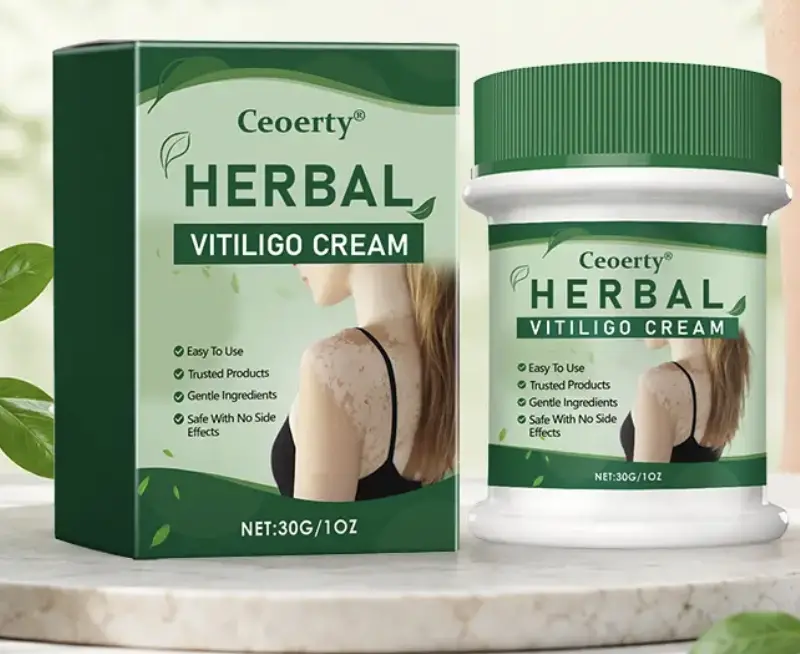
What Is Ceoerty Herbal Vitiligo Cream?
Ceoerty Herbal Vitiligo Cream is a topical skincare product sold through the Ceoerty website. It is marketed for people with vitiligo, white patches, uneven pigmentation and dry or rough-looking areas of skin.
The product page describes it as a targeted botanical treatment. Rather than using heavy camouflage to conceal white patches, the company says the cream conditions affected skin, improves hydration and helps reduce the visual contrast between depigmented areas and surrounding skin.
It is advertised for use on several parts of the body, including the face, neck, hands, arms, elbows, knees and legs.] The product is available in one-, two- and four-piece packages, with the listed price ranging from $18.90 to $40.90.
There is an important distinction here. Improving the moisture and texture of a patch of skin is not the same as restoring its pigment. Vitiligo involves the loss of functional pigment-producing melanocytes in affected areas. A moisturising cream may improve how the skin feels and looks, but that alone does not demonstrate that it can reverse the condition.
Ceoerty Herbal Vitiligo Cream Ingredients
The product page identifies seven botanical ingredients:
- Aloe vera
- Tea tree oil
- Neem
- Licorice
- Turmeric
- Ginkgo biloba
- Glycyrrhiza glabra
The list sounds familiar because most of these ingredients are commonly used in cosmetic skincare. However, the product page does not provide the amount or concentration of each ingredient. It also does not provide a complete quantitative formula that would allow customers to assess how much of each botanical is actually present.
Does Ceoerty Really Restore Skin Pigment?
This is the most important question, and the product’s marketing does not provide a convincing answer. Ceoerty describes its cream as supporting white-patch recovery and improving the appearance of affected skin. It also discusses a targeted contact system and a four-stage process involving delivery, conditioning, support and maintenance.
These descriptions make the product sound more technically developed than an ordinary moisturiser. However, the website does not provide clinical research demonstrating that this system works or explaining how it affects melanocytes. The company also describes improvements in skin appearance over periods ranging from a few days to a couple of weeks. Its claims include smoother-looking patches, softer borders and a more balanced complexion.
Those outcomes need to be separated from actual repigmentation. A patch that looks less dry or has a smoother surface may appear less noticeable without any restoration of melanin.
For a product specifically marketed for vitiligo, I would expect stronger evidence than general statements about hydration and botanical support. I could not establish that Ceoerty has published a clinical trial showing that its finished formula restores pigment in people with vitiligo.
The Problem With Its Short Results Timeline
Ceoerty’s product page promotes a seven-day targeted-care routine and describes possible improvements after 30 minutes, 12 hours, one week and two weeks. The timeline suggests that the cream can deliver noticeable changes relatively quickly. However, the page does not explain how these results were measured, how many people were assessed or whether the changes involved actual repigmentation.
It also does not provide a clinical study or independent testing report to support the timeline. Vitiligo treatment is not generally something that can be evaluated through a few days of cosmetic changes. Established treatments often require months, and response varies depending on the location and extent of the affected skin.
For example, the American Academy of Dermatology explains that topical treatments and light therapy can take time to produce visible repigmentation. Its information on ruxolitinib cream discusses clinical outcomes measured at 24 weeks, not a few days.
That does not mean every person needs the same treatment duration. It does mean that Ceoerty’s short results timeline should be treated as a marketing claim rather than an established clinical outcome.
What Do Customers Say About Ceoerty Herbal Vitiligo Cream?
Customer feedback is another area where the product page leaves questions unanswered. At the time of checking, the Ceoerty product listing displayed zero reviews. It also contained a section titled “Real Results from Real Customers”, but the listing did not provide a usable collection of independently verifiable customer reviews.
The website further claims that the product is trusted by more than 150,000 customers across the United States. However, I could not find supporting information explaining how that figure was calculated or independently verifying the number of customers who purchased this particular cream.
This does not prove that nobody has bought or used the product. It simply means that the available information does not provide a reliable basis for judging customer satisfaction or treatment outcomes.
I would be cautious about relying on testimonials or impressive customer-count figures without independent evidence.
Is Ceoerty a Legitimate Company?
Ceoerty has an active online storefront at ceoerty.com, where the vitiligo cream is listed alongside other skincare and health-related products. However, establishing that a website exists and accepts orders is not the same as establishing the credibility of the company behind it.
I could not independently establish enough about the manufacturer, production standards, clinical testing or quality-control arrangements for this cream. The product listing also does not provide the kind of detailed formulation information that would make it easy to assess the product properly.
There is another issue worth mentioning: the Ceoerty product name appears on other online storefronts, including pages using different brand identities. Some of those pages make much stronger claims about restoring natural skin colour, including claims of visible repigmentation within seven days.
The product descriptions are not entirely consistent. The Ceoerty website lists seven botanical ingredients, while another storefront’s description presents a six-botanical formulation. Other pages use different claims and sales presentations. These listings may involve different sellers, copied product descriptions or different versions of a product using the same name. I cannot establish from the available information that all of them are selling an identical formulation from the same manufacturer.
That makes it especially important to verify the actual seller and product label before purchasing.
Is Ceoerty Herbal Vitiligo Cream Safe?
The product is marketed as a gentle botanical cream, but natural ingredients are not automatically safe for every skin type. Tea tree oil, in particular, can cause irritation or allergic reactions. The absence of disclosed ingredient concentrations also makes it difficult to assess the potential for irritation from the complete formula.
The product page recommends patch testing, which is sensible. However, a patch test does not establish that a product is effective or suitable for treating a medical condition.
I would also avoid applying an unfamiliar product to large areas of skin, around the eyes or on sensitive areas without appropriate medical advice. Most importantly, people with suspected vitiligo should obtain a proper diagnosis. Other skin conditions can also cause lighter patches, and they may require different treatment.
What Are the Established Treatments for Vitiligo?
There are medical treatments with evidence supporting their use for vitiligo. The appropriate option depends on factors such as the type of vitiligo, the affected areas, how quickly it is spreading and the person’s medical history.
Some established options include:
- Topical corticosteroids: These prescription creams or ointments may help stop the spread of white patches and restore some colour. They need to be used under medical guidance because prolonged or inappropriate use can cause skin thinning and other side effects.
- Tacrolimus and pimecrolimus: These topical medicines may be used to help restore pigment, particularly on the face and other sensitive areas where corticosteroids may not be suitable.
- Phototherapy: Narrowband UVB treatment exposes affected skin to carefully controlled ultraviolet light. It may be recommended when vitiligo is widespread or has not responded adequately to topical treatment.
- Ruxolitinib cream: This is a prescription topical JAK inhibitor approved in the United States for certain people aged 12 and older with non-segmental vitiligo. It has clinical trial evidence supporting its use, although it is not suitable for everyone and availability varies by country.
The British Association of Dermatologists and the American Academy of Dermatology provide guidance on these treatment options. People with vitiligo should also protect affected areas from sunburn. Because depigmented skin has reduced natural protection from ultraviolet radiation, regular broad-spectrum sun protection is important.
Should You Buy Ceoerty Herbal Vitiligo Cream?
I would not recommend buying Ceoerty on the expectation that it will reverse vitiligo or restore lost skin pigment. The product contains familiar botanical skincare ingredients, some of which may help with hydration or general skin conditioning. That is a much more modest benefit than the product’s vitiligo-focused marketing might lead customers to expect.
The bigger concern is the absence of product-specific clinical evidence. There are no disclosed ingredient concentrations, no accessible clinical trial results for the finished cream and no meaningful customer-review history on its own product listing.
The inconsistent descriptions across different storefronts also make it difficult to establish exactly what customers are purchasing. If someone wants a moisturiser for dry skin, there are simpler products with clearer ingredient labels. If the goal is to treat vitiligo and restore pigmentation, I would prioritise a dermatologist’s assessment and treatments supported by clinical evidence.
Conclusion
Ceoerty Herbal Vitiligo Cream is marketed as a botanical solution for white patches and uneven pigmentation, but its evidence does not match the strength of its marketing.
I could not verify that the cream restores pigment, and the short improvement timelines and customer-count claims are not backed by accessible clinical evidence. The lack of ingredient concentrations and inconsistent product descriptions across storefronts are additional reasons to be cautious.
I would not label the product a confirmed scam based on the information available. However, I also would not consider it a proven vitiligo treatment or recommend relying on it to restore skin colour.
My verdict: Unproven for vitiligo. Its potential skincare benefits should not be confused with evidence of repigmentation.
Also read – Rhythm Health Review: Is It Legit or Worth Buying?