

I bought KONEO Batana Oil because, like everyone else who has been watching the Batana oil craze, I wanted to see whether this little jar of dark hair treatment was actually worth the hype. I was hoping for something that would leave my hair softer, healthier-looking, and generally easier to manage.
And surprisingly, I really liked it. My biggest problems with KONEO weren’t actually how it performed on my hair; they were the questions I had about the product itself. Mine says it was made in China, there is no ingredient list printed on the body of the product, and the smell is strong enough that it makes me wonder whether some fragrance has been added. So while I genuinely enjoyed using it, I also think there are some transparency issues worth talking about.
Key Takeaways
- I genuinely liked how KONEO Batana Oil performed on my hair.
- It left my hair feeling softer, healthier, and more conditioned.
- The texture is thicker than I expected from something called an “oil.”
- It did not leave my hair excessively greasy after use.
- The product is made in China, which isn’t automatically a problem, but it made me look more closely at the sourcing claims.
- There is no ingredient list printed on the actual product container.
- The smell seems more like added fragrance than what I expected from pure, unrefined Batana.
- I wouldn’t call the product a scam because my experience with it was genuinely good.
- However, I would like considerably more transparency about what is actually in the jar.
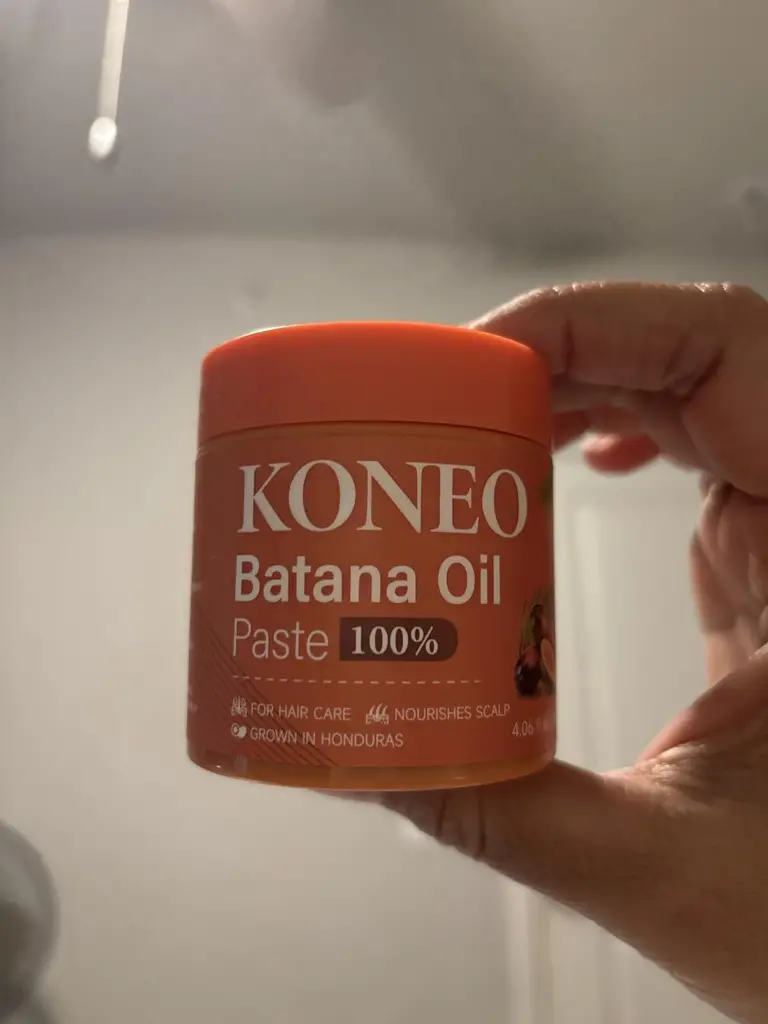
What Is KONEO Batana Oil?
KONEO Batana Oil is marketed as a hair treatment made with Batana oil, with the product positioned around hair nourishment, conditioning, and hair-growth-related benefits. The product is sold as a thick Batana oil or paste rather than the thin, runny oil you might initially imagine when you hear the word “oil.”
KONEO’s marketing describes the product as 100% pure Honduras-harvested Batana and says it contains no added oils, chemicals, fragrances, or other ingredients. That is a pretty significant claim because it means the product is essentially asking you to believe that what is in the jar is simply pure Batana.
And that is where my little investigation starts, because the product worked for me, but I still have questions.
Why I Bought It
I bought KONEO because Batana oil had become one of those ingredients that seemed to be everywhere, particularly in products claiming to help with hair growth, strengthening, dryness, and overall hair health.
I’m always a little skeptical when one ingredient suddenly becomes the answer to every hair problem imaginable, but I was curious enough to try it for myself.
What I really wanted wasn’t necessarily some dramatic overnight transformation. I wanted to see what it would actually do to my hair. Would it make my hair softer? Would it make it feel more conditioned? Would it leave behind that heavy, greasy feeling that some oils do? And, of course, would I notice any difference in my hair growth over time?
My Experience Using KONEO Batana Oil
The first thing that surprised me when I opened KONEO was the consistency. I expected an oil, but what I got was much closer to a thick paste.
Depending on the temperature, the product can become quite solid, so it isn’t the kind of hair oil you simply pour into your palm and immediately run through your hair. Instead, I take a small amount and warm it between my fingers, which makes it much easier to spread.
At first, I thought the consistency was going to be annoying, but I actually ended up liking it. Because it is thicker, I have more control over how much I use. With a liquid oil, it is incredibly easy to pour out way more than you actually need and then spend the next thirty minutes wondering why your hair suddenly looks like you deep-fried it.
KONEO doesn’t give me that problem. Once I work it between my fingers, I distribute it through my hair without feeling like I need to drown it in product.
And the biggest thing I noticed after using it was how my hair felt afterwards. It felt very soft. Not just oily-soft, where your hair feels slippery because there is a layer of product sitting on top of it, but genuinely conditioned and smoother.
That was probably the biggest reason I kept using it. I also liked that my hair didn’t feel weighed down afterward. Some hair treatments leave you with that heavy, coated feeling where you can practically feel the product sitting on every strand. With KONEO, I didn’t get that.
My hair still had some bounce to it. That was a pleasant surprise because, considering how thick the product is in the jar, I expected the finished result to be much heavier.
I also found it easy enough to incorporate into my routine. I use it as a treatment rather than simply slathering it on and leaving it there indefinitely, and I generally let it sit for a while before washing my hair.
That gives me the conditioning effect without making the product feel like an all-day commitment. And this is where I have to give KONEO credit: the product actually worked well for what I personally wanted from a hair treatment. My hair felt better after using it.
The Texture Is More Like a Paste Than an Oil
If you are expecting KONEO to behave like coconut oil, argan oil, or another thin liquid hair oil, you might be surprised when you open the jar.
The consistency is much thicker.
It can become more solid depending on temperature, and that isn’t necessarily a sign that something is wrong with the product. Batana products can naturally change consistency depending on temperature, which is one reason the paste-like texture isn’t something I would automatically consider a red flag.
In fact, I ended up liking the consistency because it makes it easier for me to control how much product I’m applying. You take a small amount, warm it between your fingers, and work it through your hair.
Simple.
The Smell Made Me Question the Ingredients
Now we get to the part that made me raise an eyebrow… the smell. KONEO’s product claims say that it contains no added fragrance, and yet the product has a noticeable, pleasant smell that strikes me as more like added fragrance than the earthy or nutty smell I would have expected from an unrefined plant-based product.
And before anyone starts typing “SCAM!” in the comments, let me make something very clear:
I cannot identify an ingredient simply by smelling it. A pleasant smell does not prove that fragrance has been added. At the same time, I think it is completely reasonable for me to question it when the company is specifically saying there is no added fragrance.
If you tell me a product contains nothing except one particular plant-derived ingredient, and I open it and immediately notice what smells to me like added perfume, I’m naturally going to wonder where that smell is coming from.
That doesn’t prove the product is mislabeled. It just makes me curious. And unfortunately, that curiosity becomes more difficult to resolve because there is another problem.
Where Is the Ingredient List?
The biggest transparency issue for me is that there is no ingredient list printed on the body of the product. That bothers me more than the smell.
If I’m buying a product marketed as 100% pure Batana, I want to be able to turn the jar around and see exactly what the manufacturer says is inside.
Instead, I have to rely heavily on the product’s marketing claims. And that becomes particularly important when the product is making a claim as strong as “100% pure.” A proper ingredient list would immediately make things much clearer.
If it’s genuinely just Batana, show me that… If there are other ingredients, show me those too. I don’t think consumers should have to investigate a product after buying it simply to figure out what is actually supposed to be in the container.
Does KONEO Batana Oil Actually Help Hair Grow?
This is where I want to separate hair conditioning from hair growth. I genuinely liked what KONEO did for the feel and appearance of my hair, but I can’t honestly tell you that it dramatically accelerated my hair growth.
Hair grows naturally. So if I use a hair product for a month or two and my hair is longer afterwards, that does not automatically mean the product caused the growth. It may simply mean that my hair continued doing what hair naturally does.
That’s why I would be careful with the huge hair-growth promises surrounding Batana oil generally. If you are buying KONEO because you expect it to suddenly make your hair grow at some supernatural speed, I wouldn’t make that promise to you.
What I can tell you is that I liked the condition of my hair while using it. And personally, I think that is still worth something.
Does KONEO Batana Oil Make Hair Greasy?
Surprisingly, no. This was one of the things I liked most about it. Considering how thick the product is in the jar, I expected it to leave my hair feeling much heavier and oilier than it actually did.
Instead, once I washed it out, my hair felt conditioned without feeling coated in grease. That is a big deal for me because I don’t enjoy hair treatments that leave behind so much residue that you can practically see the product sitting on your hair.
KONEO gave me the conditioning effect without making my hair feel unnecessarily weighed down.
Made in China: Is That a Red Flag?
The product is marked Made in China, and I think this is worth mentioning because the product is marketed around the idea of pure Honduras-harvested Batana.
But I want to be careful here. Made in China does not automatically mean the product is fake or bad. A product can contain an ingredient sourced from Honduras and still be manufactured, processed, packaged, or filled somewhere else.
What it does make me want is more information. If the Batana really is harvested in Honduras, where exactly does the processing take place? Is the raw material imported into China and then processed there? Is it simply packaged there? Is it refined? Is anything else added?
Those are reasonable questions when the product is being marketed specifically around its purity and Honduran origin. And again, the lack of an ingredient list makes those questions harder to answer.
What I Loved
The actual hair experience was very good for me.
- My hair felt noticeably softer after using it.
- It gave my hair a conditioned, healthier feel.
- It didn’t leave my hair excessively greasy.
- The thick texture made it easy to control how much I used.
- I liked the way my hair retained its bounce instead of feeling weighed down.
- It was simple to incorporate into my hair-care routine.
The most important point is that I actually enjoyed using it.
I don’t want this review to sound like I’m trying to find reasons to hate a product that worked well for me. If anything, the opposite is true.
I wish the company gave me fewer reasons to question it because I genuinely like the product.
What I Didn’t Love
My biggest complaints are about transparency rather than performance.
- There is no ingredient list printed on the body of the product.
- The product is marked Made in China despite being marketed around Honduran Batana.
- The smell makes me suspect there may be added fragrance, although I cannot prove that from smell alone.
- The sourcing and processing information is not as detailed as I would like.
- The hair-growth claims are difficult to verify based on my experience alone.
Is KONEO Batana Oil Worth the Price?
For the actual hair treatment experience, I would say yes; I understand why people like it. It worked well for me as a conditioning treatment, and I genuinely liked how my hair felt afterward.
My hesitation isn’t really about whether the product can make your hair feel good. It can. My hesitation is about how confidently I can recommend the product when I don’t have enough transparency about exactly what is in the jar.
There is a difference between saying, “This worked well for my hair,” and saying, “This is definitely 100% pure Batana from Honduras with absolutely nothing else added.”
I can confidently say the first, but I can’t independently verify the second.
Who I Think Will Love It
I think KONEO could be a good fit if you:
- Want a deep-conditioning hair treatment.
- Have dry or rough-feeling hair.
- Prefer thicker oil treatments rather than runny oils.
- Want softer, more manageable hair.
- Don’t mind warming a paste between your fingers before applying it.
- Are looking for something simple rather than a complicated multi-product routine.
Who Should Skip It
I would hesitate to recommend it if you:
- Only want products with a clearly printed ingredient list.
- Are specifically looking for verified organic or traditionally sourced Batana.
- Are buying it solely because you expect dramatic hair growth.
- Are uncomfortable with products that don’t provide much sourcing information.
- Are particularly sensitive to fragranced hair products.
Alternatives
- Traditional Honduran Batana oil from a brand that clearly identifies its source and ingredients
- Cold-pressed coconut oil
- Argan oil
- Jamaican black castor oil
Conclusion
KONEO Batana Oil is one of those products where my experience and my scepticism are somehow sitting next to each other. Because the truth is, I liked it.
My hair felt softer, healthier, and more conditioned after using it, and I was pleasantly surprised that the thick paste didn’t leave my hair feeling excessively greasy or weighed down. If we’re talking purely about how the product performed for me as a hair treatment, I have very little to complain about.
But then I look at the jar and start asking questions. It is made in China. There is no ingredient list printed on the body of the product. The smell is much more fragranced than I expected from something marketed as 100% pure Batana with no added fragrance. None of those things, individually, proves that the product is fake or that KONEO is lying about its ingredients, but together they make me wish the company would simply give customers more information.
So my verdict is a little unusual: I would happily talk about how well the product worked for my hair, but I would not personally vouch for the company’s purity claims without more transparency.
Would I buy it again?
Possibly, because I genuinely liked the results, but I would want more information about the ingredients and sourcing first.
Would I recommend it?
As a hair-conditioning treatment, yes, based on my experience. As a verified 100% pure Batana product, I’d proceed with caution because I couldn’t independently confirm that claim.
Also read my similar review on the Gluvelessia Hair Growth Roll-On