

Tydott Low Tide is a daily drink mix designed for people who want to look leaner, sharper and less puffy without giving up creatine or changing their entire diet. The basic idea is that training, sodium and certain supplements can increase extracellular water, making an otherwise lean physique look softer than it actually is.
That actually sounded more believable to me than the usual “melt fat while you sleep” supplement pitch. So, I looked into the formula, particularly the potassium, magnesium and herbal ingredients, and then checked whether the science really supports Tydott’s much bigger promise of selectively getting rid of the water hiding your definition.
Key Takeaways
- Low Tide is marketed specifically for water retention, not fat loss.
- One 5 g serving provides 500 mg potassium, 150 mg magnesium and 245 mg vitamin C, plus a 900 mg botanical blend and a 100 mg digestive enzyme/probiotic blend.
- The company says it can reduce extracellular water while leaving the water inside your muscles alone.
- Some ingredients, particularly potassium and dandelion, have legitimate connections to fluid balance, but that doesn’t prove Low Tide produces the dramatic visual changes shown in its marketing.
- I couldn’t find a clinical trial testing Low Tide itself for reducing extracellular water or improving body definition.
- The company claims there are no side effects, which is a claim I’d be more cautious about given the potassium content and the number of herbs included.
- Customer feedback is mixed, with some recent reviewers reporting noticeable changes and others saying they saw no difference after a month.
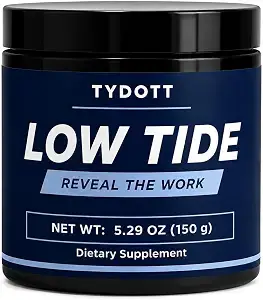
What Is Tydott Low Tide?
Low Tide is essentially a debloating/water-balance supplement for people who work out. The marketing isn’t really trying to convince you that you’re carrying excess fat. Instead, it says you may already have the physique you’re working toward, but extracellular water is sitting between your muscles and skin, making you look softer or puffier.
The company specifically positions Low Tide alongside creatine. Its argument is that creatine pulls water into your muscles, which is desirable, while Low Tide is supposed to help reduce the water sitting outside the muscles.
That distinction is actually important. Because if Low Tide genuinely worked that way, it wouldn’t be a fat burner at all. It would essentially be a cosmetic water-management supplement.
And that’s how I think it should be evaluated.
How Does Low Tide Claim to Work?
The formula is built around three main areas: electrolytes, herbs and digestive support.
Potassium
Each serving contains 500 mg of potassium citrate. This is probably the ingredient that makes the most sense for the company’s central argument.
Potassium and sodium are both involved in fluid and electrolyte balance, and increasing dietary potassium can increase urinary sodium excretion.
But there’s a catch. The fact that potassium helps regulate sodium and fluid balance doesn’t mean taking an additional 500 mg will selectively remove the water underneath your skin while leaving everything else untouched.
Your kidneys regulate fluid balance continuously. The effect depends on your overall diet, hydration, kidney function and existing electrolyte intake.
So I think Tydott has a legitimate physiological mechanism here, but the marketing makes the outcome sound much more precise than it really is.
Magnesium
Low Tide provides 150 mg of magnesium citrate. Magnesium is involved in hundreds of biochemical reactions, including processes related to electrolyte balance and muscle function.
Again, that’s legitimate.
But I couldn’t find evidence that 150 mg of magnesium specifically produces the kind of visible facial and muscular definition changes Tydott promises.
Vitamin C
There are 245 mg of vitamin C per serving. Tydott says vitamin C can help reduce cortisol-related water retention and support capillary integrity.
That’s an interesting explanation, but I wasn’t able to find evidence that this particular dose causes enough of a reduction in extracellular water to explain the dramatic before-and-after effect the marketing suggests.
The Herbal Blend
Low Tide contains 900 mg total of:
- Ginger
- Fennel
- Peppermint
- Nettle
- Hibiscus
- Juniper berry
- Dandelion root
The company describes dandelion as the “workhorse” of the formula because of its mild diuretic effect. It also says hibiscus and juniper support renal clearance while nettle and ginger help with inflammation.
This is where I think the formula becomes a little more complicated.
There are legitimate reasons some of these herbs might affect fluid excretion. Dandelion, in particular, has been studied for its diuretic potential.
But diuretic activity isn’t the same thing as selectively removing unwanted extracellular water.
If you’re making more urine, you’re losing water. That doesn’t necessarily mean you’re specifically removing the water that makes your face look puffy while preserving the water inside your muscles.
That’s an important distinction that I don’t think the marketing emphasizes enough.
My Investigation: Is Low Tide Actually Different From a Diuretic?
This was probably the biggest question I had. Tydott goes out of its way to say Low Tide isn’t a harsh diuretic and can be taken every day without cycling.
But when I looked at the formula, it contains several ingredients specifically associated with fluid excretion.
So I don’t think it’s accurate to treat the product as though it’s doing something completely different from a diuretic.
It’s certainly not the same thing as taking a pharmaceutical diuretic, and the formulation may be much gentler. But if the reason your scale or appearance changes is partly due to increased water excretion, that’s still fundamentally water loss.
And that matters because the product’s promise is: “Look leaner without losing a pound.” That’s actually a fairer description of what the product is trying to accomplish than calling it a fat-loss supplement.
If you lose some extracellular water, you may look more defined without losing body fat. But that visual change isn’t the same as getting leaner in the physiological sense.
Creatine + Low Tide
This is one part of Tydott’s marketing that I found genuinely interesting.
The company specifically tells users not to stop taking creatine because creatine increases intracellular water, which can contribute to muscle fullness. Low Tide is supposed to address the extracellular water instead.
The basic distinction between intracellular and extracellular fluid is real. What I couldn’t establish is whether Low Tide can actually selectively manipulate those two pools to the extent the advertising suggests.
That’s the part that needs clinical testing. I couldn’t find a study showing that taking this exact formula alongside creatine makes people measurably more defined by reducing extracellular water while preserving intracellular water.
So the concept is plausible. The product-specific evidence isn’t there yet.
Red Flags to Consider
“No Side Effects”
Tydott’s website simply answers the question about side effects with “No.” It then describes Low Tide as safe for daily use and says it isn’t a harsh diuretic.
I wouldn’t make that claim about any supplement this casually. The product contains potassium, magnesium, several herbs with potential diuretic effects and multiple other active ingredients.
For a healthy person, the formula may be well tolerated. But that isn’t the same thing as saying it has no possible side effects.
People with kidney problems, electrolyte disorders or certain medical conditions may need to be particularly careful with potassium-containing supplements.
The “3,000–5,000 mg Sodium” Argument
Tydott repeatedly suggests that people who train are routinely consuming 3,000–5,000 mg of sodium per day through pre-workout, whey, electrolytes and other foods.
That may be true for some people, but it’s not automatically true for everyone who works out. And if your sodium intake isn’t unusually high in the first place, there’s less reason to expect Low Tide to suddenly transform your appearance.
In other words, the product’s usefulness probably depends heavily on whether excess water retention is actually a problem for you.
The “Within Hours” Style Testimonials
This is where the customer feedback becomes interesting. One recent Trustpilot reviewer complained that the advertising included a particularly dramatic claim about seeing a change in the face within hours. Another reviewer said they took Low Tide for a month and noticed absolutely no difference.
At the same time, other customers report that the product noticeably improved their appearance. That’s exactly why I wouldn’t use testimonials as evidence that Low Tide works.
Water retention naturally fluctuates from day to day depending on sodium, carbohydrates, hydration, hormones, exercise, sleep and even how recently you ate.
A face looking less puffy tomorrow doesn’t necessarily mean the supplement caused it.
The “First Product Built Specifically for This” Claim
Tydott describes Low Tide as the first daily supplement designed specifically to address training-related water retention.
That’s difficult to verify and isn’t particularly meaningful scientifically. Being the “first” doesn’t tell me whether it works.
What I want to see is a controlled study comparing people taking Low Tide with people taking a placebo and measuring extracellular water.
I couldn’t find that.
Does Tydott Low Tide Actually Work?
This one is more nuanced than some of the supplements we’ve looked at. I don’t think it’s fair to call the entire concept nonsense.
The ingredients have plausible effects on fluid balance. Potassium can influence sodium excretion. Some herbs have diuretic properties. Magnesium contributes to normal electrolyte function.
So there is a reasonable physiological basis for expecting some effect on water balance. What I don’t have is evidence that Low Tide can do exactly what the marketing promises:
reduce the water underneath your skin, preserve muscle hydration, sharpen your face and reveal your physique in a predictable way.
That’s a much bigger claim. And because I couldn’t find a clinical trial on the finished product, I wouldn’t give it a strong efficacy rating based solely on the ingredient research.
Potential Side Effects
Despite Tydott’s claim that Low Tide has no side effects, I wouldn’t assume that everyone will tolerate it identically.
Possible issues could include:
- Increased urination
- Digestive discomfort
- Bloating
- Headache
- Changes in electrolyte balance
- Interactions with medications
The potassium content also deserves some attention. 500 mg isn’t an enormous amount for a healthy person, but potassium supplementation isn’t something everyone should treat casually, particularly people with kidney problems or those taking medications that affect potassium levels.
Pricing and Where to Buy
Tydott sells Low Tide directly through its website and currently advertises a 100-day money-back guarantee and free worldwide shipping.
One bottle contains 30 servings, so the standard bottle is intended to last approximately one month.
The company also encourages users to take before-and-after photographs and says it will refund customers who don’t see a reduction in extracellular water after 21 days.
I actually prefer that to being told to blindly buy six months’ worth, although it still doesn’t substitute for independent evidence.
Alternatives
If you’re simply dealing with occasional puffiness, I’d first look at the obvious things:
- Sodium intake
- Hydration
- Sleep
- Alcohol consumption
- Menstrual-cycle-related water retention
- Carbohydrate intake
- Training-related inflammation
If you’re using creatine, I also wouldn’t automatically blame it for looking “puffy.” Creatine’s increase in intracellular muscle water is generally considered part of the reason it can improve muscle performance and fullness.
And if someone has persistent or significant swelling, that’s a different situation entirely. That’s something I’d want evaluated rather than masked with a supplement.
What To Do If You Were Scammed
If you purchased Low Tide because you were expecting dramatic changes in your face or physique and saw nothing, document your results with photographs taken under similar lighting and conditions.
Tydott advertises a 100-day money-back guarantee, so you can contact the company within that period to request a refund.
Keep your order confirmation and payment records in case you need them.
Conclusion
Tydott Low Tide is actually one of the more interesting formulas I’ve come across because the underlying idea isn’t completely ridiculous.
Potassium, magnesium, dandelion, hibiscus and the other ingredients do have legitimate connections to fluid and electrolyte regulation. So I can understand why the formula might help someone who genuinely tends to retain excess water.
But the marketing gets ahead of the evidence. I couldn’t find a clinical trial showing that Low Tide selectively removes extracellular water while preserving intracellular muscle hydration. And that’s really the claim the product needs to prove.
I also wasn’t convinced by the blanket “no side effects” statement or the dramatic visual promises. Recent customer reviews are mixed too: some people say it works, while others report no noticeable difference after a month.
Also read – I Tried Fera Pets Hip + Joint Chews for My Dog: Here’s My Honest Review of It