

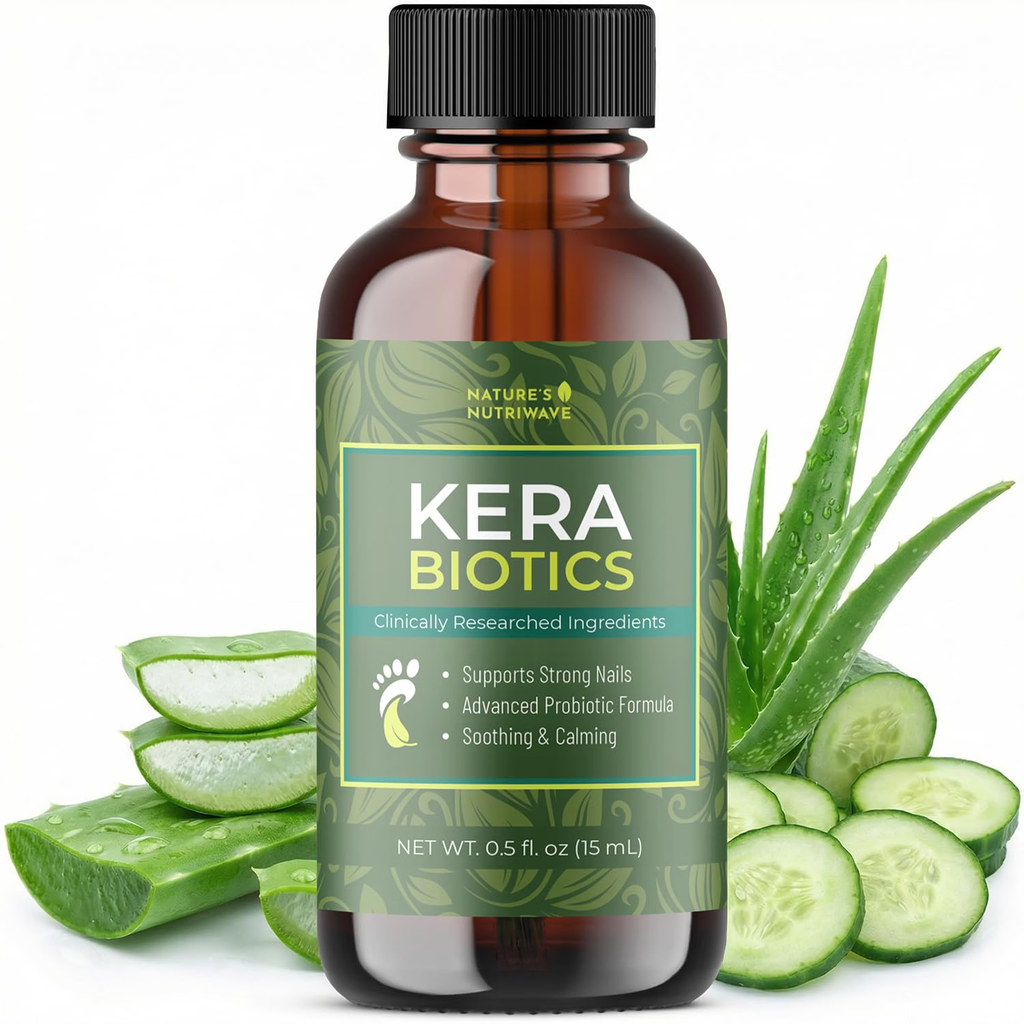
I came across KeraBiotics while looking into topical products marketed for people struggling with discoloured, brittle or fungus-infected toenails. The product makes an interesting promise: instead of simply applying an antifungal ingredient, it supposedly restores the natural balance of microorganisms around the nails, creating an environment where harmful fungi cannot thrive.
The idea sounds plausible enough to attract attention, particularly for people who have tried conventional treatments without much success. But when I examined the ingredient list, I found a mixture of cosmetic moisturisers, peptides and probiotic strains rather than a clearly established antifungal formulation.
I also found several websites promoting KeraBiotics under slightly different domains, with inconsistent descriptions of what the product actually is. Here’s what the investigation revealed.
Key Takeaways
- KeraBiotics is a topical liquid marketed for toenail fungus, discolouration, brittle nails and foot odor.
- Its disclosed formula includes aloe vera, glycerin, cucumber extract, cosmetic peptides, four probiotic strains and copper gluconate.
- The company claims the probiotics restore the nail microbiome and prevent harmful fungi from thriving, but I could not find clinical trials demonstrating that the finished formula treats fungal nail infections.
- The website describes the product as both a topical serum and a supplement, creating confusion about its identity.
- Its marketing includes claims of FDA approval, although FDA facility registration does not constitute approval of a product’s effectiveness.
- The seller recommends purchasing three to six bottles, but the available evidence does not establish that this product is an effective treatment for toenail fungus.
What Is KeraBiotics?
KeraBiotics is a liquid topical foot and nail product marketed primarily for people dealing with suspected toenail fungus. Its sales pages promise improvements in several areas, including:
- Yellow or discoloured toenails.
- Brittle and damaged nails.
- Fungal growth around the nail.
- Foot odor.
- Dry or irritated skin surrounding the nails.
The product’s central selling point is its proposed microbiome-balancing mechanism. According to the company, fungal problems develop when harmful microorganisms overwhelm beneficial bacteria around the nails. KeraBiotics supposedly introduces helpful bacteria that restore this balance and make it harder for fungi to survive.
The company also describes the formula as inspired by traditional Amazonian barefoot practices. However, I could not find independent historical or scientific documentation supporting the specific Amazonian ritual described in its marketing.
The product is sold as a liquid that customers apply directly to affected toenails and surrounding skin. The instructions recommend cleaning and drying the feet before application, followed by gently massaging the serum into the affected areas.
KeraBiotics Ingredients: What’s Inside?
The product’s ingredient information is more detailed than some competing nail-fungus products. Its published list includes:
- Deionized water
- Aloe barbadensis leaf juice
- Glycerin
- Cucumis sativus (cucumber) extract
- Palmitoyl oligopeptide
- Chrysin
- H-hydroxysuccinimide
- Palmitoyl tetrapeptide-7
- Palmitoyl pentapeptide-3
- Steareth 20
- Polysorbate 20
- Carbomer
- Phenoxyethanol
- Caprylyl glycol
- Lactobacillus paracasei
- Lactobacillus rhamnosus
- Bifidobacterium lactis
- Lactobacillus acidophilus
- Copper gluconate
- Potassium sorbate
The formula contains ingredients commonly used in skincare and cosmetic preparations. However, their presence does not automatically establish antifungal effectiveness.
Does KeraBiotics Really Treat Toenail Fungus?
This is where the product’s marketing becomes difficult to support. Toenail fungus is not simply a problem of having too many harmful microorganisms on the surface of the skin.
In onychomycosis, fungi invade the nail plate or the tissue beneath it. The infection can cause yellowing, thickening, crumbling, separation from the nail bed and other changes.
A topical product must therefore deliver an effective antifungal treatment to the infected nail tissue. KeraBiotics approaches the problem through its proposed microbiome-balancing mechanism. However, I could not find clinical research demonstrating that applying its combination of probiotics, peptides and botanical extracts eliminates the fungi responsible for nail infections.
The company also does not provide a published clinical trial showing how many people used the finished product, how their nails changed or whether laboratory testing confirmed that the infection had cleared.
This is important because an improvement in nail appearance does not necessarily mean the infection has been eliminated. A moisturising product may improve the surrounding skin, while the underlying fungal infection remains.
I would therefore distinguish between the formula’s potential cosmetic benefits and its much stronger claim of treating toenail fungus.
The Probiotic Microbiome Explanation
KeraBiotics repeatedly describes its formula as a way to rebuild the toenail microbiome. The concept of a microbiome is legitimate. Human skin hosts numerous microorganisms, including bacteria and fungi, that interact with one another.
Researchers have investigated how changes in the skin microbiome may influence certain skin conditions. However, the company’s explanation oversimplifies the biology of fungal nail infections.
The fact that beneficial bacteria can influence microbial communities does not prove that introducing selected probiotic strains onto an infected toenail will eliminate an established fungal infection.
There are several unanswered questions:
- Which specific probiotic strains are included?
- How many live microorganisms are present per application?
- Do they remain viable in the finished formula?
- Can they survive on the nail surface?
- Can they reach the infected nail tissue?
- Have they been tested against the fungi responsible for onychomycosis?
The company does not provide convincing answers to these questions. I could not find independent clinical research demonstrating that this particular probiotic combination produces the claimed results.
KeraBiotics and Its FDA Approval Claims
The KeraBiotics websites display badges describing the product as FDA approved or manufactured in an FDA-registered facility. These statements need to be interpreted carefully.
The US Food and Drug Administration does not approve ordinary cosmetic products or dietary supplements in the same way it approves prescription medicines. Facility registration also does not mean the FDA has evaluated and approved the effectiveness of every product manufactured there.
For a product claiming to treat fungal nail infections, the distinction is particularly important. A topical product making therapeutic claims about eliminating a fungal infection may fall under drug regulations depending on its intended use and marketing.
I could not establish that KeraBiotics has an FDA-approved drug application for treating onychomycosis. The website also claims GMP-certified manufacturing and American production, but I could not locate independent documentation identifying the manufacturing facility or verifying the finished product’s quality-testing arrangements.
These claims should not be treated as proof that the formula is clinically effective.
Is KeraBiotics a Supplement or a Topical Serum?
One of the more noticeable inconsistencies is how the company describes the product itself. The kerabiotics.com website calls KeraBiotics a nail-care serum and instructs customers to apply it directly to their toenails.
The kerabiotix.com website also describes a topical liquid formula. However, other promotional pages repeatedly call it a supplement, refer to it as a nail fungus supplement and even use the phrase “entire KeraBiotics Supplement” in their ordering instructions.
The product’s FAQ also recommends purchasing several bottles for three to five months of use. This terminology is confusing because the product is not presented as something customers swallow. Its instructions describe external application.
The distinction matters because supplements and topical cosmetic or drug products are subject to different regulatory considerations. The company should be clearer about the product category and the regulatory basis for its fungal-treatment claims.
KeraBiotics Pricing and Money-Back Guarantee
The promotional websites advertise a 60-day money-back guarantee. The company encourages customers to purchase multiple bottles, recommending three to six bottles to achieve the best results.
One FAQ page also states that customers can purchase one, three or six bottles. However, the publicly accessible pages I examined did not provide a sufficiently consistent, transparent pricing breakdown to establish the final cost of every package. The contact page directs customers seeking order support to BuyGoods, suggesting that the purchase process is handled through a third-party payment and fulfilment arrangement.
This is not automatically suspicious. Many online supplement and skincare sellers use third-party payment processors. However, customers should confirm the actual seller, total checkout price, shipping costs and refund conditions before paying. There is also an important limitation to the guarantee: the FAQ says customers should return the unused portion of the product within 60 days for a refund.
That is more specific than the broader marketing language, suggesting a straightforward, no-questions-asked guarantee. I would read the complete refund terms before placing an order.
Are There Customer Reviews for KeraBiotics?
KeraBiotics promotional pages include customer-result material and testimonials describing improvements in nail appearance. However, I could not establish a substantial, independently verified collection of customer reviews that would allow me to assess how consistently the product performs.
Some of the promotional material appears on dedicated sales and affiliate pages rather than independent consumer-review platforms. This distinction matters because testimonials selected and published by a seller do not provide the same level of independent evidence as reviews collected by an external platform.
I would not treat before-and-after photographs or customer stories as proof that the product eliminates fungal infections. A nail may look better for several reasons, including trimming, cosmetic care and natural nail growth. Confirming that a fungal infection has cleared requires more than observing a change in appearance.
The absence of a strong independent review history does not prove that nobody has benefited from KeraBiotics. It simply means there is insufficient reliable customer feedback to establish its effectiveness.
What Are the Established Treatments for Toenail Fungus?
There are established treatments for fungal nail infections, and they are considerably better documented than KeraBiotics. The appropriate option depends on the severity of the infection, the number of affected nails, the type of fungus and the person’s health.
Prescription topical antifungals
Prescription treatments such as efinaconazole, tavaborole and ciclopirox are designed specifically for fungal nail infections. They are applied directly to affected nails, although treatment can take many months.
Oral antifungal medication
Terbinafine is a commonly prescribed treatment for toenail fungus. It works throughout the body and is generally more effective than topical treatment for many infections. It is not suitable for everyone and may require liver-function assessment and consideration of medication interactions.
Nail care and prevention
Keeping feet clean and dry, changing socks regularly, wearing breathable footwear and avoiding shared nail-care equipment can help reduce the risk of fungal infections and recurrence. It is also important to establish that the nail problem is actually fungal. Nail psoriasis, trauma and other conditions can produce similar changes.
The American Academy of Dermatology explains that dermatologists may take a nail clipping or scraping for laboratory examination before selecting treatment.
This is particularly useful because treating the wrong condition with an antifungal product will not resolve the underlying problem.
Red Flags Worth Considering
Several issues make me cautious about KeraBiotics.
Unproven probiotic mechanism: The company claims that introducing beneficial bacteria restores the nail microbiome and eliminates harmful fungi, but it does not provide clinical evidence demonstrating that this works for established nail infections.
Missing probiotic specifications: The website identifies four bacterial species but does not provide the strain identifiers, concentrations or viability data needed to assess the probiotic component.
No product-specific clinical trials: I could not find controlled research demonstrating that the finished KeraBiotics formula clears toenail fungus.
Confusing product classification: Some pages describe it as a topical serum, while others repeatedly call it a supplement. This creates unnecessary uncertainty about the product’s intended category.
Overstated regulatory language: The FDA-approved and FDA-registered-facility claims could lead customers to believe the finished product has received FDA approval for treating fungal infections. That has not been established.
Aggressive multi-bottle recommendations: The company encourages customers to purchase three to six bottles for several months of use despite the absence of convincing evidence that the formula treats the condition.
None of these findings independently proves that KeraBiotics is fraudulent. However, they raise legitimate questions about the product’s evidence, transparency and marketing.
Should You Buy KeraBiotics?
I would not recommend purchasing KeraBiotics as a treatment for toenail fungus. Some of its ingredients have reasonable cosmetic applications. Aloe vera and glycerin can moisturise surrounding skin, while the peptides may contribute to the product’s skincare formulation. However, those benefits should not be confused with treating an infection inside the nail.
The company’s central probiotic explanation is not supported by accessible clinical evidence on the finished formula. It also does not provide enough information about the probiotic concentrations or their viability.
If your concern is discoloured, thickened or brittle toenails, I would first establish whether the problem is actually fungal. A dermatologist or qualified healthcare professional can help confirm the diagnosis and recommend an appropriate treatment.
There is little reason to commit to several bottles of an expensive product when its most important claims remain unproven.
Conclusion
KeraBiotics is a topical foot and nail serum marketed as a probiotic solution for toenail fungus, brittle nails and foot odor. Its formula contains several recognisable cosmetic ingredients, including aloe vera, glycerin, cucumber extract and peptides, alongside four probiotic strains. However, the company has not provided convincing evidence that this combination eliminates fungal infections or restores infected nails.
The microbiome explanation is scientifically interesting, but it is not a substitute for clinical testing. The unclear product classification, unsupported FDA-related marketing language and missing probiotic specifications create further reasons for caution.
I would not label KeraBiotics a confirmed scam based on the available information. However, I would not recommend it as a proven toenail fungus treatment.
My verdict: Not recommended for treating fungal nail infections. It may offer basic cosmetic conditioning, but its antifungal and probiotic claims remain unproven.
Also read Solvéa NAD+ Serum Review: Is This NAD+ Serum Legit? I Tried It