

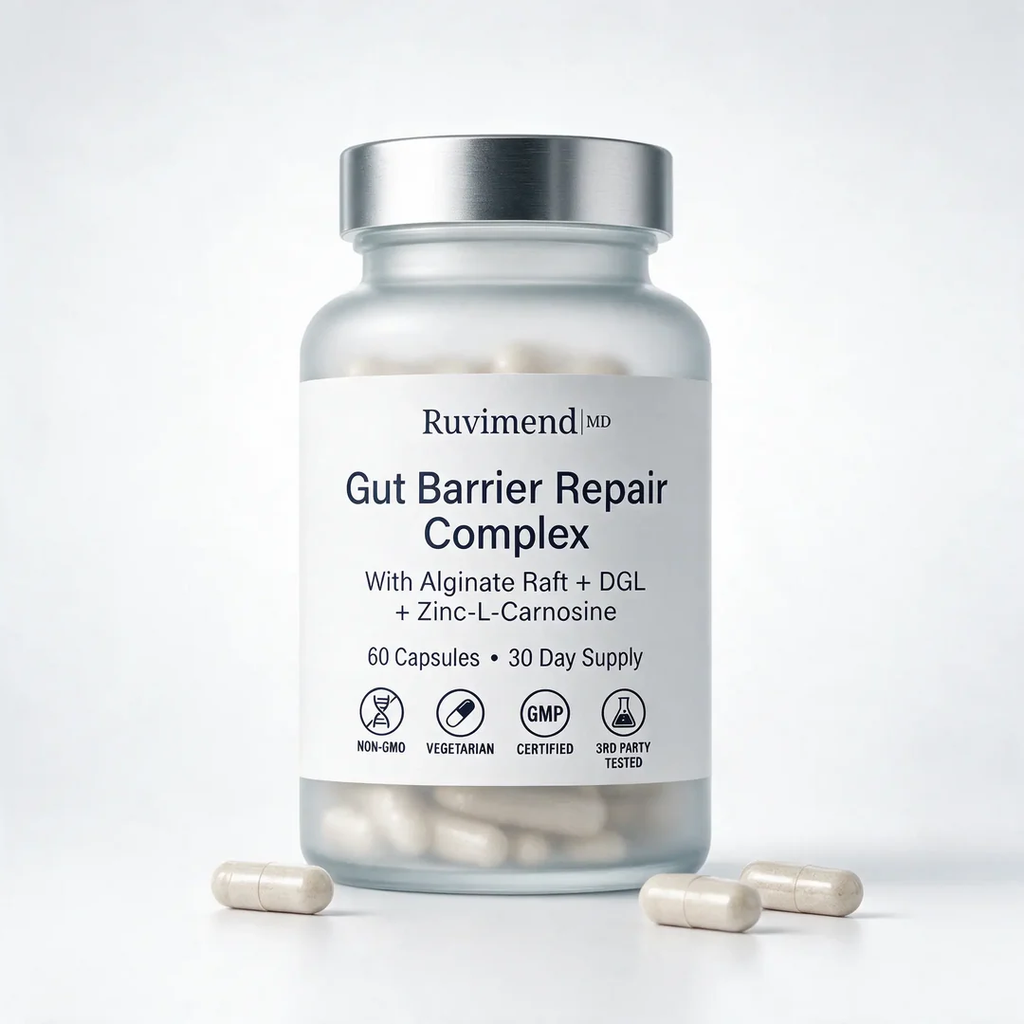
I came across RuvimendMD Gut Barrier Repair while looking into supplements marketed to people who are tired of dealing with heartburn, nighttime reflux and digestive discomfort. The product presents itself as more than another antacid: it claims to create a physical barrier against reflux while helping repair the gut lining and improve digestion. The formula includes a legitimate reflux-support ingredient, but I wanted to see whether the research actually supports the complete package being sold.
Key Takeaways
- RuvimendMD contains sodium alginate, an ingredient with research supporting its use in some reflux treatments. That does not prove this particular supplement works as advertised.
- The product contains six disclosed ingredients, including calcium carbonate, sodium bicarbonate, zinc-L-carnosine, DGL licorice and ginger extract.
- The company makes broad claims about gut-lining repair and long-term digestive improvement, but I could not verify clinical trials testing the finished RuvimendMD formula.
- Its pricing, branding and review information deserve scrutiny. The website uses both RuvimendMD and MendMD branding, and different pages display different prices and guarantee terms.
What Is RuvimendMD Gut Barrier Repair?
RuvimendMD Gut Barrier Repair, also described as Gut Barrier Repair – Reflux Relief, is a dietary supplement marketed for people experiencing heartburn, acid reflux and nighttime digestive discomfort. The product comes in vegetarian capsules, with the recommended serving listed as two capsules after the largest meal of the day.
The central selling point is its combination of a physical alginate barrier with ingredients intended to support the digestive lining and gastric motility. Rather than positioning the product simply as an acid neutralizer, the company says its formula addresses three areas: shielding the stomach’s acid pocket, supporting the gut lining and helping food move through the digestive system.
That is an appealing pitch, particularly for someone who has tried several products without finding lasting relief. However, the phrase “gut barrier repair” can sound like a proven treatment for a damaged intestinal lining, even though the product is primarily marketed for reflux. Those are not interchangeable claims, and the evidence for one ingredient does not automatically establish the effectiveness of the entire formula.
I Dug Deeper Into the Six Ingredients
The company provides the amount of each active ingredient rather than hiding them in a proprietary blend. That transparency is useful. Here is what the label lists per daily serving.
| Ingredient | Listed amount |
|---|---|
| Sodium alginate | 500 mg |
| Calcium carbonate | 150 mg |
| Sodium bicarbonate | 30 mg |
| Zinc-L-carnosine | 37.5 mg |
| DGL licorice | 80 mg |
| Ginger extract | 40 mg |
The ingredients are divided into three groups: a barrier to help reduce reflux, ingredients intended to support the digestive lining, and ginger extract for motility. The real question is whether the amounts and combination have been shown to deliver the outcomes promised on the sales page.
Sodium alginate: the strongest part of the formula
Sodium alginate is derived from seaweed and is used in some reflux products because it can form a gel-like raft above the stomach contents. This physical barrier may help reduce the movement of stomach contents back into the esophagus.
Unlike a product that relies solely on neutralizing existing stomach acid, an alginate formulation can work through a mechanical barrier. Research has found that some alginate-based treatments improve reflux symptoms compared with placebo or antacids. The National Center for Complementary and Integrative Health also acknowledges evidence that alginates may help control GERD symptoms.
This is the most credible part of RuvimendMD’s pitch. The important qualification is that research on alginate-based reflux treatments does not automatically validate every product containing sodium alginate. Formulation, dose, how the ingredients react together and how the product is taken all matter.
RuvimendMD lists 500 mg of sodium alginate per serving, but I could not verify a clinical trial establishing that this specific formula performs as well as the studied treatments it references.
Calcium carbonate and sodium bicarbonate
These two ingredients support the company’s proposed raft mechanism. Calcium carbonate can neutralize some stomach acid, while sodium bicarbonate can react with acid to produce carbon dioxide. In suitable alginate formulations, the resulting gas helps create a buoyant raft.
The mechanism is plausible, but the fact that ingredients can perform these functions individually does not establish how effectively this particular combination works in practice.
Zinc-L-carnosine and DGL licorice
Zinc-L-carnosine is studied for its potential role in protecting the stomach lining, while deglycyrrhizinated licorice, or DGL, is used in some digestive supplements with the aim of supporting the protective mucosal layer.
These ingredients give RuvimendMD a broader formulation than an alginate-only product. However, the company goes further by describing the formula as repairing the gut lining and restoring the digestive system over time.
I could not verify product-specific clinical evidence demonstrating that the listed amounts of zinc-L-carnosine and DGL in RuvimendMD produce those outcomes. Supporting a normal bodily function is also not the same as proving that a supplement repairs an established medical condition.
Ginger extract
Ginger has been studied for digestive symptoms, including nausea, and may influence gastrointestinal movement. RuvimendMD uses it as the motility component of the formula.
The company suggests that improving gastric motility helps reduce the pressure that pushes acid upward. That is a possible rationale, but it does not establish that 40 mg of this particular ginger extract meaningfully improves gastric emptying or reduces reflux in customers.
The label does not give enough information about the extract’s standardization to make a confident comparison with research using other preparations.
The Research Claims Need Context
RuvimendMD’s sales page refers to published research on alginate therapy, including a meta-analysis reporting better GERD symptom resolution than placebo and a comparison with omeprazole.
These references concern alginate-based treatments studied in clinical settings. They are not, by themselves, clinical trials of RuvimendMD. That distinction matters because a brand can use research on an ingredient or treatment category to explain why its formula might work, but it cannot fairly treat that research as proof that its own finished product has produced the same results.
I could not verify a published clinical trial specifically testing RuvimendMD Gut Barrier Repair and establishing its effectiveness, the claimed progression over several weeks, or the long-term gut-lining benefits described on its website.
The company also advertises third-party testing and GMP manufacturing. Those claims are worth checking, but I could not independently verify a public certificate of analysis for the finished product from the information reviewed. Even genuine third-party testing would primarily address specified quality measures, not prove that the supplement treats reflux or repairs the gut lining.
What I Found on the Website
The website is built around a persuasive problem-and-solution story. It tells readers that antacids only offer temporary relief, acid blockers do not address the physical movement of reflux, and restrictive diets cannot seal the reflux pathway. It then presents RuvimendMD as the missing piece.
There is a legitimate idea underneath that story: alginate formulations can help reduce reflux through a physical barrier. But the page turns that idea into a much broader argument that conventional treatments have failed to address the root cause and that this supplement provides a more complete solution.
That conclusion goes beyond what I could establish from the available evidence. Antacids, alginate products and acid-suppressing medicines work differently, and their usefulness depends on the person and the underlying problem. A supplement should not imply that someone should abandon an effective prescribed treatment simply because it offers a different mechanism.
I also noticed that the product’s branding is not entirely consistent. The current site uses RuvimendMD, while a product URL and the customer-support email retain the older MendMD name. That may reflect a rebrand, but the company does not make the relationship especially clear across every page I reviewed.
The Pricing Is Not as Straightforward as It Looks
The product pages display several different prices. One product page showed a single bottle for $39.99 on promotion, compared with a stated $69.99 reference price. Another displayed $49.99, while the collection page showed offers starting at $29.99.
Those differences may reflect different bundles, discounts or product-page variants. Still, I would not assume the highest crossed-out price is the product’s usual selling price or that every customer will receive the lowest advertised price. Before ordering, check the actual amount charged at checkout, shipping costs, the number of bottles included and whether the order is a one-time purchase or a subscription.
The site advertises free shipping on orders of two or more bottles. Buying multiple bottles may lower the unit price, but it also means spending more before you know whether the product suits you.
The 90-Day Guarantee: Read the Actual Terms
The current product page advertises a 90-day money-back guarantee and directs customers to contact support if the supplement does not work for them. However, older promotional material associated with the same branding refers to a 60-day guarantee. I could not establish from the pages reviewed whether every offer has the same terms or whether the guarantee has changed over time. That is worth resolving before purchasing.
Save the guarantee displayed at checkout and ask customer support to confirm the eligibility conditions, deadline, return procedure and whether shipping fees are refundable. Do not assume that a large guarantee headline automatically means every purchase qualifies for a full refund without restrictions.
What Do Customers Say?
The website displays positive testimonials describing better reflux control, more comfortable nights and improved confidence around meals. Those are encouraging anecdotes, but testimonials are not controlled clinical evidence. I also found a Ruvimend storefront on Shop with an overall rating of approximately 3.2 out of 5 across 53 reviews at the time of the search. That is a more mixed picture than the glowing testimonials highlighted on the product page.
The reviews available through the storefront cover a limited pool of customer experiences. They cannot establish how frequently the product works, whether reported improvements were caused by the supplement, or whether the product is effective for a particular diagnosis.
I would therefore treat both the positive testimonials and the mixed storefront rating as clues to investigate, not definitive proof for or against the formula.
Is RuvimendMD a Scam?
I would not call RuvimendMD a confirmed scam based on the evidence I found. The product has a published ingredient list, an identifiable website and stated customer-support details. Sodium alginate is also a legitimate ingredient used in some reflux treatments.
There are nevertheless several reasons to be cautious:
- The finished formula has not been independently demonstrated to work: I could not verify a published clinical trial testing RuvimendMD itself.
- The marketing extends beyond the clearest evidence: Research supporting alginate-based reflux treatments does not establish that this product repairs the gut lining or delivers every advertised long-term benefit.
- Prices vary across pages: The different advertised prices make it important to check the actual checkout total.
- Branding and guarantee terms are inconsistent: RuvimendMD and MendMD names both appear, and promotional material displays different guarantee periods.
- Independent reputation information is limited: The available customer-review data is relatively small and mixed, so it is difficult to draw strong conclusions about customer satisfaction or the reliability of the business.
These are reasons to investigate further, not proof that the product is counterfeit, unsafe or deliberately deceptive.
Is RuvimendMD Safe?
The company advises customers to consult a healthcare professional before combining the supplement with prescription medication. That is sensible advice, especially for people who take blood thinners, diabetes medication or medicines for reflux, or who have an existing medical condition.
The ingredients also deserve individual consideration. Calcium carbonate and sodium bicarbonate contribute minerals and sodium-containing compounds, which may matter for people with certain medical restrictions. Licorice preparations and ginger can have potential interactions or may not be appropriate for everyone. The term DGL refers to deglycyrrhizinated licorice, but that does not mean every possible risk disappears.
If you are already taking a proton pump inhibitor, such as omeprazole, do not stop or reduce it simply because a supplement claims to offer a more natural or more complete approach. Discuss any changes with your healthcare professional.
Persistent reflux, difficulty swallowing, unexplained weight loss, vomiting blood or black stools warrant medical attention rather than experimentation with supplements.
What Are the Alternatives?
If the main problem is heartburn or acid reflux, I would compare RuvimendMD with established options rather than automatically switching to another supplement with similar marketing.
- Alginate-based reflux products: Some formulations have clinical evidence for reducing reflux symptoms. Compare the active ingredients and directions on the actual label rather than assuming all alginate products are interchangeable.
- Antacids: These can provide short-term relief by neutralizing stomach acid. They are not intended to solve every cause of recurrent reflux.
- Acid-suppressing medication: H2 blockers and proton pump inhibitors can be appropriate for certain reflux symptoms. A healthcare professional can help determine whether one is suitable and how long it should be used.
- Lifestyle adjustments: Avoiding meals close to bedtime, identifying personal food triggers and elevating the head of the bed for nighttime reflux may help some people.
For frequent or persistent symptoms, it is worth establishing what is causing the problem instead of relying indefinitely on a product marketed as a complete digestive repair system.
Conclusion: Would I Recommend RuvimendMD?
My verdict is cautious, not a definite scam accusation. RuvimendMD has a more credible starting point than many supplements that rely entirely on vague promises about gut health. Sodium alginate has a plausible mechanism and evidence supporting some alginate-based reflux treatments. The formula also discloses the amounts of its six active ingredients.
But the brand’s broader claims about gut-lining repair, improved motility and a lasting return to normal digestion go further than the product-specific evidence I could verify. The pricing, mixed review information and inconsistent branding and guarantee details add reasons to pause before buying.
I would not spend money on a multi-bottle package based solely on the sales page. If I were considering this product for reflux, I would first compare it with established alginate-based options, verify the exact refund terms and ask the company for its independent product-testing documentation. I would also avoid treating it as a replacement for prescribed medication.
Bottom line: The central ingredient is legitimate, but the claims surrounding the complete product remain insufficiently verified. RuvimendMD may be worth investigating further, but I would not consider it a proven gut-barrier repair solution.
Also read – I Bought the Wood Ranger Power Leaf Blower for My Mum: Here’s Our Honest Review
[…] Also read – RuvimendMD Gut Barrier Repair Review: Does It Really Help Reflux? […]