

Delorien Recovery Foundation Capsules are marketed as an all-in-one supplement for women taking GLP-1 medications, promising to address hair loss, low energy, mood changes, digestive problems, poor sleep and even declining skin elasticity. But the closer I looked, the more questionable the presentation became.
The biggest issue isn’t that the ingredients are inherently suspicious. It’s that Delorien makes some very broad claims about what GLP-1 medications do to the body, advertises the capsules as “safe with all medications,” and appears to be selling an extremely similar formula to products already marketed under completely different brand names. So, is Delorien Recovery Foundation legit? Let’s take a closer look.
Key Takeaways
- Delorien Recovery Foundation contains 10 listed active ingredients, including saffron, L-theanine, myo-inositol, ginger, magnesium, zinc, copper, vitamins B12, C and D3.
- The product claims to reduce GLP-1-related hair shedding, restore energy and mood, improve digestion, support skin elasticity and promote better sleep.
- Some of the underlying nutritional concerns are legitimate. Research has linked GLP-1 therapy and rapid weight loss with inadequate intake of nutrients such as vitamin D, iron, calcium, zinc, magnesium, B12 and vitamin C.
- However, Delorien goes considerably further by implying that GLP-1 medications themselves cause the body to stop absorbing these nutrients and that its formula can simply “replace” what the medication takes away.
- Delorien’s website claims the formula is third-party tested, but I could not find an actual certificate of analysis or independent laboratory report attached to the product page.
- The website also says customers can “see exactly what’s in every capsule and how much,” yet the accessible product page does not provide the amounts for most of the active ingredients.
- A separate company, Zafira Organics, sells a Recovery Foundation with the same 10 active ingredients and the same 60-capsule/30-day format, with remarkably similar marketing claims and an almost identical formula.
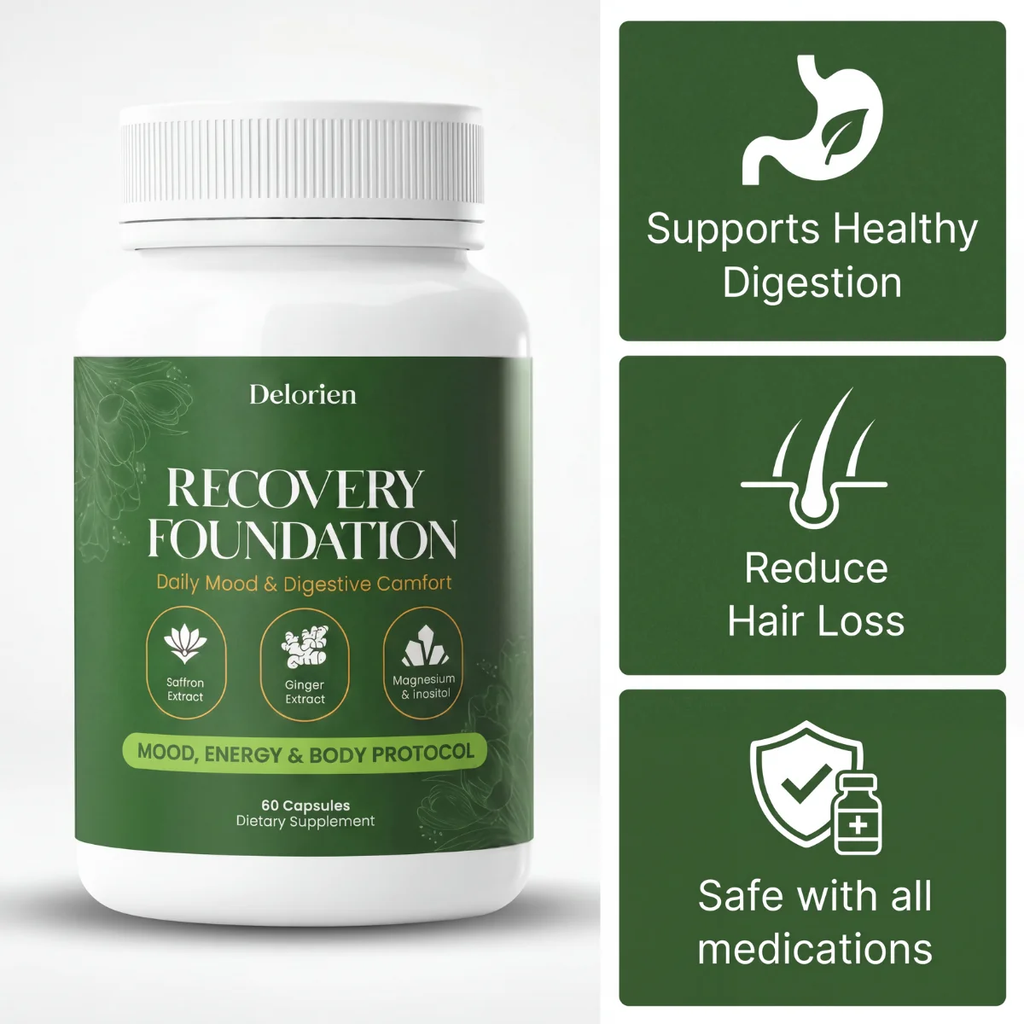
What Is Delorien Recovery Foundation?
Delorien Recovery Foundation is a 60-capsule dietary supplement designed primarily for women using GLP-1 medications such as Ozempic and Wegovy.
The company says two capsules a day can help reduce hair shedding, restore energy and mood, protect skin elasticity, calm nausea and bloating, and improve sleep. It also claims that GLP-1 medications change nutrient absorption and that Recovery Foundation supplies the vitamins, minerals and botanicals the body supposedly stops getting during rapid weight loss.
There is a legitimate nutritional issue underneath this marketing. GLP-1 medications can substantially reduce appetite and food intake, and recent reviews have identified potential nutritional concerns involving vitamin D, iron, calcium, magnesium, zinc, B12 and other nutrients. Rapid weight loss can also contribute to temporary hair shedding.
That does not mean every person taking a GLP-1 medication becomes deficient, however, and it certainly does not establish that a particular supplement can prevent or reverse all of these problems.
How It Claims to Work
Delorien’s theory is fairly simple: GLP-1 medications reduce appetite, people eat less, nutrient intake can fall, and the resulting deficiencies contribute to problems such as fatigue, hair shedding, poor mood and changes in skin.
The company then assigns different ingredients to different problems. Ginger is supposed to address nausea and digestive discomfort, magnesium and L-theanine are positioned around sleep and relaxation, zinc, copper, B12 and vitamin D3 are associated with hair and energy, while saffron and myo-inositol are used for mood and emotional wellbeing.
The basic nutritional concept isn’t ridiculous. The problem is the leap from “nutritional deficiencies can occur” to “this particular formula restores everything your GLP-1 medication took away.”
Those are two very different claims.
Reality vs. Claims
This is where I became much less comfortable with Delorien.
The website says GLP-1 medications cause the body to stop getting the nutrients it needs and claims Recovery Foundation “replaces what your body can no longer get from food alone.” It also says the formula will reduce hair shedding, restore energy, stabilize mood, protect skin and calm the stomach.
The current research is much more nuanced.
A 2026 review found meaningful nutritional concerns among GLP-1 users, but the authors specifically noted that much of the available evidence is observational and that causality cannot yet be definitively established. The authors recommend targeted nutritional assessment and individualized laboratory evaluation for people at increased risk rather than assuming everyone needs the same supplement.
The same distinction matters for hair loss. A 2026 systematic review found an association between some GLP-1 therapies, particularly semaglutide and tirzepatide, and hair loss, but rapid weight loss and nutritional deficiencies appear to be possible contributors. The evidence does not establish that taking a particular combination of vitamins and herbs will prevent or reverse GLP-1-related hair loss.
So there is a real problem being marketed here, but Delorien’s solution is presented with much more certainty than the evidence supports.
Let’s Look at the Listed Ingredients
Delorien says the formula contains 10 active ingredients: vitamin B12, vitamin C, vitamin D3, magnesium glycinate, zinc citrate, copper glycinate, myo-inositol, L-theanine, ginger extract and 4:1 saffron extract. The product is supposed to be taken as two capsules daily, with 60 capsules providing a 30-day supply.
The biggest problem is the dosage transparency. Delorien repeatedly says there are no proprietary blends and that customers can see exactly what is in each capsule and how much, yet the accessible product page gives an actual amount for vitamin D3 but does not provide the quantities for most of the other active ingredients.
That becomes particularly interesting when another company selling a product with the same “Recovery Foundation” name publishes a complete formula.
Zafira Organics lists 30 mg saffron extract, 200 mg L-theanine, 600 mg myo-inositol, 100 mg ginger extract, 50 mg magnesium, 10 mg zinc, 0.5 mg copper, 50 mcg vitamin B12, 50 mg vitamin C and 2,000 IU vitamin D3 per two capsules. It also sells the product in a 60-capsule, 30-serving bottle.
That is an extremely close match to what Delorien is selling.
I cannot prove from the available information that Delorien and Zafira use the same manufacturer, but the overlap is too substantial to ignore. It raises the possibility that this is a white-label or rebranded formula rather than a uniquely developed Delorien product.
Red Flags to Consider
The “Safe With All Medications” Claim
This is probably the most obvious problem visible in the image itself. The Delorien product image literally states “Safe with all medications.”
That is an extremely broad statement for a supplement containing multiple vitamins, minerals and botanicals. For example, the NIH’s Office of Dietary Supplements specifically notes that zinc can interact with quinolone and tetracycline antibiotics, penicillamine and certain diuretics. Magnesium can also interfere with the absorption of certain antibiotics and bisphosphonates and can interact with some diuretics and other medications.
Even Delorien’s own website tells customers to inform their prescribing doctor before adding the supplement to their routine.
So the website effectively says “safe with all medications” while simultaneously acknowledging that people should discuss the supplement with their doctor.
Those two messages do not sit comfortably together.
The Formula Appears Elsewhere
The strongest red flag isn’t an ingredient itself; it’s the apparent duplication. Zafira Organics sells a Recovery Foundation product with the same 10 active ingredients, the same 60-capsule format and virtually the same intended use for GLP-1 users. Its marketing also makes the same connections between saffron, L-theanine and myo-inositol and mood; ginger and nausea; and zinc, copper, B12 and vitamin D3 and hair and energy.
Another company, Nutri, sells a Recovery Foundation product with the same core formula as well, including saffron, L-theanine, myo-inositol, ginger, magnesium, zinc, copper, B12 and D3.
That doesn’t automatically make Delorien fraudulent. White-label supplements are a real part of the supplement industry.
But when a company presents a formula as its own specialized “foundation” for GLP-1 users, I would want considerably more transparency about who actually manufactures it, where it is manufactured, and whether the advertised testing applies to the finished product.
The Third-Party Testing Claim
Delorien repeatedly advertises the capsules as “third-party tested.” The problem is that I could not locate the actual laboratory report, certificate of analysis or testing company on the product page.
That’s important because “third-party tested” is a claim, not evidence by itself. A stronger presentation would identify the laboratory, testing date, batch number and the substances tested for, or provide the relevant report.
“Clinically Studied” Does Not Mean Clinically Proven
Delorien uses phrases such as “clinically studied ingredients” and repeatedly talks about clinically studied compounds. There is an important distinction here.
Individual ingredients can have human studies without the finished Delorien formula having been clinically tested. A study on saffron, for example, does not prove that Delorien’s particular saffron extract, in its particular dose and combination, produces the results advertised by the company.
I found no published clinical trial demonstrating that Delorien Recovery Foundation itself reduces GLP-1-related hair loss, restores mood, improves skin elasticity or produces the company’s advertised timeline of results.
The Website Has Some Very Aggressive Marketing
The product page says the product is “93% Sold,” warns about low stock, says it supposedly sold out 10 times the previous year and encourages customers to subscribe to avoid future stockouts.
The same page prominently promotes a 90-day guarantee.
This is not proof of a scam, but it is classic urgency-based supplement marketing, and it makes the lack of independent evidence more significant.
The Refund Policy Is Not as Simple as “90-Day Money Back”
This one really caught my attention.
The product page repeatedly advertises a 90-day money-back guarantee and even says customers can return their order for a full refund with “no questions asked.”
But the actual refund policy says something considerably different.
It states that supplements and wellness products are non-returnable and non-refundable once delivered, except in limited circumstances such as qualifying damage during shipping. It also says subscription renewal orders are non-refundable and that eligible returns can be subject to a $10 processing fee and return shipping costs.
That’s a substantial difference from the simple “90-Day Risk-Free Trial” message displayed on the sales page.
Delorien’s Store History Raises Questions
There is another unusual detail that has nothing specifically to do with the formula.
The Delorien website currently sells Recovery Foundation alongside products such as sleep patches, a luxury sleep mask and a silk pillowcase. Its bestsellers page still presents the business as a broader lifestyle store rather than a dedicated nutritional company.
Trustpilot is even more interesting. The company is currently flagged as having breached Trustpilot’s guidelines because of misleading use of Trustpilot content. The profile has five reviews, with four being one-star reviews, including complaints about refunds, customer service and alleged additional charges. Those complaints appear to concern the Delorien store and its older products rather than Recovery Foundation specifically, so I would not use them as proof that the supplement itself is fraudulent.
Third-party website checkers also have reservations about the domain, although these automated scores should be treated as warning signals rather than proof of wrongdoing. Scam Detector currently rates the domain 51.6/100 and describes it as questionable, while ScamAdviser has previously given it a very low trust score.
Efficacy
There is a reasonable supplement underneath all of this. Several of the nutrients in Recovery Foundation are genuinely important, and nutritional deficiencies can contribute to fatigue, hair shedding and other problems. Ginger also has some evidence for helping certain forms of nausea, although the quality and applicability of the research vary.
The problem is that Delorien takes a legitimate nutritional concern and packages it as a much more comprehensive solution than the evidence currently supports.
I would not expect these capsules to magically “restore” everything a GLP-1 medication supposedly took away, nor would I assume they can prevent hair loss or guarantee improvements in mood and skin.
More importantly, someone experiencing significant hair loss, fatigue or other symptoms while taking a GLP-1 medication may have an actual deficiency that needs to be identified rather than simply covered with a broad supplement. Recent clinical guidance specifically supports nutritional assessment and individualized evaluation for people at risk.
And because Delorien’s product is not the only Recovery Foundation formula on the market, I see little reason to pay a premium for a brand that has not clearly established what makes its version different.
Pricing and Where to Buy
Delorien sells Recovery Foundation through its own website, with each bottle containing 60 capsules and providing a 30-day supply. The accessible product page did not expose a reliable current dollar price in the page text I could verify, so I would not insert a guessed price here.
The company advertises free worldwide shipping and a 90-day guarantee, although, as noted above, the actual refund policy places significant restrictions on returns of supplement products.
What To Do If You Already Bought Delorien Recovery Foundation
If you have already purchased it, I would not panic. The ingredients themselves are not automatically dangerous simply because the marketing is questionable.
However, I would not rely on the “safe with all medications” claim. If you take prescription medication, particularly antibiotics, osteoporosis medication, diuretics or other drugs that may interact with minerals or supplements, check with a pharmacist or doctor before taking it.
I would also save screenshots of the original product page, the advertised 90-day guarantee, the checkout page and your order confirmation. Given the discrepancy between the sales-page guarantee and the detailed refund policy, having the original marketing saved could be useful if a refund dispute develops.
Conclusion
Delorien Recovery Foundation is not a product I would immediately label a fake supplement. The ingredients are real, several have legitimate nutritional or research interest, and the nutritional problems associated with rapid weight loss and GLP-1 therapy are not completely invented.
But the marketing is considerably more convincing than the evidence behind it. The biggest problems are the “safe with all medications” claim, the lack of readily verifiable finished-product clinical evidence, the unsupported certainty around GLP-1 nutrient absorption, the third-party testing claim without an easily accessible report, and the striking similarity between Delorien’s formula and Recovery Foundation products sold by other brands. Add the contradictory refund language and the site’s broader reputation issues, and there are simply too many unanswered questions for me to recommend buying it.
If you’re taking a GLP-1 medication and experiencing hair loss, fatigue, digestive problems or other symptoms, I’d rather see those issues evaluated individually than throw a catch-all supplement at them.
My conclusion: I would skip Delorien Recovery Foundation for now.
Also read – MemoFlow Memory Support Drops Scam Review: The Truth About the Memory Supplement