

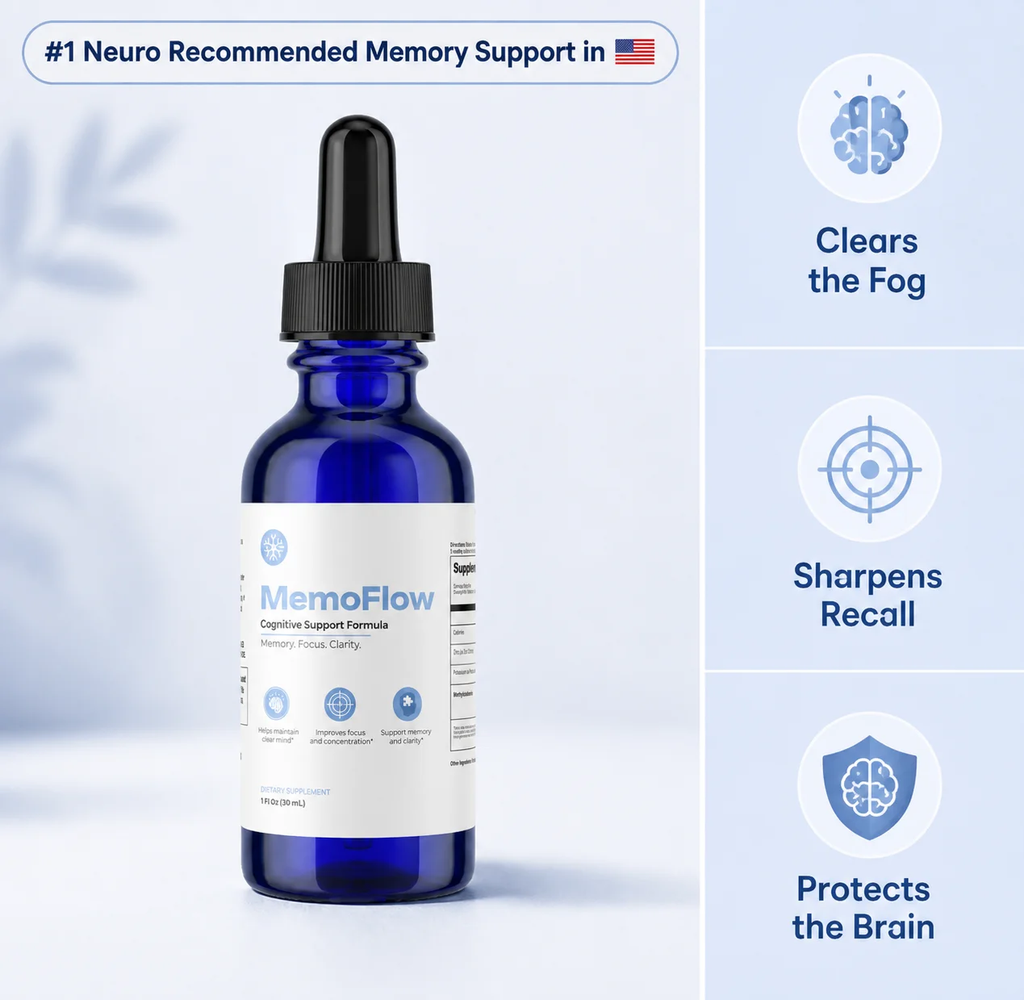
MemoFlow is marketed as a natural memory and brain-health supplement designed to improve recall, mental clarity, focus and brain fog. Its current sales page presents the product as a simple two-drop daily routine containing Ikarian mountain honey extract and lithium orotate.
But there are some pretty significant problems once you look beyond the polished sales page. The marketing makes unsupported claims about environmental toxins interfering with the brain’s ability to use glucose, the checkout process can take customers to a different company selling a different product, and the evidence for lithium orotate as a cognitive supplement is far from established. So, is MemoFlow legit? Let’s take a closer look.
Key Takeaways
- MemoFlow is sold as sublingual memory-support drops containing Ikarian honey-derived anthocyanins and lithium orotate.
- The company claims the formula can support memory, focus, word recall and mental clarity, with some results supposedly appearing within 1–4 weeks.
- Its explanation that everyday heavy-metal exposure interferes with the brain’s ability to use glucose is presented as the basis for the product, but the website does not provide clinical evidence that MemoFlow reverses this process.
- The product contains lithium orotate, which deserves more scrutiny than the “natural” marketing suggests.
- Recent research says clinical trials are still needed to establish the safety and effectiveness of low-dose lithium supplements for cognition.
- The advertised MemoFlow storefront can redirect customers to a Mediterra checkout where the product displayed may be Oil of Oregano rather than MemoFlow.
- The checkout has also been reported to include a Wellness Club offer with a $197 annual renewal, creating an additional billing concern.
- The MemoFlow site claims more than 12,000 customers while separately displaying only 193 customer reviews, making the enormous headline review figure difficult to independently verify.
- There is no published clinical trial demonstrating that the finished MemoFlow product improves memory or prevents cognitive decline.
What Is MemoFlow?
MemoFlow is a dietary supplement sold as liquid drops taken under the tongue. The current website recommends two full drops once a day and says the formula is intended for adults over 45 who want everyday memory, focus and mental-clarity support.
The formula is presented as a two-part system: anthocyanins from what the company calls wild Ikarian mountain honey, plus lithium orotate supposedly sourced from Ikarian spring water. The company also promotes something called Neural MicroLock, which it describes as a proprietary micromilling process designed to improve sublingual absorption.
That sounds impressively scientific, but the important question is whether the finished product has actually been demonstrated to produce the results being advertised.
It hasn’t.
How MemoFlow Claims to Work
The sales pitch is built around the idea that your brain needs glucose for fuel and that everyday exposure to trace heavy metals from water, food and air can interfere with the ability of neurons to use that fuel efficiently.
According to MemoFlow, the anthocyanins are supposed to support the body’s natural clearance pathways, while lithium orotate provides “neuroprotective” support. The two ingredients are then presented as a way of getting the brain’s fuel system working properly again.
The problem is that this is an elaborate biological explanation for a product that has not been clinically tested as a finished formula.
There is a big difference between describing a plausible biological mechanism and demonstrating that taking two drops of MemoFlow actually improves memory in humans.
The Lithium Orotate Issue
This is probably the ingredient I would pay the most attention to.
MemoFlow repeatedly describes its lithium orotate as a naturally sourced ingredient and emphasizes that it is different from the high-dose lithium used medically. But lithium is still lithium, and “natural” does not automatically mean irrelevant from a safety standpoint.
Research on lithium orotate is still limited. A 2026 paper in the British Journal of Psychiatry noted that claims about lithium orotate’s advantages require further scrutiny and argued that more research is needed before the compound can be confidently positioned as a superior form of lithium.
Another recent study examining people’s experiences with over-the-counter lithium supplements found that participants reported perceived cognitive and mood benefits, but the researchers specifically concluded that clinical trials are needed to clarify safety and efficacy.
So I would not treat MemoFlow’s lithium claims as established science.
Let’s Look at the Listed Ingredients
The current formula is surprisingly simple: Ikarian mountain honey extract containing anthocyanins and lithium orotate, delivered through the company’s proprietary Neural MicroLock process. The exact amounts of the two active ingredients are not clearly presented on the main sales page.
That lack of dosing information matters particularly because lithium is involved. Other lithium-orotate supplements listed in the NIH Dietary Supplement Label Database disclose their elemental lithium content and include warnings concerning kidney problems, thyroid conditions, certain medications and other medical circumstances.
MemoFlow tells consumers to consult a doctor if they take prescription medication or have a medical condition, but the sales page’s “natural” presentation can make the lithium component sound considerably less consequential than it actually is.
What About the Ikarian Honey?
There is a real scientific basis for studying honey from Ikaria. Researchers have chemically characterized authentic Ikaria heather honey and identified numerous phenolic compounds, flavonoids and other secondary metabolites. So the existence of distinctive compounds in Ikarian honey isn’t something I would dismiss as completely fabricated.
What I cannot establish is the much bigger claim MemoFlow makes about its honey extract. The company says the anthocyanins support the body’s clearance of everyday toxins and form one half of a system designed to improve brain fuel utilization. The scientific paper on Ikaria honey, however, was a chemical characterization study. It did not demonstrate that an Ikarian honey extract improves human memory or clears heavy metals from the brain.
That’s an important distinction. Finding interesting compounds in a food is not the same thing as proving that a concentrated extract of that food can produce a particular therapeutic effect.
Red Flags to Consider
The Checkout Doesn’t Match the Product
This is the biggest practical red flag I found. A recent investigation of the MemoFlow funnel reported that clicking the purchase link from the advertised storefront redirected the customer to a Mediterra-branded checkout, where the displayed product was an Oil of Oregano pouch rather than MemoFlow. The same checkout reportedly promoted a Wellness Club trial with a $197 annual renewal. citeturn1search1
That is not a minor cosmetic difference. If I click “buy MemoFlow” and arrive at a checkout displaying another supplement, I should not have to figure out whether I am purchasing the product I originally selected.
The same investigation also found that the seller identity, support information and refund contacts varied between the MemoFlow storefront and the Mediterra checkout.
The Huge Review Count
The MemoFlow sales page prominently claims a 4.8 rating and 12,000+ reviews/customers, while the page’s detailed customer-review section displays 193 reviews.
Those numbers may refer to different things, but the distinction isn’t clearly explained. More importantly, these are testimonials displayed by the seller. They are not equivalent to an independently conducted clinical trial or an independent review database.
The website also presents highly specific success stories: people supposedly noticing clearer mornings in two weeks, improved word recall around week three and substantially better conversational memory by week eight. Those are marketing testimonials, not controlled evidence.
The “Heavy Metals Block Brain Fuel” Explanation
MemoFlow’s entire mechanism is built around a story that everyday environmental exposure to trace heavy metals interferes with neuronal fuel utilization.
The sales page then positions its honey extract as helping clear those toxins and its lithium orotate as protecting the brain. That’s a very convenient explanation because it gives the product something dramatic to “fix.”
But the website does not provide clinical evidence demonstrating that ordinary consumers taking MemoFlow have this supposed problem, nor that two drops of the product reverse it.
A complicated biological story should not be mistaken for clinical proof.
The “Neural MicroLock” Claim
MemoFlow says its proprietary micromilling process makes the active compounds dramatically smaller and allows them to be absorbed directly under the tongue.
That sounds impressive, but I could not find published clinical evidence showing that Neural MicroLock specifically improves MemoFlow’s effectiveness compared with an ordinary supplement containing the same ingredients.
Calling something a proprietary delivery technology does not establish that the technology actually improves cognitive outcomes.
The Company Identity Is Not Straightforward
The MemoFlow site identifies itself as an independent marketing website and says it receives compensation when a purchase is made through its links. It also states that the site is operated by Dollarize Marketing LTDA in Brazil, while claiming that the product itself is made in the USA.
Meanwhile, the recent checkout investigation identified Mediterra as the payment/checkout identity. There may be legitimate business relationships between these entities, but the buyer should not have to piece them together from separate pages.
Efficacy
This is where MemoFlow falls apart for me. There is legitimate scientific interest in low-dose lithium and in the antioxidant compounds found in various foods, including honey. But there is currently not enough human evidence to conclude that MemoFlow’s particular combination of Ikarian honey extract and lithium orotate improves memory.
A recent review of lithium supplementation found that clinical evidence for cognitive and neuropsychiatric effects remains limited, while a 2026 paper specifically called for more research into lithium orotate’s pharmacology and potential benefits.
The same problem applies to the product as a whole: I found no published randomized clinical trial demonstrating that MemoFlow itself produces the improvements claimed on its sales page.
The testimonials may sound convincing, but they don’t substitute for that evidence.
Is MemoFlow a Scam?
I would be careful about saying that every MemoFlow bottle is fake. There appears to be a real supplement being sold under the MemoFlow name, and the company provides an ingredient description, usage instructions and a refund policy.
The bigger concern is the sales funnel and the claims surrounding the product.
A customer can start on a MemoFlow page and end up at a different company’s checkout displaying a different product. There are conflicting identities and support details, additional membership language and a substantial gap between the product’s confident marketing claims and the available clinical evidence.
That’s enough for me to recommend staying away from the current offer.
Pricing and Where to Buy
MemoFlow’s promotional pricing changes depending on the package. The current sales page advertises a “Buy Two, Get One Free” offer and discounts of up to 70%, along with a 90-day money-back guarantee.
However, because the checkout process has reportedly redirected customers into a separate Mediterra offer, I would not rely on the advertised bottle price alone. The more important number is the final amount that appears immediately before payment, along with any recurring membership or delivery terms.
If the checkout page shows a different product, stop there.
What To Do If You Already Bought MemoFlow
If you purchased MemoFlow, save screenshots of the exact advertisement and checkout page that convinced you to buy it.
Keep the order confirmation, payment receipt, product name, quantity, final amount and any information about recurring deliveries or memberships. If your confirmation says MemoFlow but your package contains another product, photograph the package and its contents before opening or using it.
If you discover a recurring membership or charge you did not knowingly authorize, contact the seller and your payment provider promptly.
And because MemoFlow contains lithium orotate, I would not casually combine it with other lithium-containing products or assume that “natural” means there are no medication or health considerations. People with kidney or thyroid problems and those taking certain medications should discuss lithium supplementation with a healthcare professional.
Conclusion
MemoFlow initially looks like a fairly polished memory supplement: two drops a day, a 90-day guarantee, an interesting Ikarian honey story and a supposedly innovative delivery system.
The closer look is much less convincing. The product’s explanation about environmental toxins interfering with brain fuel is presented with far more confidence than the available clinical evidence supports. The finished MemoFlow formula has not been clinically demonstrated to improve memory, while the lithium orotate it contains is an ingredient that deserves genuine attention rather than being waved away as simply “natural.”
Then there is the purchasing problem.
My investigation found that the MemoFlow sales funnel could redirect buyers to a Mediterra checkout displaying Oil of Oregano instead of MemoFlow, alongside a Wellness Club offer carrying a reported $197 annual renewal. That is the part I find hardest to overlook.
I would not recommend MemoFlow based on the current sales funnel. The product may exist, but the combination of unsupported cognitive claims, unclear evidence, lithium supplementation, inconsistent seller identities and a checkout that reportedly doesn’t always match the advertised product creates far too many questions for a memory supplement.
If someone is experiencing genuine or worsening memory problems, I would also be particularly wary of any advertisement suggesting that a couple of drops can fix the problem. Memory changes can have many causes, and a supplement sales funnel is not a substitute for finding out what is actually going on.
Also read – Is Play.lacewin.com a Legit Crypto Scam? Read This Before Signing Up