

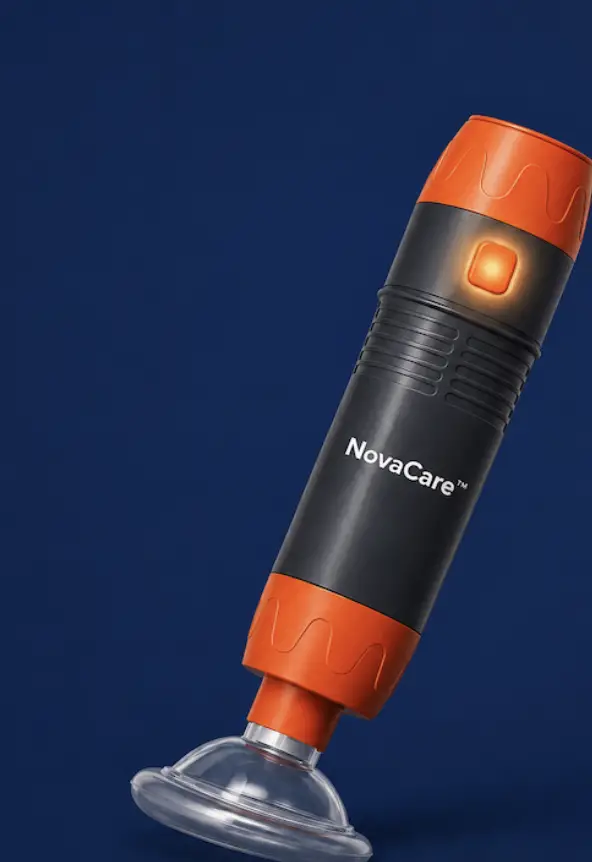
NovaCare’s One-Button Anti-Choking Device is marketed as an emergency suction device that can remove an object blocking someone’s airway with a single press. The company presents it as an easy backup for parents, seniors and people who may be alone during a choking emergency.
But this is one product where the usual supplement-style red flags aren’t enough. NovaCare is selling a device that could literally be used in a life-or-death situation, yet its regulatory claims are easy to misunderstand, its website is very new, and I couldn’t verify the product as the FDA-authorized anti-choking device. So, is NovaCare legit? Let’s take a closer look.
Key Takeaways
- NovaCare sells a suction-based anti-choking device with adult and child masks.
- NovaCare says its device is FDA registered, but FDA registration is not the same as FDA authorization or approval.
- The FDA says established choking protocols should remain the first response, with suction devices used only in appropriate circumstances.
- The FDA’s March 2026 authorization for an anti-choking device was for LifeVac, not NovaCare.
- I would not rely on NovaCare as my primary choking-rescue method, and I would be cautious about buying it until its regulatory status can be independently verified.
What Is the NovaCare Anti-Choking Device?
NovaCare is a handheld, non-powered suction device designed to create a seal around the mouth and nose and pull an airway obstruction outward. The company advertises a one-button design and includes separate adult and child masks. Its main selling point is simplicity: place the mask, press the button and allow the suction mechanism to work.
The company also repeatedly describes NovaCare as suitable for adults, children and seniors and says it can be used without formal training. That makes the product sound like an appealing emergency backup, particularly for parents and people who worry about freezing during a choking incident.
There is nothing inherently suspicious about the concept itself. Suction-based anti-choking devices are a real category of medical device. The problem is whether this particular device has the regulatory authorization, evidence and reliability that its marketing suggests.
How It Claims to Work
The principle is relatively simple. The mask is placed over the victim’s mouth and nose to create a seal, and the device generates negative pressure intended to pull the obstruction out through the mouth.
NovaCare markets this as a one-button system and says it does not require strength or training. Its own educational material describes suction devices as second-line tools to be used after traditional choking-rescue methods have failed.
That last part is important because the company’s advertising can make the device sound almost like an alternative to conventional choking first aid. It isn’t.
The FDA currently tells consumers to follow established choking-rescue protocols, including back blows and abdominal or chest thrusts, and says the established protocols remain the most effective method for relieving airway obstruction.
Reality vs. Claims
This is where I became much more cautious.
The NovaCare website says the device is an “FDA Class I registered medical device” and gives a registration number. Its regulatory page also explicitly says that FDA registration and listing does not mean FDA approval, clearance, authorization or endorsement.
That disclaimer is actually important because “FDA registered” sounds much more impressive in an advertisement than it really is. The FDA itself has addressed this exact issue. In March 2026, the agency said that some anti-choking manufacturers had registered their establishments and listed their devices with the FDA even though registration and listing did not mean the devices had been authorised. The FDA specifically said that, as of March 4, 2026, it had authorised one anti-choking device for U.S. marketing: LifeVac.
The FDA’s database identifies that authorized device as LifeVac under a De Novo classification for a suction anti-choking device intended as a second-line treatment.
I could not find a comparable FDA De Novo authorization for NovaCare. That doesn’t automatically mean NovaCare is fake. It does mean I would not read the words “FDA registered” on the NovaCare website as proof that the device has been FDA-authorized.
Let’s Look at the Device Claims
NovaCare’s central claims are that the device:
- Uses one-button operation.
- Can be used for adults and children.
- Requires no formal training.
- Uses suction to remove airway obstructions.
- Can be kept ready for emergencies.
- Is manufactured under FDA-registered arrangements.
The basic mechanical concept is plausible, but the question isn’t whether suction can theoretically move an obstruction. The question is whether this particular device has been adequately evaluated and authorized for the claims being made about it.
That distinction matters enormously when we’re talking about someone’s airway.
Red Flags to Consider
“FDA Registered” Is Doing a Lot of Work
This is the biggest issue. NovaCare’s website prominently discusses FDA registration, but its own regulatory notice acknowledges that registration is not FDA approval, clearance or authorisation.
The FDA independently makes the same distinction. A manufacturer can register a facility and list a device in the FDA database without the FDA having determined that the device is safe and effective or authorized it for marketing. So if someone sees “FDA registered” and assumes that means “FDA-approved choking device,” that would be the wrong conclusion.
LifeVac Is the FDA-Authorized Device
This is particularly important because there is now a direct comparison. On March 4, 2026, the FDA granted a De Novo authorization to LifeVac for a suction anti-choking device intended as a second-line treatment after an established choking protocol has been unsuccessful.
That does not mean LifeVac is guaranteed to save someone. It means the FDA has actually created and authorized that device category for that specific use.
NovaCare’s website, meanwhile, talks about FDA registration and listing rather than providing evidence of an equivalent FDA authorization. For a product intended for an emergency, that distinction would be enough for me to stop and investigate before buying.
The Website Is Very New
The NovaCare website’s domain was registered in January 2026, according to a recent independent website assessment.
A new domain isn’t proof of fraud. Plenty of legitimate businesses launch new websites. But this isn’t a phone case or a skincare product. This is an emergency medical device. I would expect a much stronger trail of regulatory documentation, manufacturer information and independent evidence before trusting it with something as serious as airway obstruction.
The Company Information Isn’t Completely Consistent
There are also inconsistencies in the company’s own documentation. One NovaCare regulatory page identifies NovaCare Medical LLC in Wilmington, Delaware as the distributor. The terms and conditions identify Top C Group LLC in Wilmington as the authorized distributor.
The terms identify the manufacturer as Yiwu Medical Pro Products Co., Ltd. in China, while the homepage prominently markets the device as “Engineered in Germany.” None of these things individually proves wrongdoing, but together they make the corporate and manufacturing story harder to follow than I would like.
The Reviews Are Not Proof of Performance
NovaCare currently displays hundreds of reviews directly on its website, with a very high average rating. There are also positive reviews on Trustpilot. There are positive experiences there, including customers saying the device arrived and appeared easy to use.
But customer reviews cannot establish that a choking device reliably clears real airway obstructions under emergency conditions. Someone saying the suction felt strong during a home test is not equivalent to a controlled clinical or regulatory evaluation.
And there are negative customer reports too. One Trustpilot reviewer alleged that a package was delivered to the wrong location and that the company refused a refund or replacement. NovaCare disputed that account and said the carrier’s delivery evidence was reviewed by a third party.
That dispute is mainly a customer-service issue, but it does show why I wouldn’t use the glowing reviews as my primary reason for trusting the product.
Does It Actually Work?
This is the part where I have to be especially careful. Suction-based airway-clearance devices can work in certain circumstances. The FDA’s authorization of LifeVac establishes that this type of device can be legitimately marketed as a second-line choking intervention when used according to its authorized indication.
But that does not automatically validate every suction device sold online. For NovaCare specifically, I could not establish the same level of FDA authorization from the information publicly presented by the company. The website relies heavily on its registration claim and seller-provided testimonials rather than giving me the kind of independent evidence I would want before recommending an emergency device.
And the FDA’s own guidance is very clear: established choking protocols should come first.
For a conscious adult or child with a complete airway obstruction, the Red Cross recommends cycles of five back blows followed by five abdominal thrusts, with modifications for infants and certain other situations. If the person becomes unresponsive, CPR should begin according to the rescuer’s training.
So I would never want someone to freeze because they are searching for a NovaCare device instead of immediately starting appropriate choking first aid and calling emergency services.
Pricing and Where to Buy
NovaCare’s current website has advertised the one-button device around the $60 range, although pricing and promotions can change. The company also sells replacement masks and other emergency products.
There is a 90-day money-back guarantee displayed on the product page, but because this is an emergency-use product, I wouldn’t make a purchase decision based primarily on the guarantee. Getting your money back after a failed choking device doesn’t undo the potential consequences of relying on it during an emergency.
What To Do If You Already Bought It
If you already purchased NovaCare, keep the receipt, order confirmation, packaging and all documentation that came with the device. Most importantly, learn standard choking first aid anyway. Don’t treat the device as a replacement for knowing how to perform back blows, abdominal thrusts, chest thrusts where appropriate and CPR.
The NovaCare website itself says not to delay emergency services and to follow established rescue protocols. That is good advice.
If an actual choking emergency occurs, call your local emergency number immediately and follow the emergency dispatcher’s instructions. Use any additional device only in accordance with its verified instructions and regulatory indication.
Conclusion
NovaCare is a real product being sold through a functioning online storefront, so I wouldn’t simply call it a fake product or a classic “you pay and nothing arrives” scam.
But I would absolutely question the way its regulatory status is presented. NovaCare says it is an FDA-registered Class I medical device, while the FDA explicitly warns that registration and listing do not equal authorization. Meanwhile, the FDA’s March 2026 De Novo authorization for a suction anti-choking device went to LifeVac, and I could not verify an equivalent FDA authorization for NovaCare.
The company also has a very new website, inconsistent corporate information and a heavy reliance on its own reviews and certifications.
My conclusion: I would not make NovaCare my primary anti-choking solution. If I wanted a suction device as a backup, I would choose one whose exact regulatory authorization and manufacturer information I could independently verify. Regardless of which device is in the house, I would still learn established choking-rescue techniques because a suction device should never become an excuse to delay proven first-line care.
Also read – Noefux.com Review: Fake or Legit Crypto Exchange Site? Find Out