

CardioClear7 is marketed as a daily heart-health supplement designed to support cardiovascular health, cellular energy and circulation. The formula is built around three ingredients: CoQ10, PQQ and shilajit, which are supposed to work together to support the mitochondria and keep the heart producing energy efficiently.
The ingredients themselves aren’t what immediately bothered me. CoQ10, in particular, has been studied for cardiovascular health. The bigger question is whether those studies actually prove that CardioClear7 can do everything the marketing suggests. I also found some inconsistencies around the product’s marketing and some customer complaints about the company selling it. So, is CardioClear7 legit? Let’s take a closer look.
Key Takeaways
- CardioClear7 contains CoQ10, PQQ and shilajit and is taken as one capsule per day.
- CoQ10 has legitimate human research behind it, including studies involving heart failure and blood pressure, but that doesn’t prove CardioClear7 itself works.
- PQQ has much weaker human evidence, and one small trial using 20 mg/day did not improve aerobic performance.
- The exact amount of PQQ and shilajit is not clearly disclosed on the product page, which makes it difficult to compare the formula with clinical research.
- I wouldn’t call CardioClear7 a fake product, but I would be very cautious about treating it as a proven heart-health solution.
What Is CardioClear7?
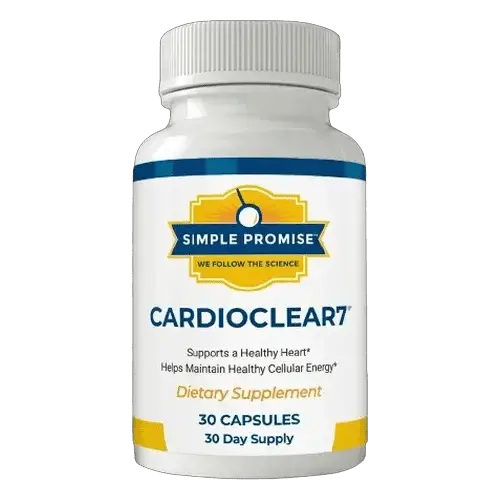
CardioClear7 is a dietary supplement sold by Simple Promise. It comes in a bottle containing 30 capsules, with the recommended serving being one capsule per day. The current product page lists CoQ10, shilajit extract and PQQ disodium salt as the three active ingredients. The company says the formula is designed around cellular energy and mitochondrial function, particularly because the heart has a high demand for energy. It also markets CardioClear7 toward adults who want to support their heart as they age.
The company advertises CardioClear7 as being manufactured in the USA, suitable for vegans and vegetarians, and third-party tested. It also offers a 365-day money-back guarantee.
Why I Looked Into CardioClear7
The mitochondrial angle was what made me look twice. It’s not complete nonsense. Mitochondria really are responsible for producing much of the energy cells use, and the heart is obviously one of the body’s most energy-demanding organs.
CoQ10 also isn’t some random ingredient that was invented for a supplement advertisement. It has been studied for decades, particularly in cardiovascular disease and heart failure. But this is where I always slow down.
An ingredient having legitimate research behind it doesn’t automatically mean a supplement containing that ingredient will produce the same results. That’s exactly what I wanted to figure out with CardioClear7.
What Does the Science Say?
This is where CardioClear7 gets more interesting. CoQ10 has actually been studied in cardiovascular disease. A 2022 systematic review of 14 studies involving 1,067 participants found that CoQ10 supplementation in people with cardiovascular disease improved some measures of functional capacity and was associated with fewer major adverse cardiovascular events, although the researchers emphasised that the evidence should still be interpreted cautiously.
A 2023 overview of systematic reviews and meta-analyses also found possible benefits of CoQ10 in heart failure, including improvements in some measures of cardiac function and reductions in hospitalisations and mortality in some analyses, although the authors said more research was needed.
There is also evidence around blood pressure. A 2025 meta-analysis covering 45 randomised controlled trials found that CoQ10 reduced systolic blood pressure by about 3.4 mmHg overall, although it did not significantly affect diastolic blood pressure or heart rate.
So yes, CoQ10 has something going for it. But that still doesn’t prove CardioClear7 is going to lower your cholesterol, clear your arteries or prevent a heart attack. That’s a much bigger claim.
What About PQQ?
PQQ is where the evidence gets thinner. PQQ is associated with mitochondrial function and has attracted interest because of its potential role in mitochondrial biogenesis. That sounds impressive, and it makes for excellent supplement marketing. But human evidence is still limited.
One randomised trial involving 23 untrained men gave participants 20 mg of PQQ per day during six weeks of endurance training. The researchers found no significant difference between the PQQ and placebo groups in aerobic performance.
That doesn’t prove PQQ is useless. It does mean I wouldn’t take the word “mitochondrial” and automatically translate it into “more energy and a healthier heart.” We’re not there yet.
And Then There’s Shilajit
Shilajit is another interesting ingredient, but it is also one I approach cautiously because the quality of shilajit products can vary considerably depending on sourcing and purification.
CardioClear7 says shilajit is included because its fulvic acid content may help improve the efficiency or bioavailability of CoQ10. The product page cites a Life Extension article discussing research on the combination. That’s an interesting concept, but again, it doesn’t establish that CardioClear7 itself improves cardiovascular health.
And because the exact shilajit dosage isn’t clearly shown on the main product page, I can’t tell whether the amount in CardioClear7 matches the amounts used in any meaningful human research. That’s a recurring problem with this product.
The Dosage Information Is More Important Than It Looks
This is probably my biggest formula complaint. The company tells me what is in CardioClear7, but not everything I need to know about how much I’m getting. If I’m evaluating a supplement scientifically, I need to know the dose.
For example, CoQ10 research has often used doses around 100 to 200 mg per day, and a 2022 dose-response meta-analysis found that 100 to 200 mg/day was associated with the greatest reduction in systolic blood pressure among the doses studied in people with cardiometabolic disorders.
If CardioClear7 provides 100 mg of CoQ10, that’s useful information. But I still need the same transparency for PQQ and shilajit. Without it, I can’t properly compare the entire formula with the research.
Does CardioClear7 Clear Blocked Arteries?
This is where I’d draw a very firm line. No, I didn’t find evidence showing that CardioClear7 can literally clear plaque from blocked arteries.
Some of the broader CardioClear7 marketing uses language about maintaining clear arteries and supporting circulation. But atherosclerotic plaque isn’t something a supplement simply “flushes” away like dirt from a pipe.
The research on CoQ10 is much more nuanced. It’s about things such as cellular energy, oxidative stress, blood pressure and certain cardiovascular outcomes.
That’s very different from reversing established atherosclerosis. So if somebody is buying CardioClear7 because they have diagnosed artery disease and think the capsules will physically clean out their arteries, I would absolutely not rely on that.
The “Clinically Studied” Argument Needs Some Context
CardioClear7’s marketing leans heavily on the research behind its ingredients. That’s fair to a point. But I noticed the company also uses phrases such as “clinically inspired” and talks about research involving the combination of CoQ10 and shilajit.
The important question is whether CardioClear7 itself has been clinically tested. I couldn’t find a randomized controlled trial of the finished CardioClear7 product.
That’s a major distinction. The research I found was on CoQ10, PQQ or shilajit separately, or on particular combinations. None of that is equivalent to testing this exact capsule.
There Are Also Multiple CardioClear7 Websites
This is another thing that made me look twice. The main product is associated with cardioclear7.com and Simple Promise, but there are several other CardioClear7 domains online using the same name and making considerably stronger claims.
For example, one CardioClear7 site says the supplement can prevent plaque buildup, lower blood pressure, strengthen the immune system and even reduce cancer risk.
I would not treat those claims as established evidence for the product. They go far beyond what I could verify from the scientific literature. This is one reason I would stick to the actual Simple Promise product page rather than assuming every website using the CardioClear7 name is legitimate.
What About the 365-Day Guarantee?
The guarantee sounds extremely reassuring. The company says customers have 365 days to request a refund and that even empty bottles can be returned. That’s generous on paper, but a guarantee isn’t evidence that the supplement works.
And I wouldn’t ignore the company’s broader customer-service history either. Trustpilot contains both positive CardioClear7 feedback and complaints about Simple Promise’s billing and shipping practices involving other products. One reviewer specifically reported receiving additional bottles and being charged more than expected, while another CardioClear7 customer said they had a positive experience and received a refund on another purchase.
So the feedback isn’t uniformly negative. I just wouldn’t use the guarantee as a reason to assume there is no purchasing risk.
Is CardioClear7 Effective?
There is enough science here for me to say the formula is plausible. CoQ10 has legitimate cardiovascular research behind it. PQQ has a biologically interesting role, although the human evidence is much thinner. Shilajit has some research of its own, but product quality and dosing matter.
The problem is that I don’t have evidence showing that these three ingredients, in the exact amounts and form used in CardioClear7, produce the cardiovascular benefits being marketed.
So I wouldn’t call CardioClear7 clinically proven. I’d call it a supplement built around some legitimate ingredients with a much bigger marketing story attached to them.
Is CardioClear7 a Scam?
I wouldn’t call the product itself a scam. There’s a real product, a disclosed formula, an identifiable company and ingredients that aren’t simply made-up buzzwords. The research behind CoQ10 is particularly legitimate. What I do have a problem with is the potential for the marketing to make people believe they’re buying something that can do much more than the evidence supports.
Claims about clearing arteries, dramatically improving cardiovascular function or preventing serious disease need considerably more evidence than this product has.
So for me, this isn’t a “fake bottle full of nothing” situation. It’s more of a real supplement with overextended expectations situation.
Pricing and Where to Buy
The CardioClear7 sales page has advertised $59 for one bottle, with lower per-bottle prices when buying three or six bottles. The current product page also advertises free U.S. shipping and the 365-day guarantee.
I wouldn’t immediately buy six bottles just because the price per bottle drops. If I were determined to try it, I’d start with one bottle and see whether I actually wanted to continue.
Who Might Like CardioClear7?
I could see CardioClear7 appealing to someone who specifically wants a simple CoQ10-based supplement and likes having PQQ and shilajit included in the same capsule.
The formula is also refreshingly short compared with those supplements that throw 15 or 20 ingredients into a proprietary blend.
Who Should Skip It?
I’d skip it if you’re expecting CardioClear7 to reverse heart disease, remove arterial plaque or replace prescribed cardiovascular medication.
I’d also be cautious if you’re already taking medication for blood pressure, cholesterol or heart disease. The product itself tells people taking medication or managing a medical condition to consult a doctor before use.
And if you’re experiencing chest pain, shortness of breath or other possible symptoms of a cardiac emergency, this is absolutely not the time to experiment with a supplement.
Conclusion
CardioClear7 isn’t the worst heart-health supplement I’ve come across. In fact, the formula is one of the more sensible ones. CoQ10 has genuine human cardiovascular research behind it, and the idea of combining it with PQQ and shilajit isn’t completely out of left field. But I think the marketing gets ahead of the science.
There is no clinical trial showing that the finished CardioClear7 capsule clears blocked arteries, prevents heart attacks or produces the broad cardiovascular benefits suggested by some of the advertising. The lack of clear dosing information for PQQ and shilajit also makes it harder for me to judge how meaningful the formula actually is.
My verdict: CardioClear7 is not an obvious scam, but I would be cautious about it.
If you’re simply looking for a CoQ10 supplement with a couple of additional ingredients, I can understand why this formula is appealing. But if you’re buying it because you believe it can clean your arteries or protect you from serious heart disease, I wouldn’t put that kind of trust in it.
Also read – I Bought Meimei Firming Serum: Here’s My Honest Review of this NAD+ Anti-Aging Serum