

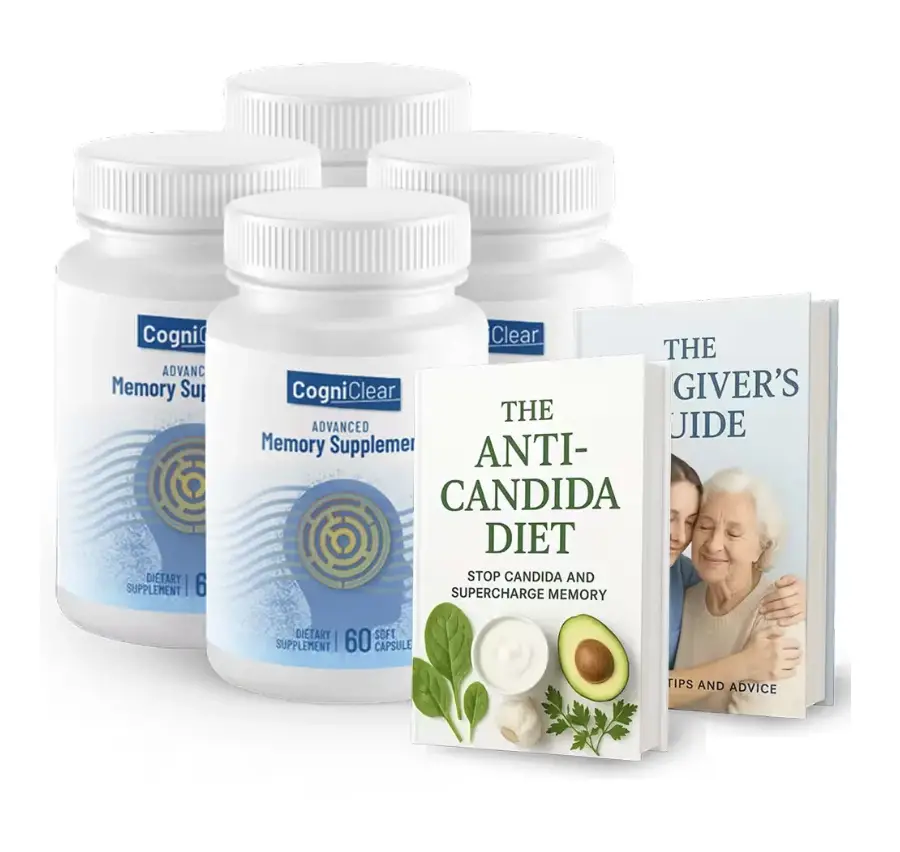
CogniClear is marketed as a natural brain supplement for memory, focus and mental clarity, but the more I looked into the product, the harder it became to pin down exactly what CogniClear actually is. Multiple websites sell products under the same name, with different formulas and even different explanations for how the supplement supposedly works.
Some versions go as far as claiming that hidden fungal buildup in the brain is a root cause of memory problems. So, is CogniClear legit? Let’s take a closer look.
Key Takeaways
- CogniClear is marketed for memory, focus, mental clarity and brain health.
- Multiple websites sell CogniClear with different formulas, making the product difficult to verify.
- Ingredients such as Bacopa and Ginkgo have been studied, but that does not prove the finished product works.
- Some versions make unsupported claims about fungal buildup, toxins and cognitive decline.
- The sales pages use aggressive testimonials, “FDA” language and long money-back guarantees that can make the product appear more clinically established than it is.
What Is CogniClear?
CogniClear is a dietary supplement marketed as a natural brain-health formula. The main version I found is promoted for memory retention, focus, mental clarity, brain fog and long-term cognitive support. It is generally presented as a stimulant-free formula containing ingredients such as MCT oil powder, Ginkgo biloba, Bacopa monnieri, Magnolia extract, oregano, clove, inulin and gum arabic.
The recommended serving on one current website is two capsules daily. That would be fairly ordinary for a cognitive supplement if there were only one clearly identifiable product.
There isn’t. I found multiple CogniClear domains using the same name but presenting different formulas, different ingredient counts and different marketing claims.
That immediately makes the product much harder to evaluate.
How It Claims to Work
The more conventional CogniClear sales pages say the formula supports cognition through several pathways. MCT oil is supposed to provide an alternative energy source for the brain. Ginkgo is positioned around circulation, Bacopa around memory and learning, Magnolia around calm focus, while oregano and clove are presented as antioxidant support.
The formula also includes prebiotic ingredients such as inulin and gum arabic, with the company connecting digestive health to the gut-brain axis. That is the relatively conventional version of the story. Another CogniClear website takes the claims much further.
It says cognitive decline can be caused by fungal infection and inflammation within the brain, specifically suggesting that Candida overgrowth can interfere with brain function. It then presents CogniClear as a way to eliminate this fungal buildup, clear toxins and repair neurons.
That is a very different proposition from simply taking a memory-support supplement.
Reality vs. Claims
There are legitimate research questions around several of the ingredients. Bacopa monnieri has been studied in randomized trials for memory and cognitive performance, and some systematic reviews have found potential benefits, particularly after several weeks of use.
Ginkgo biloba has also been extensively studied. However, evidence for improving cognition in healthy people is not conclusive, and the results depend heavily on the population and the specific extract used. MCTs can provide ketone bodies that the brain can use as an energy source, but that does not automatically mean that an MCT-containing supplement will improve memory in healthy adults.
So, there is genuine science around parts of the formula. What I did not find is a clinical trial showing that the finished CogniClear product improves memory, reverses cognitive decline or produces the dramatic results shown in its testimonials.
And the fungal-infection explanation is a much bigger problem. There are fungal infections that can affect the central nervous system, but that is very different from claiming that ordinary memory lapses and brain fog are caused by hidden Candida buildup in the brain.
I would not accept that explanation without strong clinical evidence.
Red Flags to Consider
There Is More Than One CogniClear Formula
This is the biggest issue. One current CogniClear site publishes a formula with MCT oil, Ginkgo, Bacopa, Magnolia, phosphatidylserine, inulin, gum arabic, oregano and clove.
Another website promotes a nine-ingredient version. Another says the formula contains 12 ingredients. And yet another version focuses heavily on caprylic acid and claims to target Candida in the brain.
Those are not simply different ways of describing the same formula. They are materially different products or substantially different versions of the same product. That makes me question which company actually owns the brand and which formula a customer is receiving.
The “Fungal Infection in the Brain” Story
This is the claim I would be most sceptical about. One CogniClear website says fungal infection and Candida overgrowth in the brain are hidden causes of cognitive decline and presents the supplement as a way to eliminate them. That is a dramatic medical explanation for common problems such as brain fog and forgetfulness.
A genuine fungal infection of the central nervous system is a serious medical condition. It is not something that should be casually inferred from forgetting names, feeling mentally tired or struggling to concentrate. I found no clinical evidence showing that CogniClear treats a fungal infection of the brain.
“FDA Approved” Language
Several CogniClear pages display an “FDA Approved” style badge or use language suggesting FDA approval. When you read the actual wording, it usually says the supplement is manufactured in an FDA-registered facility or a facility that follows FDA regulations.
That is not the same thing as FDA approval of CogniClear. Dietary supplements are not pre-approved by the FDA for effectiveness in the way prescription medicines are. This distinction is especially important when the product is making claims about cognitive decline.
The Review Numbers Are Seller-Controlled
Some CogniClear pages claim thousands of verified reviews, while another sales page displays 1,680 verified reviews. The numbers differ from site to site. The testimonials themselves describe dramatic improvements in memory, focus and mental clarity after only a few weeks.
Those testimonials may represent genuine customer experiences, but they are not controlled clinical evidence. A customer saying “my memory improved” cannot tell us whether the supplement caused that improvement.
The 365-Day Guarantee
Several sales pages advertise a 365-day money-back guarantee, sometimes describing it as an “ironclad” guarantee. A long refund window can be useful for customers, but it should not be confused with evidence that the product works. The guarantee is a commercial policy.
It does not establish efficacy, safety or clinical validation.
The “97% Choose Six Bottles” Strategy
One CogniClear sales page says that 97% of customers order six bottles, with six bottles priced at $294. This is a classic direct-response sales tactic. It creates the impression that almost everyone is committing to a six-month supply, which can make a buyer feel that purchasing one bottle is somehow unusual.
There is no independent evidence establishing that 97% of customers actually choose six bottles. I would not let that number influence how much product you buy.
Is CogniClear Effective?
There is enough legitimate research behind individual ingredients to say that CogniClear is not simply a formula made from completely meaningless substances. Bacopa has some promising cognitive research. Ginkgo has an extensive research history. MCTs have a plausible metabolic mechanism, and phosphatidylserine has also been studied in relation to cognitive function. But ingredient research is not finished-product research.
I did not find a randomised controlled clinical trial demonstrating that CogniClear itself improves memory or focus. And because different websites sell different CogniClear formulas, even an ingredient-based assessment becomes difficult. The fungal and “toxin buildup” claims are even less convincing.
My biggest problem is therefore not that every ingredient is useless. It is that the marketing takes several plausible ingredients and wraps them in a much bigger story about hidden causes of cognitive decline that has not been demonstrated for this product.
Safety
The fact that CogniClear is made from herbs does not mean it is automatically safe for everyone. Ginkgo can interact with medications that affect bleeding, while Bacopa can potentially interact with certain medications and may cause gastrointestinal side effects.
Magnolia and other botanicals may also have pharmacological effects. The situation becomes even more complicated when different websites appear to sell different formulas under the same name.
Anyone taking prescription medication, pregnant or breastfeeding, or dealing with a medical condition should check the exact ingredient label with a healthcare professional before using the product.
And if someone is experiencing significant or progressive memory problems, a supplement should not be used as a substitute for medical evaluation.
Pricing and Where to Buy
The direct-response CogniClear sales pages commonly promote:
- $69 per bottle when buying two
- $59 per bottle when buying four
- $49 per bottle when buying six
The six-bottle package is advertised at $294, with free shipping. Other CogniClear websites show different pricing, including single bottle offers around $49. That price variation is another reason I would verify exactly which seller you are buying from before paying.
I would also avoid purchasing six bottles simply because the website says it is the “best value.” There is no reason to commit to six months of a cognitive supplement before knowing whether the exact product agrees with you.
What To Do If You Already Bought
If you already purchased CogniClear, look at the physical bottle and compare the Supplement Facts panel with the website you ordered from.
If the ingredient list does not match the advertised formula, take screenshots and contact the seller before opening additional bottles. Keep your order confirmation, payment receipt and the exact sales-page terms.
If you are taking medication, check the complete ingredient list with a pharmacist or doctor.
And if you purchased it because you are experiencing significant memory loss, confusion or progressive cognitive changes, get those symptoms properly evaluated rather than assuming they are caused by “toxins” or Candida.
Conclusion
CogniClear is one of those products where the ingredient list is not necessarily the biggest problem. Bacopa, Ginkgo, MCTs and phosphatidylserine are all real ingredients with varying amounts of research behind them. That gives the formula at least some scientific plausibility.
What concerns me much more is the lack of a single, consistent product identity. There are multiple CogniClear websites with different formulas, different ingredient counts and different explanations for what supposedly causes cognitive decline. One version even builds its entire pitch around eliminating Candida and fungal buildup from the brain.
Then there is the “FDA approved” style language, enormous seller-controlled review counts, aggressive six-bottle offers and dramatic testimonials.
My conclusion: I would skip CogniClear for now. Not because Bacopa or Ginkgo are fake, but because I cannot establish that there is one consistent CogniClear product with a clearly documented formula and clinical evidence behind the finished supplement.
Until the company clearly explains which formula is authentic and provides product-specific evidence, there are simply too many unanswered questions for me to treat CogniClear as a trustworthy cognitive-health solution.
Also read – Sun Bum SPF 15 Tanning Oil Review: Is It Worth It? My Honest Experience