

Curadose Hair Care Treatment System is marketed to women experiencing thinning hair, widening parts, sparse temples, and visible scalp. Unlike a conventional hair serum, it comes with a microneedling applicator that the company says helps deliver its formula deeper into the scalp. The promise is appealing: use the system twice a month, see fuller hair within three months, and supposedly keep the results without committing to a daily treatment forever.
But hair loss is an emotional subject, and the promise of regrowth without medication or a demanding routine can be particularly attractive to someone who has already spent money on products that did not work. I wanted to find out whether Curadose has credible evidence behind its claims, whether its formula is consistent across its websites, and whether using a microneedling device at home is worth the potential risks.
Key Takeaways
- Curadose claims that 93% of women experience fuller-looking hair or new growth, but I could not verify a published clinical study establishing that result. The website refers to an independent trial without providing enough detail to evaluate its methods.
- The product information is inconsistent across websites. The formula on Curadose.com does not list copper tripeptide-1, while the Growth System on trycuradose.com does. The brands also use different descriptions of the technology and its benefits.
- The system uses 0.5 mm microneedles at home. This is more invasive than applying an ordinary serum. Microneedling can cause bleeding, irritation, infection, and pigmentation changes, and the FDA has not cleared microneedling devices for treating hair loss.
- The formula contains several conditioning ingredients, but that is not proof of hair regrowth. Ingredients such as panthenol, glycerin, centella asiatica, and hyaluronic acid can support skin hydration, but the finished product has not been shown to deliver the results advertised.
- I would not buy it based on the promise of permanent regrowth in 90 days. The evidence is insufficient to establish that the system reverses hair loss or that any regrowth will last after treatment stops.
What Is Curadose Hair Care Treatment System?
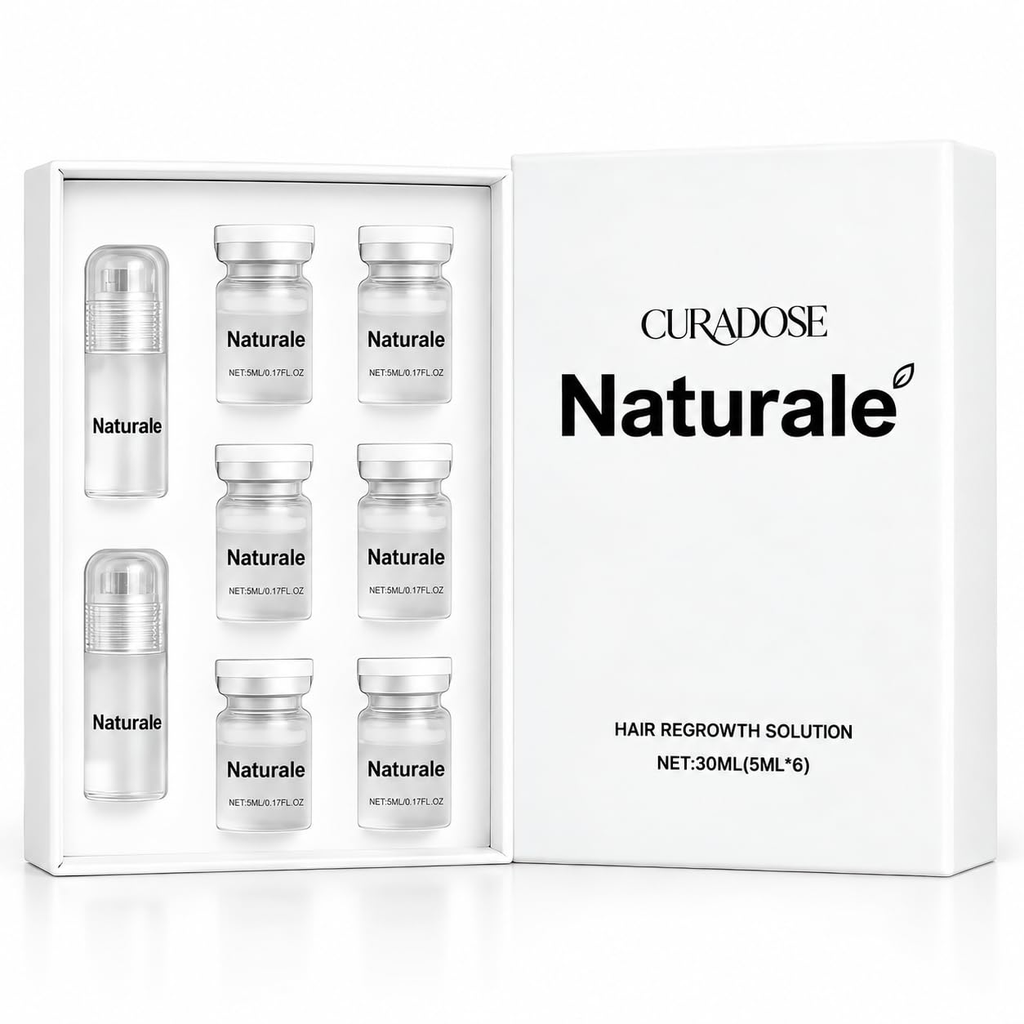
Curadose sells an at-home scalp-care system that combines a liquid serum with a precision stamping applicator. The recommended routine involves using the system twice a month. The user fills the applicator with serum, stamps it across areas of concern, and massages any remaining serum into the scalp.
The company markets the system for women with thinning around the temples, hairline, part, and crown. It suggests that the treatment can help reduce shedding, reactivate hair follicles, and produce fuller-looking hair. The product is sold in several package sizes. The three-month kit includes six treatments, with a serum vial and a single-use treatment head for each session.
Curadose also advertises a 90-day money-back guarantee. Its marketing encourages customers to expect visible results within approximately three months, with claims that they can keep their regrowth without maintaining a daily treatment indefinitely.
That is a much bigger promise than ordinary scalp conditioning. To establish it, the company would need convincing evidence that the finished system produces meaningful hair growth and that those results persist after treatment ends.
I Dug Deeper Into Curadose’s Hair-Growth Claims
One of the most prominent claims on the company’s sales website is that the system has been clinically shown to regrow hair in 93% of women. The website also states that 97% of users reported less shedding. Those figures sound impressive, but the information provided alongside them is not sufficient to assess the results independently.
I could not verify a published clinical study that clearly identifies the number of participants, the study design, the control group, the treatment duration, the measurements used, and the statistical analysis behind these percentages. The company refers to an independent trial, but simply calling a trial independent does not tell us whether it was adequately designed or whether its results have been replicated.
There is also a difference between reporting that hair looks fuller and demonstrating actual new hair growth. Hair can look denser because of changes in styling, lighting, hair texture, or the way it lies across the scalp. A reliable study should distinguish cosmetic improvements from measurable changes in hair density and growth.
I am not saying that every customer’s before-and-after photograph is false. I am saying that photographs and percentages on a sales page are not enough to establish the effectiveness of a hair-loss treatment.
The 93% claim needs more context
The company uses the 93% figure to support the suggestion that the treatment works for almost everyone. However, without a published study protocol and detailed results, I could not establish what the percentage actually measures or whether the participants’ results were assessed objectively.
For example, did 93% experience measurable new growth, report that their hair looked fuller, or simply indicate that they were satisfied with their results? Those outcomes are not interchangeable.
I would also want to know whether participants had different causes of hair loss, whether they used other treatments simultaneously, and whether the results were compared with a control group. Until that information is available, I would treat the 93% figure as a marketing claim rather than a verified probability that the system will work for an individual customer.
The Biggest Red Flag: Curadose’s Websites Describe Different Formulas
I found an inconsistency that deserves more attention than the usual exaggerated hair-growth marketing. Curadose.com presents the product as the Curadose Scalp Care System, featuring a serum with its proprietary CuraPhase Complex.
Its published ingredient list includes:
- Glycerin
- Panthenol
- Centella asiatica extract
- Sodium hyaluronate
- Tremella mushroom extract
- Panax ginseng extract
- Rosemary leaf extract
- Green tea extract
- Turmeric root extract
- Other botanical and conditioning ingredients
The list also includes ingredients used for moisturizing and maintaining the condition of the scalp. However, the separate trycuradose.com website markets the Growth System by Curadose as a microinfusion treatment and explicitly lists copper tripeptide-1 and acetyl tetrapeptide-3 in its formula.
The two websites also differ in how they describe the system’s action. One emphasizes targeted scalp conditioning and fuller-looking hair, while the other claims to deliver active ingredients directly to hair follicles and reactivate dormant follicles. These may be different versions of the product, or the company may have updated its formula and marketing. I could not establish that explanation from the information available.
The problem is that the websites do not clearly explain the relationship between the two formulas or identify which version a customer will receive when ordering through each site.
That matters because the ingredients are part of the justification for the company’s hair-regrowth claims. If the formulas differ, evidence supporting one version cannot automatically be applied to the other. Before buying, I would want written confirmation of the exact formula being sold and a complete ingredient list that matches the product shipped.
Does Copper Peptide Actually Regrow Hair?
The trycuradose.com version highlights copper tripeptide-1, also known as GHK-Cu, as a key ingredient. Copper peptides are used in cosmetic products, and researchers have investigated their potential biological effects. However, evidence that a particular ingredient has interesting properties does not establish that applying it through this specific device will reverse hair loss.
Curadose describes the peptide as capable of reversing follicle miniaturization and switching dormant follicles back into active growth. Those are strong biological claims. I could not verify clinical evidence demonstrating that Curadose’s particular concentration of copper peptide reverses follicle miniaturization in women or produces the results shown on its sales pages.
The same caution applies to acetyl tetrapeptide-3 and the botanical extracts in the formula. Their inclusion does not establish that the finished system produces clinically meaningful regrowth.
The product also lacks a clearly disclosed concentration for each key active ingredient in the marketing information I reviewed. Without those details, it is difficult to compare the formula with preparations studied in research.
Does the Microneedling Device Make Curadose More Effective?
This is an important distinction between Curadose and a conventional scalp serum. The Growth System uses an applicator with 0.5 mm microneedles. According to the company, the needles create tiny channels that allow the serum to penetrate the scalp more effectively.
Microneedling has been studied as an adjunct to some hair-loss treatments. However, findings from studies involving particular devices, treatment schedules, and medications cannot automatically be applied to Curadose.
The US Food and Drug Administration states that it has not cleared microneedling devices for treating hair loss. It also says that microneedling devices have not been cleared for delivering cosmetics or topical medications into the skin. The FDA identifies potential complications, including redness, irritation, bleeding, infection, and pigmentation changes. The risks associated with combining a microneedling device with a particular cosmetic serum may not be fully known.
This is relevant because Curadose is designed to create microchannels and deliver its serum during the same session. The company describes the process as a way to reach the follicles, but I could not verify that the device-serum combination has been independently established as safe and effective for hair regrowth.
The inclusion of a fresh, single-use treatment head is a sensible hygiene measure. It does not, by itself, establish that the device is appropriate for home use or that the serum is safe to introduce through freshly created channels.
I would be especially cautious about using a microneedling device on an irritated, infected, or inflamed scalp. If someone is considering microneedling for hair loss, discussing the risks and evidence with a dermatologist is a better starting point than assuming that an at-home kit is equivalent to a supervised procedure.
What Does the Serum Actually Do?
Looking at the ingredients separately, Curadose contains several substances that can help condition the scalp. Glycerin is a humectant that helps attract and retain moisture. Panthenol is used in cosmetic formulations to condition skin and hair. Sodium hyaluronate helps retain moisture, while centella asiatica is commonly used in skin-care products for its conditioning properties.
Rosemary extract, ginseng, green tea, and other botanical ingredients are often promoted in scalp-care products. However, research on individual botanicals varies, and their presence does not establish that a finished formula can reverse hair loss.
These ingredients could contribute to a more comfortable, hydrated scalp. That is a different outcome from stimulating new hair growth or reversing follicle miniaturization. I could not verify a clinical study showing that the complete Curadose serum, at its marketed concentration and application frequency, produces the dramatic results claimed by the company.
It is also worth noting that the serum contains eucalyptus and mint-related oils. These ingredients may irritate some people’s skin, particularly when the skin barrier has been disrupted. Because the system uses microneedles, I would not assume that a cosmetic serum is automatically suitable for application immediately after needling.
Can Curadose Permanently Regrow Hair in Three Months?
The company’s marketing suggests that customers can regrow their hair in approximately three months and keep the results for life. I would be very cautious about that promise.
Hair loss is not a single condition. Female pattern hair loss, traction alopecia, temporary shedding after illness, nutritional deficiencies, hormonal changes, and inflammatory scalp disorders can all produce thinning, but they do not necessarily respond to the same treatment.
For some forms of hair loss, treatment can help maintain or improve density. For others, addressing the underlying cause is essential. Some types of damage may be reversible, while certain forms of scarring alopecia can cause permanent loss if not treated promptly.
There is no sound basis for assuming that a single cosmetic system will work for all these causes. Even established hair-loss treatments may require ongoing use to maintain their benefits. The American Academy of Dermatology explains that minoxidil can help some people with female pattern hair loss, but results take time and continued use is generally needed to maintain them.
That makes Curadose’s suggestion of lasting regrowth without an ongoing routine particularly important to verify. I could not find sufficient evidence demonstrating that the system produces permanent results after treatment stops.
What Are Customers Saying About Curadose?
Curadose’s websites display a 4.9 out of 5 rating and more than 11,000 reviews. The sales pages feature testimonials from women who say they experienced fuller-looking hair around their temples, part, or crown after several months. Some testimonials describe less visible scalp, reduced shedding, and greater confidence in wearing their hair down or pulled back.
These stories may reflect genuine customer experiences. However, they are presented on the company’s own sales pages, and I could not independently establish that the photographs and reported results demonstrate the effectiveness of the product in a controlled setting.
A testimonial can tell us what one person believes happened during treatment. It cannot establish that the treatment caused the change or that the same result is likely for other customers. The company also makes substantial claims about the proportion of users who experience results. Those figures would be much more convincing if supported by a publicly available clinical report with clear methods and independently assessable outcomes.
I would not base a hair-loss treatment decision solely on the number of reviews or the appearance of before-and-after photographs.
How Much Does Curadose Cost?
The product page advertises three package options:
| Package | Treatments | Advertised cost per treatment |
|---|---|---|
| One-month supply | 2 | $37 |
| Two-month supply | 4 | $25 |
| Three-month supply | 6 | $19 |
Based on the listed per-treatment prices, that works out to approximately $74 for the one-month kit, $100 for the two-month kit, and $114 for the three-month kit. Promotional prices and checkout totals may change.
The three-month package is the least expensive per treatment, but it also requires the largest initial commitment. The issue is not simply whether $114 is a lot of money for a hair product. It is whether the evidence justifies paying that amount for a microneedling system whose hair-regrowth claims I could not independently verify.
I would be reluctant to purchase the larger kit solely because the company says the results become more noticeable after 90 days. A suggested treatment timeline is not evidence that the product will work.
Is Curadose’s 90-Day Money-Back Guarantee Reliable?
Curadose advertises a 90-day money-back guarantee. The website’s published terms say that customers should use the system as directed for 12 consecutive weeks, retain treatment records and progress photographs, and submit a claim within 90 days of delivery.
The company says that approved claims receive a refund of the eligible product price and applicable taxes, while certain other fees are excluded. That is more specific than a guarantee with no stated conditions, but it is still important to read the complete terms before ordering. The conditions may require customers to document their treatment and follow the prescribed routine, and the company retains an approval process for claims.
I would save the exact guarantee shown at checkout and confirm what happens if the product causes irritation or cannot be used safely. A customer should not feel compelled to continue a treatment that causes a reaction simply to meet a usage requirement. Most importantly, a money-back guarantee does not demonstrate that a product works. It is a purchasing policy, and its practical value depends on the terms and how claims are handled.
Red Flags I Found
Here are the main concerns that stood out during my investigation:
- The 93% hair-regrowth claim lacks sufficient supporting detail. I could not verify a published clinical study establishing what was measured or how the result was calculated.
- The formula differs across websites. One ingredient list omits copper tripeptide-1, while another includes it as a key active ingredient.
- The company makes strong claims about dormant follicles. I could not verify clinical evidence showing that this system reverses follicle miniaturization or reactivates dormant follicles as advertised.
- The device uses microneedles at home. The FDA has not cleared microneedling devices for hair-loss treatment or for delivering cosmetics into the skin.
- The permanent-results promise is not established. I could not verify evidence showing that any regrowth produced by the system lasts for life after treatment stops.
- The review count and testimonials are not substitutes for clinical evidence. They may describe customer experiences, but they cannot establish causation or predict individual results.
These issues do not prove that Curadose is a scam. They do mean that I would want substantially better evidence before trusting its hair-regrowth promises.
What Would I Recommend Instead?
If you are experiencing hair thinning, I would first try to identify the cause rather than immediately buying a product that promises to reverse it. A dermatologist can assess the scalp and determine whether the pattern suggests female pattern hair loss, traction alopecia, a temporary shedding episode, or another condition. Depending on the findings, blood tests or other investigations may be appropriate.
For women with female pattern hair loss, topical minoxidil is one of the better-established treatment options. It is not suitable for everyone, and the appropriate product and usage instructions should be discussed with a healthcare professional when necessary.
If thinning is related to tight hairstyles, reducing tension may help prevent further damage. Sudden, patchy, painful, or unexplained hair loss warrants medical assessment rather than an experimental scalp treatment. I would also avoid combining microneedling with multiple scalp products without professional guidance. Introducing cosmetic ingredients through freshly created channels may carry different risks from applying them to intact skin.
Conclusion: Is Curadose Hair Care Treatment System Legit?
My conclusion is caution. I could not establish that Curadose is a confirmed scam, but I also could not verify that it reliably regrows hair as advertised. The system includes a serum with several ingredients commonly used to condition the scalp, and the company provides instructions for its applicator and a stated refund policy. Those are useful practical details, but they do not establish clinical effectiveness.
What concerns me most is the combination of dramatic regrowth claims, limited publicly verifiable clinical evidence, inconsistent ingredient lists across the company’s websites, and an at-home microneedling device that introduces additional safety considerations.
I would not spend $114 or more on this system expecting permanent hair regrowth within 90 days. Before considering it, I would want the company to clarify which formula is being sold, provide the full study behind its 93% claim, and establish that the device and serum combination has been appropriately evaluated for the intended use.
For now, I would choose a treatment with stronger evidence and seek a diagnosis if the hair loss is persistent or unexplained. Hair thinning can have several causes, and the best treatment depends on what is actually happening at the scalp.
Also read – Is Nabhyaayurveda.com a Trustworthy Online Shopping Store? Find Out