

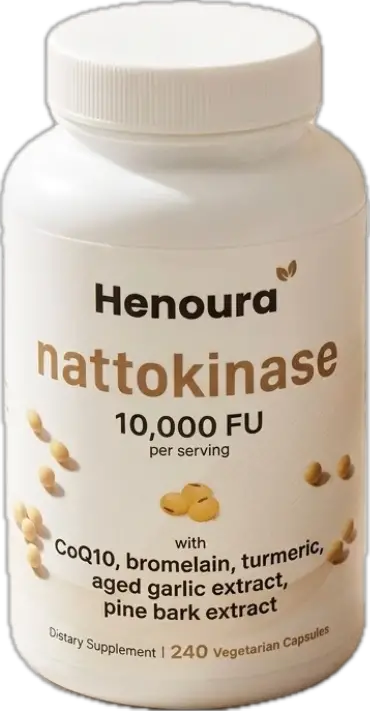
Henoura Nattokinase is marketed as a powerful cardiovascular supplement that supposedly improves circulation, supports healthy blood pressure, and, most impressively, reduces arterial plaque by 36%. Its formula combines 10,000 FU of nattokinase with CoQ10, turmeric, aged garlic, grape seed, bromelain and pine bark.
That 36% number immediately caught my attention because it sounds very specific. So I traced the claim back to the research, looked at what was actually studied, and then took a closer look at Henoura itself. There is legitimate research behind nattokinase, but the story being sold here is considerably stronger than the evidence for this particular product.
Key Takeaways
- Henoura provides 10,000 FU of nattokinase per three-capsule serving.
- The company claims nattokinase can reduce arterial plaque by 36%.
- The 36% figure appears to come from a real human study, but that study used 6,000 FU daily, not Henoura’s 10,000 FU formula.
- The study also did not test Henoura Nattokinase.
- Nattokinase has been studied for blood pressure and cardiovascular markers, but that doesn’t make it a proven plaque-removal treatment.
- Henoura is a very new brand, with little independent history available.
- Because nattokinase can affect blood clotting, I’d be particularly cautious about combining it with blood-thinning or antiplatelet medications.
- I wouldn’t buy Henoura based on the 36% plaque claim.
What Is Henoura Nattokinase?
Henoura Nattokinase is a dietary supplement marketed primarily for cardiovascular health.
The star ingredient is nattokinase, an enzyme produced during the fermentation of soybeans used to make the Japanese food natto. Henoura describes it as a fibrinolytic enzyme capable of breaking down fibrin, a protein involved in blood clot formation.
The company then takes that basic mechanism and builds a much bigger story around it. According to Henoura, nattokinase can act like a “plumber” for your arteries, breaking down the fibrin associated with arterial plaque and improving circulation.
That’s the part I wanted to investigate.
How Does Henoura Claim to Work?
The company’s theory is fairly simple: Nattokinase breaks down fibrin → less buildup in the arteries → better blood flow → better cardiovascular health.
The formula also includes ingredients intended to support the process:
- Nattokinase — 10,000 FU
- CoQ10
- Turmeric
- Aged garlic extract
- Grape seed
- Bromelain
- Pine bark
Henoura describes these ingredients with rather colourful titles. Nattokinase is the “plumber,” turmeric is the “firefighter,” aged garlic is the “decalcifier,” and bromelain is the “amplifier.”
It certainly makes the formula sound impressive. But scientific claims need a little less plumbing terminology and a little more evidence.
My Investigation: Where Did the 36% Claim Come From?
This is probably the most important thing I found. The 36% figure isn’t completely fabricated. There is a published human study that reported a 36.6% reduction in carotid plaque size in people taking nattokinase.
But here’s the catch. The study involved only 82 participants, with 76 completing it, and the nattokinase group took 6,000 FU per day for 26 weeks.
Henoura, meanwhile, provides 10,000 FU per day. And most importantly, the study did not test Henoura Nattokinase.
So when Henoura’s website says that “one clinical study showed” a 36% reduction, that’s technically pointing toward a real piece of research, but it is very easy for a consumer to interpret that as:
“If I take Henoura’s 10,000 FU capsules, my arterial plaque will decrease by 36%.”
The study does not establish that. That’s a pretty important distinction.
Does 10,000 FU Actually Clear Arterial Plaque?
This is where I’d pump the brakes. Nattokinase is an interesting enzyme, and there is legitimate human research into it. But “has fibrinolytic activity” and “clears established arterial plaque” aren’t interchangeable claims.
Arterial plaque is a complex mixture involving cholesterol, inflammatory cells, connective tissue, calcium and other components. Fibrin can be involved in atherosclerotic plaque, but that doesn’t mean taking an oral enzyme will simply dissolve the entire plaque.
And even if nattokinase influences certain components associated with plaque, that doesn’t establish that it can safely reverse atherosclerosis in the way a consumer might imagine from the advertisement.
I would therefore treat the 36% figure as a research finding worth investigating, not as a guaranteed outcome of taking Henoura.
The 10,000 FU Claim
Henoura makes a big deal about its 10,000 FU dose, saying this is the “full clinical dose” and suggesting that cheaper products using 2,000–4,000 FU don’t provide enough nattokinase.
I wasn’t convinced by that argument. There’s no universal rule that says 10,000 FU is the minimum amount required for nattokinase to work.
FU measures enzymatic activity, which is useful for comparing nattokinase products, but a higher number doesn’t automatically mean greater clinical benefit.
And more importantly, the research Henoura uses for its headline plaque claim involved 6,000 FU, not 10,000 FU.
So the company can’t simultaneously borrow the 36% result from a 6,000-FU study and then imply that its higher dose has been clinically proven to produce the same, or better, result.
What About the Other Ingredients?
The additional ingredients make the formula look more comprehensive, but I wouldn’t confuse a long ingredient list with a clinically validated combination.
Aged Garlic
Aged garlic extract has been studied for cardiovascular health and blood pressure, so this isn’t a random addition.
Henoura says its formula contains aged garlic equivalent to 7,500 mg of garlic, derived from garlic aged for 24 months.
That’s interesting, although “garlic equivalent” isn’t the same thing as saying the capsule contains 7,500 mg of the active compounds used in clinical trials.
CoQ10
CoQ10 is involved in cellular energy production and has been studied extensively in cardiovascular contexts.
But including CoQ10 doesn’t turn Henoura into a clinically proven treatment for arterial plaque.
Turmeric
Turmeric and its compounds, particularly curcumin, have been investigated for inflammation and oxidative stress.
Again, that’s plausible support for general cardiovascular health, but it’s not evidence that the amount in Henoura removes arterial plaque.
Bromelain
Bromelain is an enzyme derived from pineapple. Henoura calls it an “amplifier” and claims it enhances nattokinase absorption.
That’s an interesting claim, but I couldn’t establish clinical evidence showing that bromelain in this particular formula improves nattokinase’s cardiovascular effects.
Grape Seed and Pine Bark
Both provide plant compounds with antioxidant properties, and pine bark extracts have been studied for vascular health.
But, once again, research on an individual ingredient isn’t proof that the finished Henoura formula produces the advertised cardiovascular outcomes.
Red Flags to Consider
The Product-Specific Evidence Is Missing
This is probably my biggest issue. Henoura repeatedly uses language such as “clinically proven benefits” and talks about a 36% reduction in arterial plaque.
But I couldn’t find a clinical trial testing Henoura Nattokinase 10,000 FU Extra Strength. That’s what I would want before calling the product clinically proven. There is research on nattokinase.
There is research on some of the supporting ingredients. But that isn’t the same thing as research on Henoura.
“Nattokinase Thins the Blood Naturally”
Henoura says nattokinase “thins the blood naturally” and connects it to symptoms such as cold fingers, numb legs and tingling feet.
That is a particularly concerning way to market a supplement. Cold or numb extremities can have many causes, some of which require medical evaluation. Telling consumers that these symptoms are signs of poor circulation and then presenting a nattokinase supplement as the solution is far too simplistic.
The Cholesterol Claims Go Too Far
The website features customer testimonials claiming cholesterol reductions of nearly 100 points and says CoQ10 and turmeric can support healthy lipid levels “without statins.”
That’s not something I’d take lightly.
If someone has high cholesterol and has been prescribed a statin, replacing that treatment with a supplement based on customer testimonials could be dangerous.
A supplement should not be marketed as though it can casually replace established cardiovascular medication.
“No Medication Necessary” Messaging
Henoura’s sales copy repeatedly frames the product as a natural alternative to conventional cardiovascular treatment, including statements about doctors telling people to take medications “forever” while “nature has an answer.”
That’s a major red flag for me.
There is nothing inherently wrong with wanting a supplement to support cardiovascular health.
There is a problem with implying that a supplement can replace medically indicated treatment without equivalent evidence.
The Brand Is Extremely New
This was another thing I found noteworthy. The Henoura website appears to be very new, and there is very little independent history available for the brand itself.
That doesn’t automatically make it fraudulent. A new company can be completely legitimate.
But when a new brand is selling a supplement for cardiovascular health while making very specific claims about arterial plaque, blood pressure and cholesterol, I want considerably more independent evidence before trusting it.
Is Henoura Nattokinase Safe?
This is where I’d be especially careful.
Nattokinase isn’t simply a harmless vitamin. Its interest in cardiovascular research comes partly from its effects on fibrinolysis and blood clotting.
Henoura itself acknowledges that people taking blood thinners such as warfarin or aspirin should consult a doctor first.
I’d take that warning seriously. Anyone taking anticoagulant or antiplatelet medication, anyone with a bleeding disorder, or anyone preparing for surgery should speak with a healthcare professional before taking nattokinase.
And I wouldn’t interpret “natural blood thinning” as a benefit that everyone needs. Blood clotting is essential. You don’t want to interfere with it unnecessarily.
Does Henoura Nattokinase Actually Work?
Here’s where I landed after separating the product from the marketing. Nattokinase itself is worth taking seriously as a research subject.
There is legitimate human research investigating its effects on blood pressure and cardiovascular markers.
But Henoura’s strongest claim is much more specific: 36% reduction in arterial plaque.
And that is where the evidence doesn’t follow the marketing. The 36.6% result came from a small study using 6,000 FU of nattokinase for 26 weeks, not 10,000 FU of Henoura.
So I cannot honestly tell a reader that taking Henoura will clear 36% of their arterial plaque. I also couldn’t find evidence that the finished Henoura formula has been clinically tested.
That doesn’t mean the product does nothing. It means we don’t know that it does what the advertisement says it does.
Pricing and Where to Buy
Henoura currently lists one bottle at $49.95, discounted from a stated $69.95. The bottle contains 240 capsules and is described as an 80-day supply when taking three capsules daily.
The company also promotes multi-bottle bundles and a 60-day money-back guarantee.
The heavy discounting and bundle offers aren’t proof of anything either way, but I wouldn’t let the “Buy 2 Get 1 Free” type offers push me into purchasing several bottles of a cardiovascular supplement before I’ve established that the product is worth taking.
Alternatives
If your concern is cardiovascular health, I’d put much more weight on things that have established benefits:
- Managing blood pressure
- Managing cholesterol
- Not smoking
- Regular physical activity
- A heart-healthy diet
- Maintaining a healthy weight
- Taking prescribed medications when they’re medically indicated
If you’re specifically interested in nattokinase, I’d also discuss it with your healthcare provider rather than using it as a substitute for treatment.
What To Do If You Were Scammed
If you purchased Henoura because you were promised a 36% reduction in arterial plaque, save screenshots of that claim.
Keep your:
- Order confirmation
- Payment receipt
- Product packaging
- Advertising screenshots
- Emails with the seller
- Shipping information
Henoura advertises a 60-day money-back guarantee, so contact the company within that period if you want to request a refund.
If you experience unauthorized recurring charges or can’t obtain a refund, contact your payment provider.
Conclusion
Henoura Nattokinase is interesting for one reason: nattokinase itself isn’t fake science.
There is genuine research into the enzyme, including a small human study that reported a 36.6% reduction in carotid plaque size. But once I traced that claim back to its source, I found that the study used 6,000 FU per day for 26 weeks… not Henoura’s 10,000 FU formula.
That’s the distinction I think gets lost in the advertising.
Henoura also hasn’t demonstrated that its finished seven-ingredient formula produces the cardiovascular results it promises. And some of the marketing around cholesterol, circulation and replacing conventional medication is much more aggressive than I’d be comfortable with.
So would I call nattokinase useless? No. Would I trust Henoura to clear my arteries because its website says “36%”? Also no.
For a cardiovascular supplement, that’s simply not enough evidence for me.
Also read – Can QIFOR Really Restore Yellowed Headlights? I Tried It and Here’s My Honest Review