

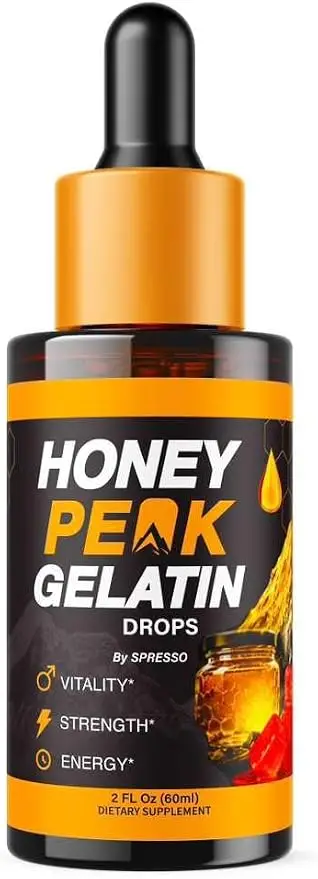
Honey Peak Drops is marketed as a liquid supplement for energy, vitality and male performance. But the more I looked into the product, the more it became clear that the strange part isn’t really the bottle itself.
The advertising is the bigger problem. Honey Peak Drops has been promoted through videos featuring Bill Gates and medical figures, with a story about a secret red-honey remedy that supposedly holds the key to improving men’s health. Those videos show several signs of AI-generated or manipulated content, and I couldn’t find credible evidence that the people appearing in them actually endorsed Honey Peak Drops.
Key Takeaways
- Honey Peak Drops is a liquid dietary supplement marketed for energy, vitality and performance.
- Its advertising uses a “red honey” story involving famous people and supposed medical discoveries.
- Videos connected to the campaign appear to use AI-generated or manipulated celebrity footage.
- I found no credible evidence that Bill Gates or the doctors featured in the advertisements actually endorsed Honey Peak Drops.
- The same basic red-honey advertising story has reportedly been used to promote other supplements, including IronPulseX.
- The product contains a 21-ingredient proprietary blend, but the individual amounts aren’t disclosed.
- The entire proprietary blend weighs just 15.47 mg per serving, alongside 7 mcg of chromium.
- The current offer I examined is advertised as a one-time purchase rather than an automatic subscription.
- The combination of deceptive advertising, an opaque formula and weak product-specific evidence makes Honey Peak Drops a product I would avoid.
What Is Honey Peak Drops?
Honey Peak Drops is a 1 fl oz liquid dietary supplement that instructs users to take one dropperful per day. The product is marketed around energy, strength, vitality and performance rather than being presented as a treatment for a specific medical condition.
If you only looked at the product page, you might think you’re dealing with a fairly ordinary wellness supplement. Then you see the advertisements.
Instead of simply saying “here’s a supplement for vitality,” the marketing wraps the product in a much bigger story involving honey, a supposed health discovery and recognizable public figures. That’s where Honey Peak Drops becomes much harder to take seriously.
How It Claims to Work
The advertising surrounding Honey Peak Drops revolves around the idea that a simple honey-based remedy can produce significant improvements in men’s energy, vitality and sexual performance.
The story is designed to sound like a hidden health discovery: familiar ingredients, a supposedly overlooked natural remedy, medical explanations and a famous person supposedly revealing information that the public wasn’t meant to know.
But none of that establishes that Honey Peak Drops itself works. The actual product page is considerably more cautious, using general wellness language about vitality and performance rather than making the extreme medical claims used in some of the promotional material.
That distinction matters because the advertisement is what gets the customer’s attention and creates the expectation of what the product can do.
The AI-Generated Bill Gates Videos
This is probably the biggest reason I would stay away from Honey Peak Drops.
Videos connected to the campaign have presented Bill Gates discussing a supposed red-honey discovery, alongside doctors and researchers who are made to appear as though they are validating the story. Versions of the campaign have also used names such as Yoshinori Ohsumi, Dr. Anika Ackerman and other medical figures.
I found no credible evidence that Bill Gates endorsed Honey Peak Drops. And this is exactly where AI-generated advertising becomes dangerous.
A few years ago, a fake celebrity endorsement usually looked ridiculous enough that most people could spot it. Now, scammers can take genuine footage of a public figure, manipulate the mouth movements, clone or alter the voice, and create entirely new dialogue that looks and sounds convincing.
Someone watching a short video while scrolling through Facebook or another social platform may have absolutely no reason to immediately realize that the person on screen never said those words.
That’s what makes this type of advertising so effective. The video isn’t necessarily trying to convince you that Bill Gates personally sells Honey Peak Drops. It’s using his face and perceived authority to make the entire story feel legitimate before sending you to the sales page.
The Same Story Can Sell a Different Product
This is another detail I found particularly revealing. The red-honey story isn’t exclusive to Honey Peak Drops. Very similar versions of the campaign have reportedly been used to promote other products, including IronPulseX. The product name can change while the celebrity, medical discovery and “secret honey” narrative remain remarkably similar.
That is a huge red flag for me. If this were genuinely a groundbreaking medical discovery, I’d expect the research, inventor, treatment and product to remain identifiable. Instead, the story appears capable of being attached to different bottles.
That makes it look much more like a reusable advertising script than a genuine medical breakthrough.
Reality vs. Claims
Let’s strip away Bill Gates, the doctors, the dramatic music and the red honey for a moment.
What are we actually left with? A liquid supplement containing chromium and a proprietary blend of 21 ingredients. There is no published clinical trial demonstrating that the finished Honey Peak Drops formula produces the dramatic benefits suggested by the advertising.
That’s a problem because the advertising makes the product sound revolutionary, while the evidence available for the actual bottle is considerably less impressive.
The presence of individual ingredients with existing research doesn’t prove that this particular combination works, especially when the doses aren’t disclosed.
Let’s Look at the Listed Ingredients
The label lists 7 mcg of chromium alongside a 21-ingredient proprietary blend containing botanicals and other compounds. The entire proprietary blend weighs only 15.47 mg, and the individual amounts of those 21 ingredients aren’t disclosed.
That’s really all I need to know to have a problem with the formula.
I’m not saying every ingredient in the blend is useless. I’m saying that when 21 ingredients are grouped together into 15.47 mg without telling the customer how much of each one they’re actually getting, it becomes extremely difficult to determine whether any of them are present at meaningful amounts.
The impressive ingredient count therefore doesn’t tell me very much.
Red Flags to Consider
The Celebrity Endorsement Doesn’t Check Out
The entire advertising strategy depends heavily on recognisable people lending credibility to the product. But I couldn’t find credible evidence connecting Bill Gates or the other public figures featured in versions of the advertisements to Honey Peak Drops.
That’s a serious problem when their apparent endorsement is one of the main reasons someone might believe the product is legitimate.
The “Secret Red Honey” Story Is Doing Too Much Work
Honey is familiar. Red honey sounds exotic. Add a supposed medical discovery and a famous person, and suddenly an ordinary supplement starts feeling like forbidden knowledge.
But a compelling story isn’t evidence. The fact that a video looks like an interview doesn’t prove that the interview happened. The fact that a doctor appears on screen doesn’t prove that the doctor reviewed the product. And the fact that Bill Gates appears to say something doesn’t prove Bill Gates actually said it.
The Formula Is Not Transparent
Twenty-one ingredients sounds impressive until you discover that they’re all hidden inside a proprietary blend weighing just 15.47 mg.
I would much rather see a shorter formula with clearly disclosed amounts than a huge ingredient list where I have no idea how much of anything I’m actually consuming.
The Product Has a Very Short Online History
The current Honey Peak Drops domain was registered in July 2026, according to domain information reported by ScamAdviser.
Again, a new domain isn’t automatically proof of a scam. But when a newly registered website is selling an unfamiliar supplement through AI-generated celebrity advertising and a recycled marketing story, the lack of history becomes another reason to be cautious.
The Product and Payment Entities Aren’t the Same
The Honey Peak material identifies Honey Peak Nutrition LLC as the distributor, while the checkout uses PagAmerican as the merchant of record.
That doesn’t automatically mean anything is wrong with the transaction. Payment processors routinely handle payments for other businesses.
But when buying from an unfamiliar supplement company, I want the seller, manufacturer, customer-support details and payment entity to be easy to understand.
The more pieces I have to connect myself, the less comfortable I am.
Efficacy
I don’t see enough evidence to recommend Honey Peak Drops for the results being advertised. The product may contain ingredients that are perfectly ordinary in the supplement industry, but the actual formula hasn’t been shown to deliver the dramatic benefits implied by the red-honey advertisements.
And once you remove the AI videos and celebrity names, there’s very little left supporting the extraordinary story.
That’s important because the marketing is essentially asking customers to trust the presentation of the product rather than strong evidence for the product itself.
Pricing and Where to Buy
The offer I examined is not particularly cheap.
The current packages are advertised at approximately $158 for two bottles, $207 for three and $294 for six. The checkout states that the purchase is a one-time payment with no automatic subscription.
I actually appreciate that the current checkout is explicit about being a one-time purchase because I don’t want to accuse a product of running an autoship scheme without evidence.
But I still wouldn’t spend $158, $207 or $294 on this product. The problem isn’t simply the price. It’s that the price is being attached to a product whose marketing relies on an apparently fabricated celebrity endorsement and whose formula doesn’t disclose individual ingredient amounts.
What To Do If You Already Bought Honey Peak Drops
If you already purchased it, don’t panic, but document everything.
Save the advertisement you saw, your order confirmation, the checkout page, the receipt and photographs of the bottle and Supplement Facts label. If the product you receive doesn’t match what was advertised, contact the seller in writing and request a refund.
Also keep an eye on your bank or card statement for the exact amount and merchant name associated with the transaction.
And if you bought it because you believed Bill Gates or a doctor personally recommended it, remember that the video itself isn’t evidence of an endorsement. Verify the supposed endorsement through the person’s official website or verified social accounts rather than relying on the advertisement.
Conclusion
Honey Peak Drops is not a product I would recommend. The formula itself isn’t necessarily the most outrageous thing I’ve seen in the supplement world. The bigger issue is the way this product is being sold.
The red-honey story, the apparent AI-generated celebrity videos, the use of medical figures who don’t appear to have any verifiable connection to the product, and the fact that essentially the same advertising narrative can be attached to different supplements all point in the same direction.
Then there’s the formula: 21 ingredients hidden inside a 15.47 mg proprietary blend with individual amounts undisclosed. That’s not enough transparency for me to take the impressive health claims seriously.
Could Honey Peak Drops physically contain a legitimate mixture of supplement ingredients? Sure. But that’s not the question I’m trying to answer.
The question is whether I would trust this product enough to give the seller my money based on the evidence available.
No.
Also read – I Bought the Leilo Berry Calming Kava Drink Mix: My Honest Review After Use