

Manna Gut Repair Honey is marketed as a honey-based gut supplement that supposedly clears bacterial overgrowth, repairs the gut lining, rebuilds the microbiome and improves problems ranging from bloating and diarrhea to brain fog and poor sleep. But the more I looked into the product, the more I noticed that the science behind some of the ingredients is being stretched into claims about the finished formula.
The product also has a very young website, inconsistent customer numbers and a marketing story that makes raw honey sound almost like a targeted treatment for gut dysbiosis. So, is Manna Gut Repair Honey legit? Let’s take a closer look.
Key Takeaways
- Manna contains raw honey, Bacillus coagulans MTCC 5856, slippery elm and L-glutamine.
- The probiotic strain does have human clinical research, including studies involving IBS, bloating and gas.
- There is no clinical trial showing that the finished Manna formula repairs the gut or clears bacterial overgrowth.
- The company claims 50,000+ happy customers while displaying only 200+ reviews, and its review count changes across pages.
- The website is only a few months old and uses strong scarcity and health claims to sell a $84 box of 25 sachets.
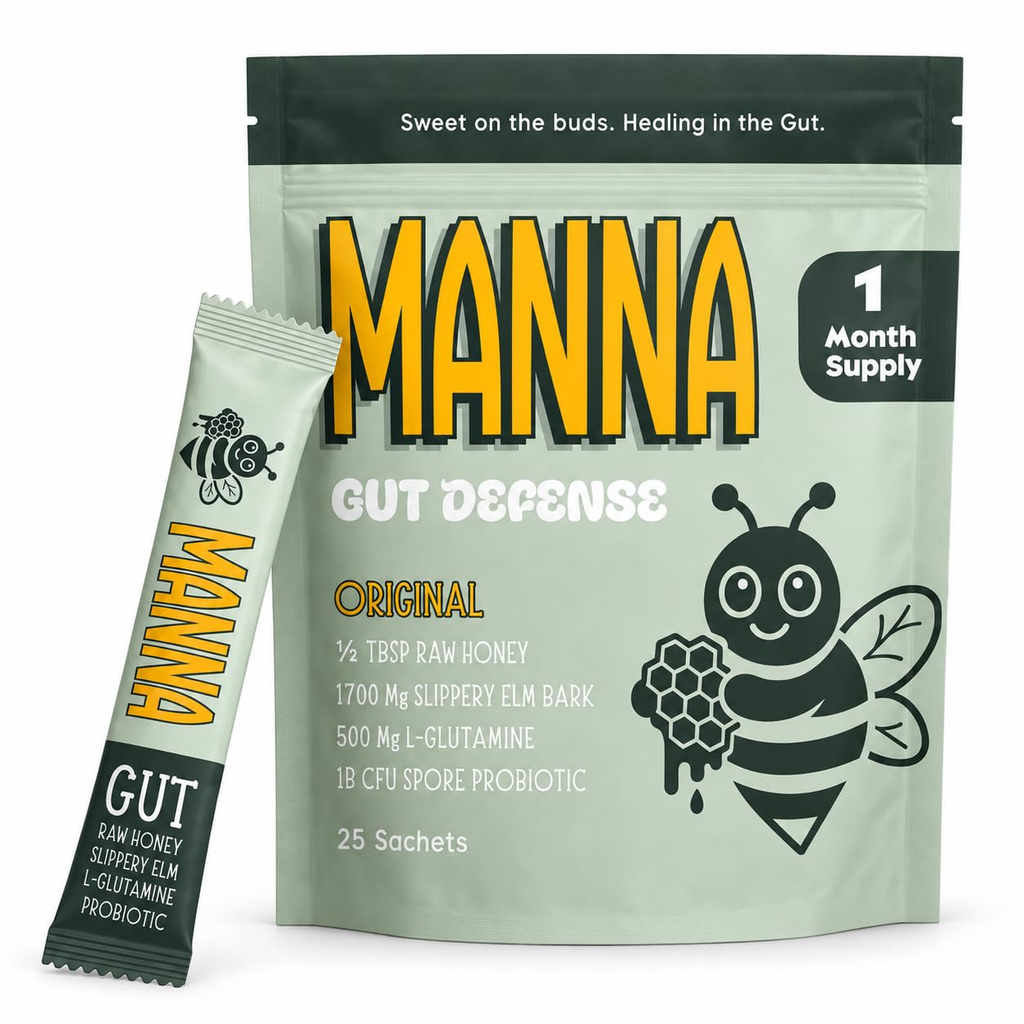
What Is Manna Gut Repair Honey?
Manna Gut Repair Honey is a honey-based digestive supplement sold in individual sachets. The current product page calls it Manna Gut Defense Sachets, although the main website and product branding also refer to it as Manna Gut Repair Honey. Each box contains 25 sachets, with one sachet recommended each day. The current one-time price is $84 plus shipping.
The product is built around four ingredients: raw Canadian clover honey, Bacillus coagulans MTCC 5856, slippery elm bark and L-glutamine.
That is actually a much simpler formula than many of the gut supplements I’ve investigated. The bigger question is whether the company’s claims about what those four ingredients accomplish are justified.
How It Claims to Work
Manna’s entire marketing strategy revolves around the idea that many seemingly unrelated health problems originate with an unhealthy gut. The company claims its raw honey can clear bacterial overgrowth, while Bacillus coagulans supposedly repopulates the gut with beneficial bacteria. Slippery elm is described as coating and soothing the intestinal lining, while L-glutamine supposedly provides the fuel needed to repair damaged gut cells.
The company then connects this proposed process to a huge range of symptoms, including bloating, diarrhea, urgency, brain fog, anxiety, insomnia, fatigue, hormonal problems, skin issues and even ADHD.
That is where the claims start getting much harder to defend.
Reality vs. Claims
There is legitimate science behind one important part of this formula: Bacillus coagulans MTCC 5856. A randomised, double-blind, placebo-controlled trial involving 36 people with diarrhoea-predominant IBS used 2 billion CFU of this strain daily for 90 days and reported improvements in several IBS symptoms, including bloating, diarrhoea, abdominal pain and stool frequency.
A separate 2023 randomized trial involving 70 adults with functional gas and bloating also used 2 billion spores daily and reported improvements in gastrointestinal symptoms over four weeks.
So I wouldn’t dismiss the probiotic as pseudoscience. There is actual human research on this particular strain. But here’s the important distinction: those studies tested the probiotic strain, not Manna Gut Repair Honey.
The researchers did not test raw honey + Bacillus coagulans + slippery elm + L-glutamine in Manna’s sachet. Therefore, the results cannot be presented as clinical proof that Manna repairs the gut or produces the dramatic improvements shown in its testimonials.
Let’s Look at the Listed Ingredients
Manna’s four-ingredient formula is:
- Raw Canadian clover honey
- Bacillus coagulans MTCC 5856
- Slippery elm bark
- L-glutamine
The company says the probiotic is included at 2 billion CFU per sachet, which is useful because it gives us an actual dose to compare with published research.
The other ingredients are less transparent. The product page does not provide equally detailed amounts for the honey, slippery elm and L-glutamine.
That makes the probiotic the easiest component to evaluate scientifically, while the rest are largely supported through general ingredient research and traditional use rather than a clinical trial of this particular combination.
Red Flags to Consider
The Honey Is Supposed to “Clear” Bacterial Overgrowth
This is probably my biggest issue with the marketing. Manna says its raw honey clears bacterial overgrowth in the small intestine because of antimicrobial compounds such as hydrogen peroxide, phenolic acids and defensin-1.
Honey does have antimicrobial properties, particularly in laboratory and wound-care research. But that does not establish that eating raw honey selectively clears bacterial overgrowth in the human small intestine. In fact, honey is still largely a sugar-containing food. The company’s own page acknowledges that each sachet contains about 9.6 grams of honey.
So the leap from “honey has antimicrobial activity” to “this honey clears bacterial overgrowth in your gut” is much bigger than the sales page makes it sound.
“Repairing” the Gut Is Doing a Lot of Work
Manna repeatedly uses language about repairing the intestinal lining. L-glutamine is an important fuel source for intestinal cells, and slippery elm contains mucilage that can form a soothing coating. Those facts are reasonable.
But that doesn’t prove that taking these ingredients together repairs a damaged gut lining in people with IBS, leaky gut or other gastrointestinal disorders.
The product’s slogan makes the mechanism sound established when the finished formula has not actually been tested that way.
The 90% Serotonin Claim
Manna’s marketing says that 90% of the body’s serotonin is produced in the gut and then uses that statistic to connect gut problems with depression, anxiety, sleep problems and brain fog. There is a real gut-brain connection, and the gastrointestinal tract contains a large amount of the body’s serotonin. But that does not mean that gut serotonin simply travels into the brain and determines whether someone is depressed or anxious.
The company’s explanation is considerably more simplistic than the underlying biology. The claim that “the 3 AM wake-up isn’t a sleep problem. It’s a gut problem” is particularly sweeping. There are many possible causes of insomnia, and the product has not been shown to resolve them by repairing the gut.
The Testimonials Go Far Beyond the Evidence
The product page contains testimonials claiming improvements in IBS-D, depression, insomnia, anxiety, long COVID, fibromyalgia, ADHD, postpartum symptoms, chronic fatigue and other conditions.
One testimonial claims that Manna improved depression while the person remained on antidepressants. Another claims it improved ADHD symptoms. Others describe dramatic improvements in chronic fatigue and fibromyalgia.
These are testimonials, not clinical evidence. The company itself actually makes a more careful statement elsewhere, acknowledging that the clinical trial evidence belongs to the probiotic ingredient rather than the finished formula. I appreciate that distinction, but the testimonials and broader marketing still create a much stronger impression than the available evidence supports.
The Review Numbers Don’t Add Up Cleanly
The homepage currently advertises 4.8 stars from 200+ reviews and says Manna has 50K+ happy customers. The product page shows 4.4 stars from 200+ reviews. Then the page presents a large collection of testimonials as “verified buyer reviews.”
None of this proves that the reviews are fabricated. But the difference between 200+ reviews and 50,000+ customers raises an obvious question: where are all those customers, and why is there such a tiny independent review footprint for a product supposedly used by tens of thousands of people?
I would treat the customer numbers as seller-generated claims rather than independent evidence of popularity.
The Website Is Very New
The domain trymannahoney.com was registered on May 26, 2026. That’s important because the website presents Manna as though it has an established customer base and a substantial track record, yet the domain itself is only a few months old.
A young domain doesn’t automatically mean a bad product. A new brand can be perfectly legitimate. But when a very new website is simultaneously claiming 50,000+ happy customers, thousands of units sold and a long-standing wellness philosophy, I want considerably more independent evidence.
The Scarcity Story Is Very Aggressive
The website says Manna comes from a single annual Alberta honey harvest and repeatedly displays messages such as August Sold Out, September 79% Sold and October Available October 1.
It also claims thousands of units were sold during specific months. The annual-harvest explanation could be genuine, but the countdown-style scarcity messaging is still a classic direct-response sales technique. I would not let “limited harvest” messaging pressure me into buying several boxes.
Is Manna Gut Repair Honey Effective?
This is one of those products where my answer is more nuanced than simply calling it useless.
Bacillus coagulans MTCC 5856 has legitimate human evidence. The strain has been studied at 2 billion CFU daily in randomised trials involving IBS and functional gas and bloating.
That’s a meaningful positive. But Manna is not the same thing as the probiotic used in those studies. The finished honey formula has not been subjected to a clinical trial demonstrating that it repairs the gut lining, clears bacterial overgrowth or improves the enormous range of conditions featured in its testimonials.
The honey, slippery elm and L-glutamine may have reasonable roles in a digestive-support formula, but the company’s “clear the overgrowth, rebuild the microbiome, repair the lining” sequence is a proposed mechanism, not a clinically established treatment.
So I would put Manna in the category of plausible gut-support supplement with substantially overextended marketing, rather than a proven gut-repair treatment.
Pricing and Where to Buy
The current direct price is $84 for 25 sachets, which works out to about $3.36 per daily sachet before shipping. The company offers a 100-day money-back guarantee and says no product needs to be returned for a refund. There are also subscription options, and the site encourages customers to maintain a daily routine for 60 to 90 days.
That means following the company’s preferred timeframe could cost more than $250 before shipping, which is a significant amount for a product without a finished-product clinical trial.
What To Do If You Already Bought It
Check the actual sachet or packaging against the ingredient information on the website, particularly the probiotic strain and dosage.
If you bought Manna because you believed it could treat IBS, bacterial overgrowth, depression, ADHD, chronic fatigue or another medical condition, don’t use the product as a substitute for proper diagnosis or treatment.
And if you have diabetes or are watching your blood sugar, remember that this is still a honey-based product containing approximately 9.6 grams of sugar per sachet. The company’s claim that the effect on blood sugar is minimal “for most people” is not something I would generalize to everyone.
Conclusion
Manna Gut Repair Honey is actually more interesting than many of the gut-health supplements I’ve investigated because it contains a specific probiotic strain with real human clinical research behind it. That gives the formula a legitimate scientific starting point.
But the product’s marketing goes much further than that evidence. There is no clinical trial showing that Manna itself clears bacterial overgrowth, repairs the gut lining or improves depression, anxiety, insomnia, ADHD, chronic fatigue and the other conditions appearing in its testimonials. The honey’s antimicrobial properties don’t prove that eating it will selectively eliminate gut bacteria, and the 50,000-customer claim is difficult to reconcile with the site’s tiny independent review footprint and very recent domain registration.
My conclusion: Manna is not an obvious fake supplement, but I would not pay $84 per box based on the “gut repair” claims. The probiotic component is the strongest part of the formula, while the broader gut-healing story is considerably more ambitious than the evidence.
Also read – NeuroRecall Reviews: Is This Memory Supplement Legit? I Investigated
[…] Also read – Is Manna Gut Repair Honey Scam? I Investigated the Gut Supplement […]