

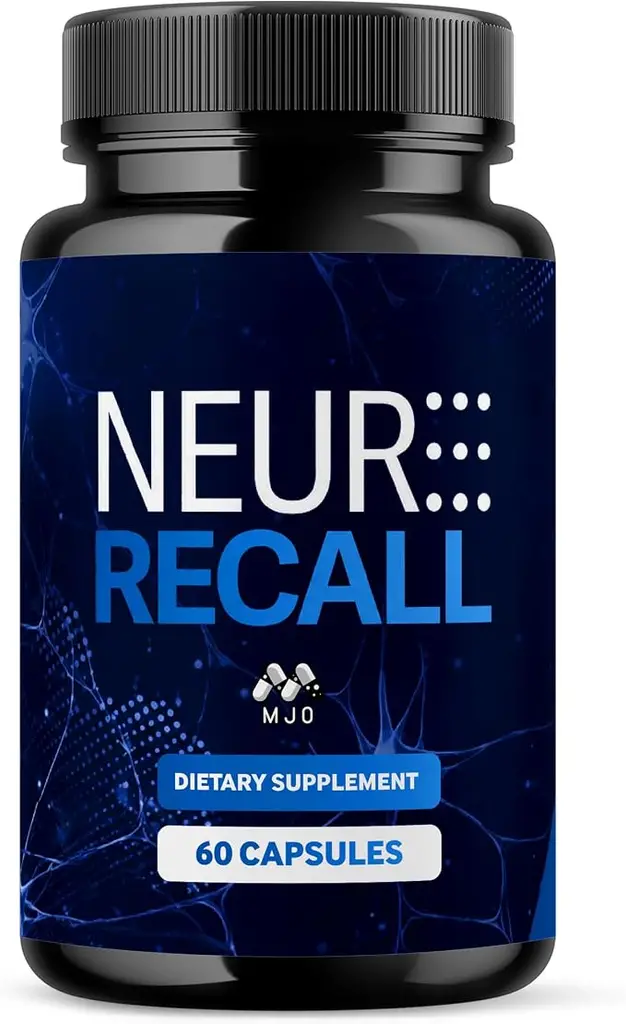
NeuroRecall is marketed as a natural memory and focus supplement that supposedly supports sharper recall, better concentration and overall brain health. But the more I looked into the product, the harder it became to establish which NeuroRecall is actually being sold, because several websites use the same name while listing completely different formulas.
One version even redirects customers to a completely different product called MemoHoney at checkout. Add the extremely young domains, inflated customer claims and lack of a finished-product clinical trial, and there is quite a bit to investigate. So, is NeuroRecall legit? Let’s take a closer look.
Key Takeaways
- NeuroRecall is marketed for memory, focus and mental clarity.
- Different NeuroRecall websites list substantially different formulas.
- One NeuroRecall site reportedly redirects the checkout to MemoHoney.
- The product has no accessible clinical trial showing that NeuroRecall itself improves memory or reverses cognitive decline.
- The websites make strong claims about thousands of customers despite being only weeks old.
What Is NeuroRecall?
NeuroRecall is sold as a daily cognitive-support supplement for adults who want better memory, focus, mental clarity and mental performance. The problem starts with the fact that there is no single, consistent NeuroRecall formula online.
One website lists six ingredients: Ginkgo biloba, Bacopa monnieri, L-theanine, vitamin B12, phosphatidylserine and Rhodiola rosea. Another lists green coffee bean, L-tyrosine, L-theanine, Rhodiola and Huperzia serrata alongside B vitamins. Yet another claims to contain eight ingredients, including Bacopa, Rhodiola, Huperzia serrata and L-tyrosine.
These aren’t minor differences in wording. They are different formulas.
How It Claims to Work
The various NeuroRecall websites use the usual cognitive-supplement pitch: support neurotransmitters, improve blood flow to the brain, protect brain cells from oxidative stress and provide the nutrients needed for memory and concentration. Some versions specifically highlight Bacopa and Huperzia serrata for memory, while others emphasise Ginkgo, phosphatidylserine and Rhodiola.
There is legitimate research behind some of these individual ingredients, but that doesn’t automatically establish that NeuroRecall itself works. Ingredient research and finished-product evidence are two very different things.
Reality vs. Claims
The biggest problem is that I could not find a published clinical trial testing NeuroRecall itself. The websites repeatedly use phrases such as “clinically studied,” “scientifically backed” and “proven ingredients,” but those statements refer to individual ingredients rather than a controlled clinical trial of the actual NeuroRecall formula.
For example, Bacopa has been studied in randomized trials for aspects of memory, while Ginkgo has been extensively researched in cognitive health. But if one NeuroRecall website contains six ingredients and another contains eight completely different ingredients, studies of those individual compounds cannot establish that either bottle produces the advertised results.
The websites also claim that people begin noticing results within a week or several weeks and recommend using the product for three months or longer. I found no product-specific trial establishing those timelines.
Let’s Look at the Listed Ingredients
The ingredient list depends on which NeuroRecall website you are looking at. The most prominent current version lists Ginkgo biloba, Bacopa monnieri, L-theanine, vitamin B12, phosphatidylserine and Rhodiola rosea. Another version instead lists green coffee bean, L-tyrosine, L-theanine, Rhodiola and Huperzia serrata with B vitamins.
Some of these ingredients have legitimate research behind them. Bacopa, for example, has been investigated for memory, while phosphatidylserine and Rhodiola have also been studied in cognitive and stress-related contexts.
But the exact doses are another issue. Several websites don’t provide enough information to determine whether their amounts resemble the doses used in clinical research.
Huperzia serrata also deserves some caution because it is a source of huperzine A, a compound that affects acetylcholine activity and can interact with medications. That makes accurate dosing and proper labeling particularly important.
Red Flags to Consider
Different Products Under One Name
This is the biggest problem. One NeuroRecall website says it contains six ingredients. Another says eight. Another describes a completely different B-vitamin and stimulant-containing formula.
I wouldn’t assume these are simply old and new versions of the same product when the websites present themselves as the official source. A supplement needs a clearly identifiable formula, especially when consumers may be taking other medications or supplements.
The NeuroRecall-to-MemoHoney Checkout Switch
This is an especially serious issue. A recent investigation documented that the NeuroRecall site at neurosrecall.com redirects customers to a MemoHoney checkout. The checkout reportedly displays MemoHoney branding, bottles and product codes rather than NeuroRecall.
That’s not something I would dismiss as a harmless spelling mistake. If someone researched NeuroRecall, decided that its ingredients were suitable for them and then reached checkout only to receive a different product, they would have no reason to assume that MemoHoney has the same ingredients, dosage or safety profile.
Extremely Young Domains
The domain neurorecall.co was registered on August 27, 2026. Another site, neurosrecall.com, was registered around September 6, 2026. Yet these websites already claim thousands of customers, thousands of verified ratings and, in some cases, tens of thousands of bottles shipped.
That doesn’t prove that the customer numbers are fabricated, because a business could theoretically have operated elsewhere before launching a new domain. But the websites don’t provide enough independent information to substantiate those claims.
The 93% Six-Bottle Claim
The NeuroRecall sales page claims that 93% of customers order six bottles and recommends the six-bottle package. The newer sites use similar language, saying most customers choose the six-bottle option.
These are seller-generated numbers rather than independently verified consumer data. They also conveniently encourage customers to spend hundreds of dollars upfront.
“FDA Approved Facility”
Some versions use phrases such as “FDA-approved facility,” while others say “FDA-registered facility.” Those phrases should not be confused with FDA approval of the supplement.
A dietary supplement being manufactured in an FDA-registered facility does not mean the FDA has approved NeuroRecall for memory improvement or determined that it works.
The Reviews Are Difficult to Verify
The websites display impressive numbers such as 4.8-star ratings, thousands of buyers and thousands of verified reviews. But when a website is only weeks old and is simultaneously claiming thousands of customers, those numbers need independent verification before I would treat them as evidence that the product is established.
Testimonials also can’t replace a controlled clinical trial.
Is NeuroRecall Effective?
There is a reasonable argument that some individual ingredients used in the various NeuroRecall formulas may have cognitive or stress-related effects. That is not the same as proving NeuroRecall works.
There is no accessible finished-product clinical trial demonstrating that NeuroRecall improves memory, prevents cognitive decline or produces the timelines promised on its websites.
The formula inconsistency makes the situation even harder to evaluate. I can’t confidently say that a study of Bacopa applies to the NeuroRecall being sold on another website containing a completely different formula.
Until there is one clearly identified product with a transparent label, exact doses and product-specific evidence, I would treat the cognitive claims as marketing rather than established results.
Pricing and Where to Buy
The common NeuroRecall pricing structure is:
- 2 bottles: $158
- 3 bottles: $207
- 6 bottles: $294
That works out to $79, $69 and $49 per bottle, respectively. The websites advertise 60-day money-back guarantees and describe the packages as one-time purchases rather than automatic subscriptions.
The bigger concern for me isn’t the price itself. It’s paying for several months of a product when the identity of the product and even its formula aren’t consistently established across the websites selling it.
What To Do If You Already Bought NeuroRecall
Check the bottle you received against the exact website where you placed the order. Look at the product name, manufacturer, Supplement Facts panel and ingredient amounts. If your order confirmation says NeuroRecall but the package or checkout information says MemoHoney or another product, keep screenshots and copies of all order documentation.
If you purchased several bottles based on the promise of improved memory, don’t assume that taking more bottles will produce better results. And if you take prescription medication or have a medical condition, check the actual ingredient list with a healthcare professional rather than relying on the marketing description.
Conclusion
NeuroRecall isn’t necessarily a fake supplement simply because some of its ingredients have been studied. The bigger issue is that the product being sold is surprisingly difficult to pin down.
Different websites use the NeuroRecall name for different formulas, some exact doses are difficult to verify, the domains are extremely new, and one version reportedly switches the product to MemoHoney at checkout. Meanwhile, the websites make thousands-of-customers claims and strong cognitive promises without providing a clinical trial on the finished product.
My conclusion: I would skip NeuroRecall for now. There are legitimate cognitive ingredients in some of the formulas, but the inconsistent product identity and questionable sales practices make it impossible to confidently evaluate what you’re actually buying.
Also read – Bestetter.com Review: Fake or Reliable Online Shopping Store? Find Out!