

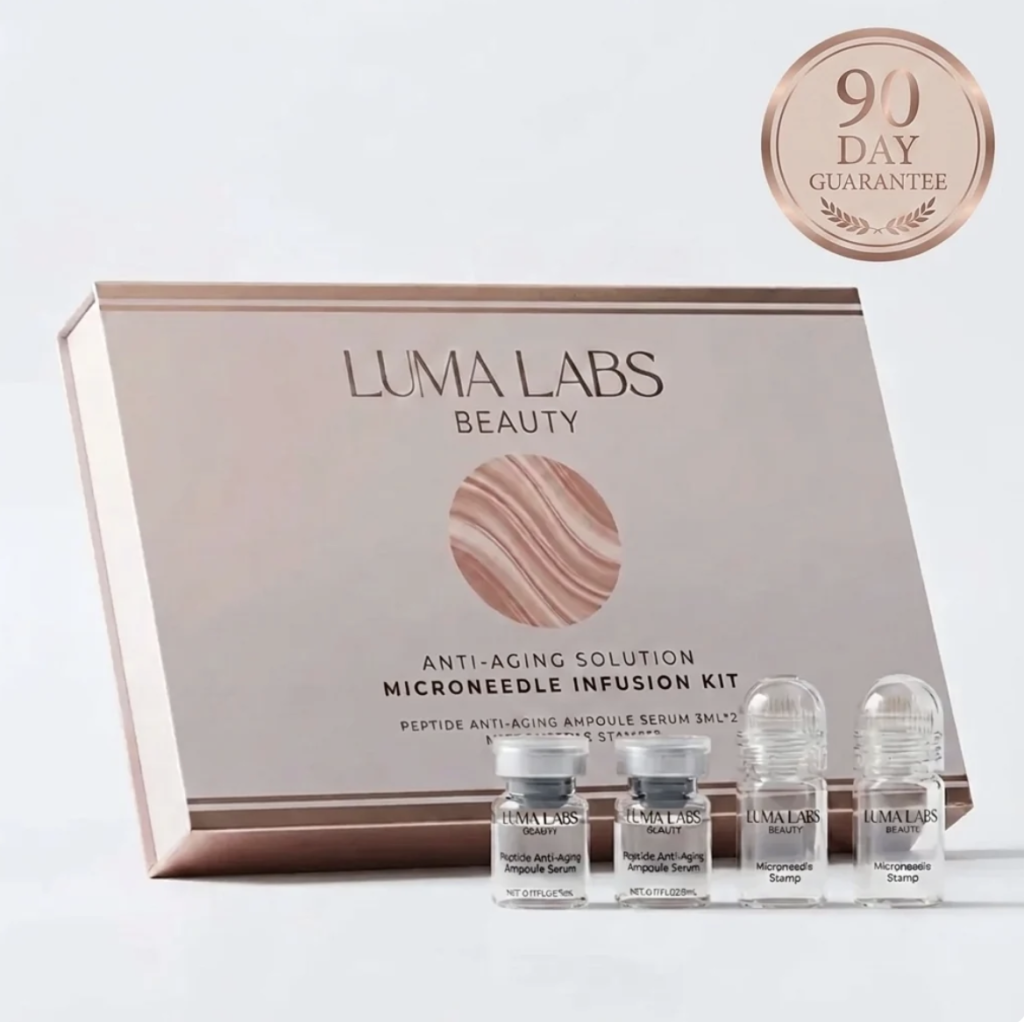
Luma Labs The Formula is a micro-infusion skincare system marketed as an at-home alternative for improving fine lines, firmness, skin texture, and overall radiance. Rather than simply applying a serum, the system uses a stamping device with tiny cosmetic-grade touchpoints to create temporary pathways in the skin while delivering a peptide serum.
There is some legitimate skincare science behind the ingredients, particularly the peptides, glycerin, and hyaluronic acid. But the bigger question is whether an at-home device can actually deliver the dramatic anti-aging results suggested by the marketing.
Key Takeaways
- The Luma Labs Formula combines a micro-infusion stamping device with a peptide serum.
- The serum contains several peptides, glycerin, sodium hyaluronate, mannitol, ergothioneine, and other ingredients.
- The company claims the system is dermatologist tested and third-party tested for safety and efficacy.
- The ingredients have plausible cosmetic benefits, but that doesn’t prove the entire Luma Labs system produces dramatic anti-aging results.
- The company advertises a 90-day money-back guarantee.
- At-home micro-infusion carries more potential for irritation and infection than ordinary topical skincare, so technique and hygiene matter.
What Is Luma Labs The Formula?
The Luma Labs Formula is an at-home micro-infusion treatment consisting of a stamping device and serum ampoules.
The device uses very fine cosmetic-grade touchpoints to create temporary microchannels on the skin. The accompanying serum is then applied through those pathways, with the goal of getting the active ingredients into the skin more effectively than conventional topical application.
The company recommends using the treatment approximately once every two weeks, making it more of an occasional treatment than a daily serum.
How Does Luma Labs The Formula Claim to Work?
The basic premise is twofold.
First, the micro-infusion device temporarily disrupts the skin’s surface barrier. Second, the peptide-rich serum is applied during that window.
Luma Labs claims this combination helps improve the appearance of fine lines, wrinkles, firmness, elasticity, texture, and radiance. The company also says its system supports natural collagen production.
That mechanism is at least biologically plausible. The question is whether the degree of penetration and collagen stimulation achieved by this particular device is enough to produce the dramatic results implied by some of the advertising.
What Does the Evidence Say?
The serum contains some genuinely interesting ingredients.
Acetyl Hexapeptide-8 (often known as Argireline) is a peptide commonly used in anti-aging skincare. It has some evidence for reducing the appearance of expression lines, although it is nowhere near as well established as prescription retinoids.
The formula also contains Palmitoyl Tripeptide-1 and Palmitoyl Tetrapeptide-7, the two peptides associated with the Matrixyl 3000 complex. These have been studied for improving the appearance of wrinkles and skin firmness.
Sodium hyaluronate is a form of hyaluronic acid that attracts and retains water, producing hydration and a temporarily plumper appearance.
Glycerin is another well-established humectant that supports hydration and the skin barrier. Ergothioneine is an antioxidant that may help protect skin from oxidative stress.
So, ingredient-wise, this isn’t nonsense. The serum contains several ingredients that make sense in an anti-ageing formulation. The catch is that ingredient evidence isn’t the same as evidence for the complete Luma Labs system. I couldn’t identify a peer-reviewed clinical trial demonstrating that The Formula itself produces the company’s advertised results.
Red Flags to Consider
The “Clinically Tested” Claim Is Vague
Luma Labs says its solutions are “clinically tested,” “backed by science,” and third-party tested for safety and efficacy on real skin. Those statements sound impressive, but the website doesn’t provide enough detail about the actual testing to determine what was tested, how many participants were involved, how long the study lasted, what the control group was, or whether the study has been independently published.
A product can undergo a small internal consumer test and technically have “clinical” data without having the level of evidence we’d expect from a genuinely well-established anti-aging treatment.
Micro-Infusion Isn’t Completely Risk-Free
The company describes the device as using cosmetic-grade touchpoints and emphasises that the treatment is painless and gentle.
Still, this isn’t equivalent to applying a moisturizer. You’re deliberately creating tiny pathways through the outermost skin barrier. Poor hygiene, excessive pressure, repeated passes, or using the device over irritated or infected skin could increase the risk of irritation, inflammation, or infection.
The company itself advises against using the system over active breakouts, open wounds, or eczema flares.
“Fast Visible Results” Need Some Context
Luma Labs says users can see firmer, smoother-looking skin and a more radiant glow “in just a few uses.”
Some improvement in hydration and surface appearance after a treatment is entirely plausible. But meaningful collagen remodeling is a much slower biological process.
A temporary plumping effect shouldn’t be confused with permanent wrinkle reversal.
The Device May Be Doing More Than the Serum
This is an important distinction. Some of the immediate improvement users see after micro-infusion may come from hydration, mild swelling, and increased blood flow, rather than dramatic structural changes in collagen.
That doesn’t make the product useless, but it means before-and-after photographs taken shortly after treatment may make the results look more impressive than the long-term effect actually is.
Ingredients
The published ingredient list for the peptide serum includes:
- Water
- Glycerin
- Butanediol
- 1,2-Hexanediol
- Hydroxyacetophenone
- Mannitol
- Ergothioneine
- Acetyl Hexapeptide-8
- Acetyl Tetrapeptide-11
- Acetyl Tetrapeptide-9
- Palmitoyl Tripeptide-1
- Palmitoyl Tetrapeptide-7
- Citrus Aurantium Amara (Bitter Orange) Flower Oil
- Sodium Hyaluronate
- Arginine
- Sodium Lactate
- PEG-40 Hydrogenated Castor Oil
- Polysorbate 20
That’s actually a fairly respectable anti-aging serum on paper. The interesting part is the combination of multiple peptides rather than relying on a single trendy ingredient.
Does Luma Labs The Formula Actually Work?
Probably to some degree, but I would temper the expectations.
The serum contains legitimate moisturizing and peptide ingredients capable of improving the appearance of skin. The micro-infusion concept may also enhance delivery compared with simply spreading the serum over intact skin.
What hasn’t been established is that this particular system can produce the kind of substantial collagen remodeling or wrinkle reduction that would make it comparable with professional microneedling or prescription anti-aging treatments.
I’d expect the most believable benefits to be hydration, temporary plumping, smoother texture, and potentially modest improvements in fine lines with consistent use.
I would be considerably more skeptical of dramatic lifting or major wrinkle reversal.
Potential Side Effects
Because the device temporarily disrupts the skin barrier, users may experience:
- Redness
- Tingling
- Mild swelling
- Temporary sensitivity
- Dryness or irritation
- Increased sensitivity to skincare actives
Luma Labs specifically recommends avoiding retinol and other strong actives for 24 hours after treatment to allow the skin to settle.
The company also recommends waiting at least two weeks after injectable cosmetic treatments before using the system.
Pricing and Availability
Luma Labs currently lists The Formula in different treatment quantities. The company’s product page lists approximately $79.99 for one month, $109.99 for two months, and $129.99 for three months, although availability and promotional pricing vary.
The company also advertises a 90-day money-back guarantee.
That makes the three-month package substantially cheaper per treatment than buying individual supplies, assuming you actually use the system consistently.
Alternatives
If your goal is fine lines and overall skin aging, alternatives include:
- Tretinoin — considerably stronger evidence for long-term collagen remodeling and wrinkle reduction.
- Retinol/retinal — gentler over-the-counter retinoid options.
- Vitamin C — useful for antioxidant protection and pigmentation.
- Daily sunscreen — arguably the most important anti-aging product.
- Professional microneedling — substantially more established for collagen induction than an at-home cosmetic micro-infusion device.
- LED red-light therapy — another non-invasive option with some clinical evidence for improving signs of photoaging.
What To Do If You Were Scammed
If you purchased Luma Labs The Formula and never received it, received a damaged or substantially different product, or were charged unexpectedly, contact the seller and request a refund under the advertised guarantee.
Keep your order confirmation, payment receipt, photographs of the product, and screenshots of the original offer. If the seller doesn’t resolve the issue, contact your payment provider.
Conclusion
Luma Labs The Formula is one of the more plausible products in this category. Unlike some of the beauty products we’ve investigated, its serum isn’t built around completely unsupported miracle ingredients. The peptides, glycerin, hyaluronic acid, and antioxidant components all have reasonable cosmetic purposes.
Where I become more cautious is with the micro-infusion device and the marketing surrounding it. There is a meaningful difference between “temporarily helps active ingredients penetrate the skin” and “stimulates enough collagen to dramatically reverse ageing.” The first is plausible; the second needs considerably stronger product-specific evidence than I could find.
The product could be worthwhile for someone who wants an at-home treatment that sits somewhere between ordinary skincare and professional procedures. But if the goal is maximum proven anti-ageing efficacy, I’d still put sunscreen and a retinoid ahead of it, and professional microneedling ahead of an at-home device for more substantial collagen induction.
Also read – Is Gewomex.com a Trustworthy Crypto Exchange Site? Read This Before Signing Up