

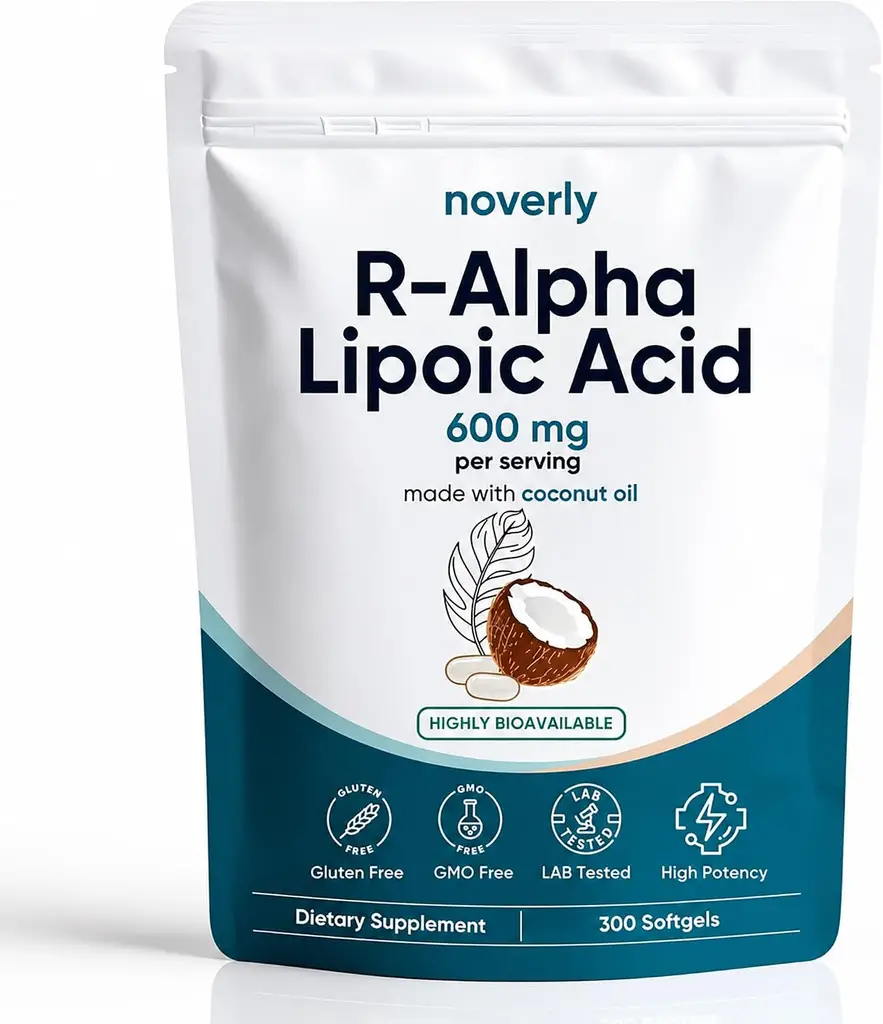
When I came across Noverly R-Alpha Lipoic Acid, I noticed how heavily the brand leans on scientific language. It describes its 600 mg supplement as a pure, biologically active form of alpha-lipoic acid and connects it to nerve health, cellular energy, blood sugar support and antioxidant protection. The product is also marketed to people dealing with symptoms such as burning, tingling and nerve discomfort, which makes its claims particularly important to examine carefully.
Alpha-lipoic acid is a real compound that researchers have studied for years. But I wanted to know whether the research actually supports the specific product Noverly is selling, whether its impressive customer ratings deserve the same confidence as independent evidence, and whether the advertised money-back guarantee is as reassuring as it sounds.
Key Takeaways
- Alpha-lipoic acid is a legitimate supplement ingredient, but evidence for its benefits is mixed. A 2024 Cochrane review concluded that it probably has little or no effect on diabetic neuropathy symptoms after six months of treatment.
- Noverly advertises 600 mg of pure R-alpha-lipoic acid, but I could not verify clinical trials demonstrating that this exact product delivers the promised benefits.
- The brand displays a rating of 4.8 out of 5 from more than 50,000 reviews on its website. A separate investigation also reported a concerning incentive for positive Trustpilot reviews, although that does not establish that all the reviews are fake.
- The advertised 90-day money-back guarantee needs closer scrutiny. A third-party investigation reported that the written refund policy restricts refunds to unopened, sealed bottles.
- At around $49.99 per bottle on the product pages I reviewed, I would want clearer evidence of product quality, more transparent review practices and unambiguous refund terms before buying.
What Is Noverly R-Alpha Lipoic Acid?
Noverly R-Alpha Lipoic Acid is a dietary supplement sold in softgel form. Its principal ingredient is R-alpha-lipoic acid, also called R-ALA, which is a naturally occurring form of alpha-lipoic acid involved in cellular energy metabolism.
The brand markets the supplement for healthy nerve function, antioxidant protection, cellular energy and blood sugar support. Some of its product pages go further, using language that appeals to people experiencing nerve discomfort and suggesting that the supplement can help them feel more comfortable and regain their normal routines.
The product is sold through Noverly’s website, with listings also appearing on third-party shopping platforms. The standard product pages I reviewed advertised a 600 mg dose and prices around $49.99, although other listings displayed different quantities and prices.
The distinction I want to make from the beginning is that a real supplement containing a researched ingredient is not automatically a clinically proven product. Noverly needs to substantiate the claims it makes about its own formulation, not merely point to research involving alpha-lipoic acid in general.
I Dug Deeper Into the Science Behind R-Alpha Lipoic Acid
Alpha-lipoic acid is involved in the chemical reactions cells use to produce energy. It also has antioxidant properties, which is one reason researchers have investigated its potential role in conditions associated with oxidative stress.
There are two forms of the molecule, R and S. The R-form occurs naturally in the body, while conventional alpha-lipoic acid supplements commonly contain a mixture of both forms. Noverly emphasises that its product contains only the R-form, presenting this as a major advantage over ordinary alpha-lipoic acid supplements.
That distinction is relevant when comparing formulations, but it does not settle the question of effectiveness. To establish that the R-form product works better for a particular health outcome, we need appropriate comparative research. The fact that one form occurs naturally does not, by itself, prove that a supplement containing only that form produces superior results in people.
Does alpha-lipoic acid help with nerve pain?
This is one of the most important questions because Noverly markets its supplement for nerve health and refers to research on diabetic neuropathy.
The evidence is not as straightforward as the sales language may suggest. A 2024 Cochrane review examined randomised trials involving alpha-lipoic acid for diabetic peripheral neuropathy. It included three studies with 816 participants and found that alpha-lipoic acid probably had little or no effect on neuropathy symptoms after six months of treatment. The review also noted limitations in the available evidence.
That does not prove alpha-lipoic acid can never help anyone. It means that the best available long-term evidence reviewed by Cochrane did not establish a meaningful benefit for the symptoms measured at six months.
This is an important qualification when a supplement is marketed to people experiencing burning, tingling or discomfort. Someone reading a product page might reasonably assume that the ingredient has been proven to relieve those symptoms, but the actual research is more uncertain.
What about the studies Noverly references?
Research involving alpha-lipoic acid, including well-known studies of diabetic neuropathy, has investigated particular formulations, doses and treatment methods. Some earlier studies reported improvements in certain symptom measures under the conditions tested.
However, those findings do not automatically demonstrate that Noverly’s oral 600 mg pure R-form softgel produces the same results. Differences in formulation, route of administration, treatment duration and the outcome being measured all matter.
I could not verify a published clinical trial showing that Noverly’s finished product repairs damaged nerves, reliably relieves nerve symptoms or produces the full range of benefits suggested by its marketing.
The issue is not that the company should never discuss research on an ingredient. It is that the relationship between the research and the product needs to be presented accurately. Studies of alpha-lipoic acid are not equivalent to clinical validation of Noverly.
The 600 mg Claim: Does a Clinical Dose Mean a Proven Product?
Noverly repeatedly highlights its 600 mg dose, describing it as the exact dose used in clinical research. That sounds reassuring, especially to someone comparing supplements that offer different amounts.
But matching the dose used in a study does not mean matching the study’s results.
The formulation, the population studied, the treatment period and the outcome measured all affect how relevant a study is to a product. Even when two products contain the same amount of an ingredient, their quality and performance cannot be assumed to be identical.
Noverly also emphasises that its supplement contains pure R-ALA rather than a conventional mixture of R and S forms. That is a formulation distinction worth investigating, but the company would need suitable comparative evidence to establish that its particular product produces superior results.
The website says the supplement is third-party lab tested. I could not independently verify a publicly available certificate of analysis establishing the finished product’s identity, potency and purity. That does not prove the product has not been tested. It means I could not confirm the claim from the documentation I found.
For a supplement charging a premium on the strength of its purity and formulation, I would like to see a current, product-specific laboratory report or other verifiable quality documentation.
The Bigger Problem: Noverly Markets the Same Ingredient for Many Different Conditions
This was one of the more interesting things I found while investigating the brand. Noverly does not market R-alpha-lipoic acid solely as a general antioxidant or nerve-support supplement. Its website has separate product pages targeting different concerns, including nerve discomfort, carpal tunnel, PCOS, wound support, blood sugar and liver health. Some of these pages use the same central ingredient while changing the surrounding story to address a different audience.
For example, the PCOS page links R-ALA to insulin resistance, chin hair, skin problems and irregular cycles. The liver-support page promotes a separate three-in-one formula containing R-ALA, dihydroberberine and liposomal glutathione. The carpal-tunnel page presents R-ALA as support for the nerve under compression.
There is a legitimate reason a compound might be investigated for several biological processes. Alpha-lipoic acid has been studied in different medical contexts. The problem arises when a brand turns preliminary or mixed research into a series of confident product promises without demonstrating that the specific formulation works for each condition.
Evidence relating to blood sugar is not automatically evidence that a supplement treats PCOS. Research into diabetic neuropathy does not establish that an oral product resolves carpal tunnel syndrome. And antioxidant activity does not demonstrate that a supplement heals wounds.
I could not verify product-specific clinical trials supporting the wide range of outcomes suggested across these Noverly pages.
This marketing approach does not, by itself, prove fraud. It does make me question how much of the product’s apparent specificity comes from demonstrated clinical results and how much comes from tailoring the sales pitch to people searching for help with particular health problems.
The 50,000-Plus Reviews: Should You Trust the Rating?
Noverly’s website displays a rating of approximately 4.8 out of 5 and more than 50,000 reviews. At first glance, that is an impressive number. Most shoppers would naturally assume that a product with that many positive reviews has a well-established record of customer satisfaction.
But there are two important limitations.
First, the rating is displayed on the seller’s own website. Customer reviews can be useful, but a store-hosted rating is not independent clinical evidence. Even genuine customers who report feeling better cannot establish that the supplement caused the improvement or that it will work for other people.
Second, I found a separate investigation published in October 2026 that reported a potentially serious issue with Noverly’s Trustpilot review practices. According to that investigation, a review promotion offered a gift worth $45 for four- or five-star reviews, included suggested talking points and reportedly did not require reviewers to have tried the product first.
If accurately described, that would be a significant concern. Offering a reward specifically for a positive rating can undermine the reliability of a review score, especially when the product is marketed to people seeking relief from health symptoms.
I could not independently verify the underlying promotion, so I would not present that report as definitive proof of review manipulation. Nor does it establish that all Noverly reviews are fake. But it is a serious enough allegation that I would want the company to explain its review practices before relying on its ratings.
The sheer size of the website’s review count does not resolve the question. What matters is whether reviews come from genuine purchasers, whether incentives are disclosed and whether customers are free to leave negative feedback without losing a reward.
For now, I would treat the headline rating as a marketing claim rather than a reliable measure of clinical effectiveness.
The 90-Day Money-Back Guarantee Needs a Closer Look
Noverly advertises a 90-day money-back guarantee. That sounds appealing because supplements are often marketed as products that require several weeks of consistent use before customers can judge their effects.
However, the October 2026 investigation I reviewed reported that the written refund policy restricts returns to unopened, sealed bottles.
If that restriction applies to the purchase in question, it creates an obvious problem. A customer buys the supplement to find out whether it works, opens the bottle, uses it and then discovers that the product has not helped. If opened bottles are excluded, the guarantee may offer far less practical protection than the headline suggests.
I could not independently confirm that this restriction applies to every current offer, so I would check the actual policy linked at checkout rather than assume every product page has identical terms.
Before ordering, I would ask the company to confirm in writing whether a bottle can be opened and used during the 90-day period and still qualify for a refund. I would also clarify whether shipping fees are refundable, whether the customer must pay return shipping and whether the guarantee applies to every bottle in a multi-bottle order.
A guarantee is only reassuring when its terms are clear and match the impression created by the advertisement.
How Much Does Noverly R-Alpha Lipoic Acid Cost?
The standard product pages I reviewed advertised a 600 mg R-ALA product for around $49.99 per pouch. Another listing displayed $59.99, and third-party listings included different quantities and serving information.
Those differences make it important to check which exact product is being sold. A 30-softgel pouch and a listing containing hundreds of softgels are not equivalent purchases, even if the product titles look similar. At $49.99 for a 30-day supply, the cost is approximately $1.67 per day. If the supplement is intended for several months of use, the total cost adds up quickly.
A higher price is not automatically evidence of poor value. A product may cost more because of its formulation, manufacturing, testing or other factors. But Noverly’s emphasis on pure R-ALA makes verifiable quality documentation especially relevant.
I would not pay a premium simply because the website uses phrases such as “clinical dose,” “biologically active” or “pure R-form.” I would want to understand what independent evidence supports the product’s quality and what evidence supports the benefits being advertised.
Is Noverly R-Alpha Lipoic Acid Safe?
Alpha-lipoic acid has been studied in clinical research, and it is generally tolerated by many people. However, it can cause side effects, including headache, heartburn, nausea and vomiting.
There are also important considerations for people managing blood sugar. Alpha-lipoic acid has been studied for its effects on glucose metabolism, so anyone taking insulin or other glucose-lowering medication should consult a healthcare professional before using it. They should not assume that a supplement marketed as natural is free of interactions or risks.
People who are pregnant or breastfeeding, have an underlying medical condition or take prescription medication should also seek appropriate medical advice before starting the supplement.
If someone is experiencing persistent tingling, burning, numbness or nerve pain, the underlying cause matters. These symptoms can have different explanations, and a supplement should not delay evaluation or replace an established treatment without medical guidance.
Red Flags Worth Considering
I would not call Noverly a confirmed scam based on the information available. There are, however, several reasons I would be cautious about buying it.
- Broad health claims: The brand markets R-ALA toward numerous conditions, but I could not verify clinical trials demonstrating that the specific product delivers all the benefits suggested.
- Research does not equal product validation: Evidence involving alpha-lipoic acid in general does not automatically establish the effectiveness of Noverly’s pure R-form softgels.
- Unverified testing documentation: The brand says its product is third-party tested, but I could not independently verify a public certificate of analysis for the finished product.
- Questions about review credibility: A separate investigation reported a promotion rewarding positive Trustpilot reviews. The allegation requires confirmation, but it warrants caution.
- A potentially restrictive refund policy: The reported unopened-bottle requirement could make the 90-day guarantee much less useful for customers who have actually tried the supplement.
- Pricing and listing inconsistencies: Different pages display different prices and quantities, so buyers need to confirm the exact product and total cost before paying.
None of these points proves that the capsules are counterfeit or that the product contains no alpha-lipoic acid. They do, however, weaken the case for trusting the marketing without further verification.
What Are the Alternatives?
If someone is considering alpha-lipoic acid for a specific health concern, I would start by identifying the goal rather than choosing a product based on its claims.
For nerve symptoms associated with diabetes, speak with a healthcare professional about established options and the evidence for any supplement being considered. The Cochrane review’s findings are a reason not to assume that alpha-lipoic acid will reliably relieve symptoms over the long term.
If the goal is general antioxidant support, I would be cautious about spending nearly $50 on a supplement whose advertised benefits extend across numerous medical concerns without clear product-specific evidence.
For people who still want to purchase alpha-lipoic acid, compare products based on the exact amount per serving, formulation, independently verifiable quality testing, seller transparency and clear refund terms. A simpler, less expensive product with credible testing may be a better purchase than one relying heavily on an elaborate sales pitch.
Conclusion: Is Noverly R-Alpha Lipoic Acid Worth Buying?
My verdict is I would not recommend buying it on the strength of its current marketing.
The underlying ingredient is legitimate, and alpha-lipoic acid has been investigated for several health outcomes. But the evidence is mixed, and the 2024 Cochrane review found that it probably has little or no effect on diabetic neuropathy symptoms after six months.
Noverly’s emphasis on pure R-ALA does not establish that its product is superior, and I could not verify clinical trials demonstrating that the finished supplement produces the benefits suggested by its marketing. The reported review incentive and the potential restriction on its money-back guarantee add further questions that the company should answer.
I cannot establish that Noverly is committing fraud, that its capsules are fake or that every positive review is unreliable. But a real product can still be marketed with claims that go beyond the available evidence.
At approximately $49.99 per pouch, I would want clearer product-specific evidence, verifiable quality documentation, more transparent review practices and an unambiguous refund policy before spending my money.
Bottom line: Noverly R-Alpha Lipoic Acid is a real supplement offer built around a legitimate ingredient, but I would not confuse that with proof that this particular product works as advertised. Until the company provides better transparency, I would keep my money.
Also read – I Bought Stimulicat Instinct Basket for My Cat: Here’s My Honest Review