

After my experience with PurePod Produce Cleaner, I still had questions about these produce-cleaning devices, particularly the dramatic changes in water that are supposed to show what has been removed from your fruit. Several readers suggested that I try purified or distilled water, so when I came across PodBloom, I decided to give another one a try and see whether having a second device to compare against PurePod would finally make things a little clearer.
Unfortunately, after using PodBloom for about a month, I ended up with a different result, but not necessarily a clearer answer.
Key Takeaways
- I used PodBloom for approximately one month rather than judging it after a single use.
- I tested it with fresh fruit and store-bought fruit from different stores.
- Apart from the color, the PodBloom device looked almost identical to my PurePod.
- The indicator light came on, but PodBloom did not bubble the way my PurePod did.
- The water remained completely clear, including when I used it with strawberries.
- Because the device wasn’t behaving the way I expected, I eventually contacted the manufacturer because I believed my unit wasn’t working properly.
- The manufacturer told me they would issue a refund through PayPal and that I did not need to return the product.
- When I checked PayPal, however, I had not received the promised refund.
- When I tried to process a return myself, I discovered that the product would need to be shipped back to China.
- While trying to figure out whether I had simply received a defective unit, I looked more closely into the brown-water effect and found other people questioning what actually causes it.
- After testing both products, I don’t think brown or yellow water should automatically be treated as proof that contaminants have been removed from produce.
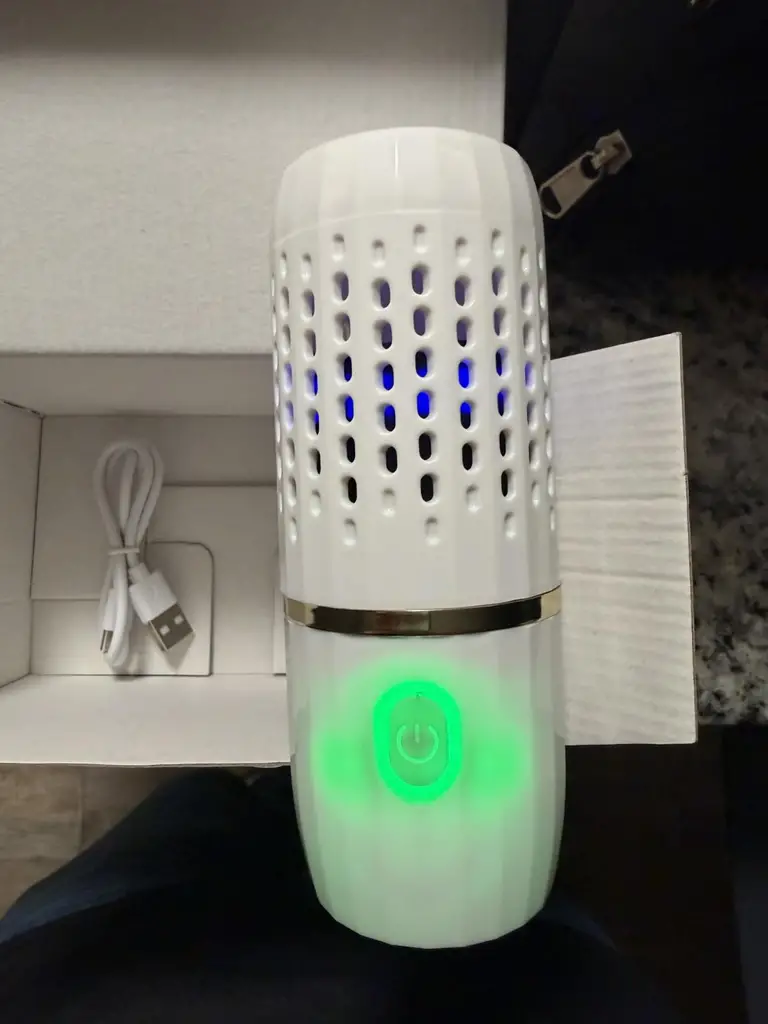
What Is the PodBloom Produce Cleaner?
PodBloom is a portable electronic produce-cleaning device designed to be placed in water with fruits and vegetables. The idea is that instead of simply rinsing your produce under running water, you can put it into a bowl or container with the device and allow the cleaning process to take place, which is obviously appealing if you regularly buy things like strawberries, grapes, apples or leafy greens and would rather not spend forever washing them individually.
I was particularly interested in PodBloom because this wasn’t my first experience with a product like this. I’d already tested PurePod, so I wasn’t approaching PodBloom wondering whether a produce cleaner could possibly be useful; I was approaching it with a much more specific question about whether another device would behave similarly and perhaps help me understand what I had actually seen during my first test.
And when PodBloom arrived, the similarity between the two was immediately noticeable. Apart from the color, the devices looked almost exactly the same, which naturally made me expect that the experience would be fairly similar too.
It wasn’t.
Why I Tried PodBloom
My reason for buying PodBloom was directly connected to my previous PurePod review, which ended up generating far more discussion than I expected, particularly around the water-only experiment I conducted.
When I tested PurePod, I noticed the water changing visibly during use, but the part that really stuck with me was what happened when I ran it without any fruit or vegetables in the water. The water still changed, which made me question whether the dramatic discoloration was actually showing me contaminants being removed from the produce or whether something else was happening during the process.
The comments from readers made that question even more interesting. Several people asked whether I had tried distilled or purified water, while others suggested that electrolysis could be responsible for the discoloration rather than the device somehow pulling visible contaminants out of the fruit.
I didn’t have a definitive answer, and I still don’t. So, when I found PodBloom, I thought trying another device would be much more useful than simply continuing to speculate about PurePod. If PodBloom produced the same kind of result, that would give me something else to consider; if it behaved completely differently, that would also be useful information.
What I wasn’t expecting was for it to look almost identical to PurePod while behaving so differently.
My Experience Using PodBloom
The first thing I noticed when I actually started using PodBloom was that, visually, it reminded me so much of PurePod that I was expecting the two experiences to be nearly interchangeable. Apart from the colour, the devices looked almost the same, so I naturally assumed that once I turned PodBloom on, I’d see something similar to what I had already seen with PurePod.
Instead, the indicator light came on, but PodBloom wasn’t bubbling. That was immediately noticeable to me because the bubbling was something I had actually observed with PurePod, so I knew what I was looking for. With PodBloom, the light gave me an indication that the device had been switched on, but I wasn’t seeing the same bubbling activity, and that difference made me wonder fairly early on whether my particular unit was functioning properly.
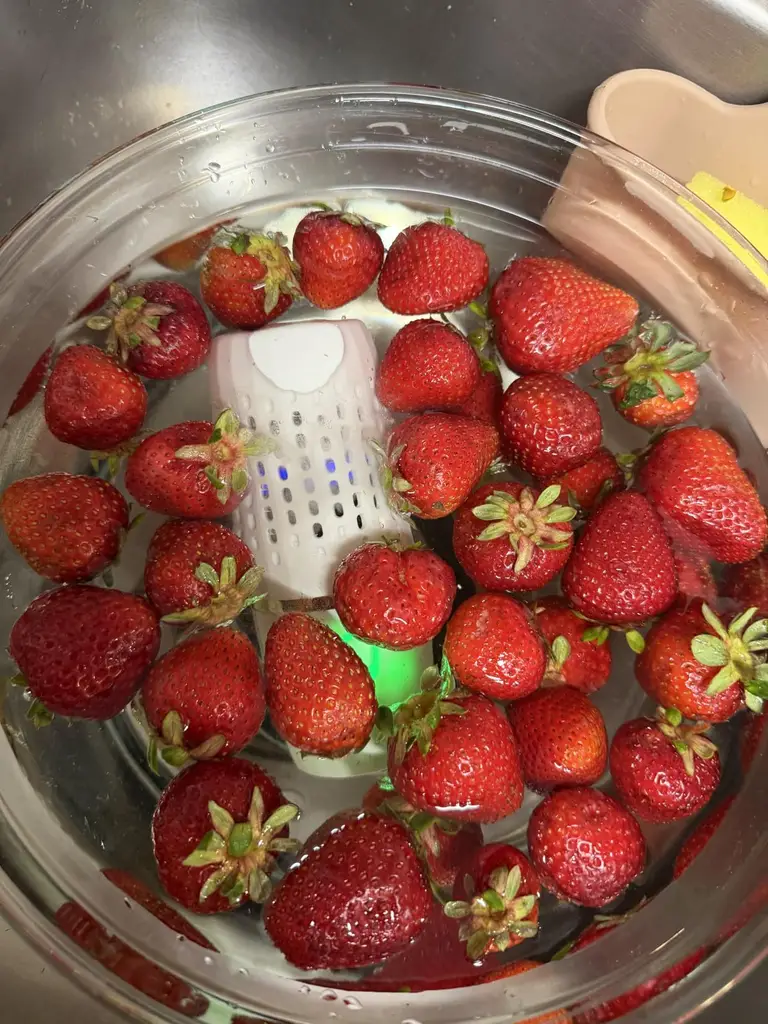
I didn’t immediately throw it into the defective-product category, though, because I wanted to give it a proper chance rather than deciding after one use that something was wrong. I used PodBloom for approximately a month and deliberately tried it with different produce, including fresh fruit and store-bought fruit from different stores, because I wanted to see whether the results changed depending on what I was putting into the water.
I also used strawberries because they were one of the fruits I had previously tested with PurePod, which gave me a particularly useful comparison. And throughout all of this, the water remained clear.
This was probably the strangest part for me because I had gone into the experiment expecting something to happen visually, even if it wasn’t necessarily going to be exactly the same as PurePod. Instead, I could put strawberries and other produce into the water, run the device, and come back to water that looked essentially the same as when I started.
There was no brown water, no yellowing and no dramatic cloudiness that would make me look at the bowl and think, “Okay, I can actually see what this thing has removed.”
And because the device also wasn’t visibly bubbling the way PurePod had, I couldn’t simply shrug and say that PodBloom must work differently. I started wondering whether I had received a bad unit.
That seemed like a reasonable possibility, especially because the product wasn’t completely unresponsive. The light came on, so it wasn’t as though I had plugged in something that was obviously dead, but the absence of the bubbling I’d seen with PurePod made it difficult for me to feel confident that my PodBloom was actually doing what it was supposed to be doing.
Eventually, I contacted the manufacturer and explained that I didn’t believe the product was working properly and wanted a refund.
They told me that they would send the refund through PayPal and that I didn’t need to return the product, which sounded like a fairly straightforward solution. Unfortunately, when I checked PayPal, I couldn’t find the refund, so the situation wasn’t quite as neatly resolved as I had expected.
I then tried to process a return myself, and that’s when I discovered that the product would need to be shipped back to China. At that point, I had already spent about a month testing a device that I wasn’t convinced was functioning properly, I was still waiting for a refund I had been told was coming, and I now had an international return process to contend with as well.
Rather than immediately buying another PodBloom just to determine whether mine was defective, I decided to look more closely at the thing that had originally made these products so interesting to me in the first place: the brown water.
The Brown Water Question
This is where my previous PurePod experience became relevant all over again. When I first tested PurePod, I naturally assumed that seeing visibly discolored water meant the device had removed something from the produce. It was a pretty compelling visual, particularly when you’re used to simply rinsing fruit under the tap and seeing absolutely nothing happen.
But then I ran the device without any produce in the water and still saw discoloration and particles, which made me question exactly what I was looking at. I went into much more detail about that experiment in my original PurePod review, but the discussion in the comments actually sent me down a rabbit hole of questions about electrolysis, purified water and whether the brown material was coming from the produce at all.
Several readers specifically asked whether I had tried distilled water or another form of highly filtered water, while others suggested that the electrical process itself could be responsible for making substances already present in the water more visible.
Then, while researching PodBloom, I came across people who said they had experienced the yellowing effect with their own units, which made my experience even more confusing. If other people were getting the result shown in the advertising while my device wasn’t even visibly bubbling like my PurePod, then perhaps I really had received a defective unit.
But that still doesn’t answer the bigger question of what the brown water actually represents.
One particularly interesting comment I found argued that the brown sludge was coming from the device rather than the fruit, questioned some of the product’s “supercharging” terminology, and claimed that food safety experts say a similar effect could be achieved simply by stirring baking soda into tap water.
I’m not presenting that comment as scientific proof because I haven’t independently verified every part of it, but I think the criticism raises an important question that applies to these products generally: if the water turns brown, what exactly is turning it brown?
Because brown water certainly looks convincing, but the appearance of the water alone doesn’t tell me what caused the color change.
Why Didn’t My PodBloom Turn the Water Brown?
I wish I could give you a definitive answer, because this is where the entire experience gets frustrating. The simplest explanation is that my unit may have been defective. The light came on, but the device wasn’t bubbling the way my PurePod did, and after repeated use with different produce, I never saw the brown or yellow water that other users apparently experienced.
That combination certainly gave me reason to believe something wasn’t right with my particular unit. But there is another possibility: perhaps PodBloom simply operates differently from PurePod and isn’t supposed to produce the same visible bubbling or discoloration.
The problem is that I don’t have enough information to confidently tell you which explanation is correct.
And because I didn’t want to spend more money buying a second PodBloom simply to find out whether my first one was defective, I had to work with the evidence I actually had.
What I had was a device that looked almost identical to PurePod, had a light that came on, didn’t visibly bubble like PurePod, and produced clear water even after a month of testing.
That’s not enough for me to say that PodBloom definitely doesn’t work, but it’s also not enough for me to tell you that it does.
Did PodBloom Actually Work?
This is probably the hardest question to answer because clear water doesn’t automatically mean nothing happened, just as brown water doesn’t automatically prove that a device removed pesticides or other contaminants from your produce.
There are obviously things that could potentially be removed from produce without being visible to the naked eye, so I wouldn’t use my clear water as proof that PodBloom accomplished absolutely nothing.
At the same time, I don’t think it’s fair to tell you that the product worked simply because I turned it on and allowed it to run. I don’t have before-and-after testing that shows what was removed from the strawberries or what changed in the water, and the fact that my unit wasn’t visibly bubbling made me even less confident about assuming everything was operating normally.
So my conclusion is fairly simple: my experience didn’t give me enough evidence to say that PodBloom worked as advertised.
That’s particularly disappointing because the whole reason I bought it was to get a better comparison after my PurePod experience.
PodBloom vs. PurePod
This was the comparison I actually wanted.
My PurePod test gave me visible bubbling and visible changes in the water, although those changes eventually raised more questions than answers for me.
PodBloom looked almost identical apart from the color, but when I used it, the light came on without the same bubbling activity I had seen with PurePod, and the water remained clear even when I used it with strawberries.
So I can’t honestly tell you that PodBloom is better than PurePod, and I certainly can’t tell you that PurePod is better than PodBloom based on what I experienced.
What I can tell you is that testing both products has made me much more skeptical about treating the appearance of the water as a simple scorecard for how well a produce cleaner is working.
PurePod gave me a dramatic visual result that I couldn’t confidently explain. PodBloom gave me almost no visible result, along with a device that didn’t appear to be operating in the same way as PurePod.
And somehow, neither experience gave me the definitive answer I was hoping to get from buying a second device.
Is PodBloom a Scam?
I wouldn’t personally call PodBloom a scam based solely on my experience, because I don’t have enough evidence to make that accusation.
What I do have are some fairly significant questions about the product and its marketing, particularly when it comes to the way consumers are encouraged to interpret the brown or yellow water that appears in demonstrations.
My own unit didn’t produce that effect at all, and because it also wasn’t bubbling like the PurePod I had previously tested, I couldn’t confidently determine whether I was seeing a different operating method or a defective product.
The fact that other people report getting the yellowing effect makes the situation even harder to interpret, because it suggests that my experience may not be representative of every PodBloom unit.
So I’m not going to tell you that clear water means PodBloom is useless, just as I wouldn’t tell you that brown water automatically means a produce cleaner has removed pesticides from your fruit.
I simply don’t think the visual evidence is enough to make either conclusion.
My Refund Experience
Unfortunately, the customer-service side of the experience didn’t give me much more confidence. After using PodBloom for approximately a month and deciding that I didn’t believe my unit was working properly, I contacted the manufacturer and requested a refund. They told me that they would issue the refund through PayPal and that I didn’t need to return the product.
That sounded fairly reasonable, but when I checked PayPal, I hadn’t received the refund.
I then tried to process a return myself, only to discover that the product would need to be shipped back to China.
That was particularly frustrating because I had already spent a considerable amount of time testing the product, I wasn’t convinced that my particular unit was functioning correctly, and I was now dealing with an unresolved refund as well as an international return option.
At that point, I decided that buying another unit just to satisfy my curiosity wasn’t worth it.
What I Liked
- The concept is convenient and easy to understand, particularly if you regularly buy a lot of fresh produce.
- The device is compact and doesn’t require an elaborate setup.
- I appreciated having another product to compare with my previous PurePod experience.
- Using it over a month gave me enough time to see that the clear-water result wasn’t simply a one-time fluke.
What I Didn’t Like
- The device did not visibly bubble the way my PurePod did.
- Although the indicator light came on, I couldn’t confidently tell whether my unit was functioning properly.
- The water remained completely clear, including when I tested it with strawberries.
- I couldn’t independently verify what, if anything, was being removed from my produce.
- The promised PayPal refund had not appeared when I checked.
- I discovered that returning the product would involve shipping it back to China.
Alternatives
- Veggie Wash Fruit & Vegetable Wash
- Baking soda and water
- Plain water and physical rubbing
Conclusion
I bought PodBloom hoping it would help answer some of the questions I had after testing PurePod, but unfortunately, it left me with even more uncertainty. The device looked almost identical to PurePod, yet the light came on without the same bubbling, and even after using it for about a month with different produce, the water never turned brown or yellow.
Maybe I received a defective unit, or maybe PodBloom simply works differently. I genuinely can’t say. What I do know is that the experience wasn’t convincing enough for me to recommend the product, especially with the unresolved refund situation and the uncertainty around what the water changes with these devices actually mean.
Would I buy it again?
No. I don’t have enough confidence in the product to spend money on another unit.
Would I recommend it?
Not based on my experience. After testing both PodBloom and PurePod, I’m much more cautious about treating brown water as proof that a produce cleaner has actually removed contaminants from your food.
Check out my review of the PurePod Produce Cleaner