

Restolin is marketed as a natural hair-health supplement that promises to support thicker hair, reduce shedding and improve scalp health from within. But the more I looked into the formula and its claims, the more the gap between nutritional support and actual hair regrowth became clear.
The product contains recognizable vitamins and plant extracts, but most of the formula is hidden inside a proprietary blend, and there is no clinical trial showing that Restolin itself can reverse baldness or regrow lost hair. So, is Restolin legit? Let’s take a closer look.
Key Takeaways
- Restolin is a real hair supplement containing vitamins, selenium and antioxidant botanicals.
- The finished product has not been clinically tested for hair regrowth.
- Most of its botanical ingredients are hidden inside a 1,512 mg proprietary blend.
- The marketing appears to exaggerate what an antioxidant supplement can do for baldness.
- Restolin may offer nutritional support, but it is not equivalent to proven hair-loss treatments.
What Is Restolin?
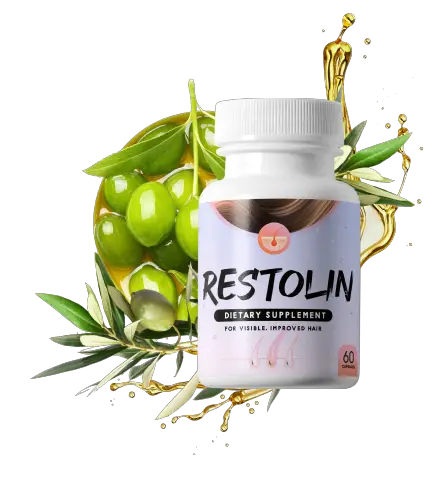
Restolin is an oral hair-health supplement sold in capsule form. Each bottle contains 60 capsules, and the recommended serving is two capsules daily.
The product is marketed toward men and women experiencing thinning, shedding or reduced hair density. Its central theory is that oxidative stress and inflammation may contribute to hair problems, so supplying antioxidants and plant compounds could help create a healthier environment for the scalp and hair follicles.
That idea is not completely unreasonable. Nutritional deficiencies can contribute to hair shedding, and oxidative stress has been investigated in relation to hair loss. However, supporting general scalp health is very different from reversing baldness or restoring hair in areas where follicles are no longer functioning properly.
How It Claims to Work
Restolin is built around antioxidant and nutritional support. Vitamin C supports collagen production and normal connective tissue function, while vitamin E acts as an antioxidant. Selenium is involved in normal thyroid function and antioxidant defence. The remaining ingredients are mostly plant extracts traditionally associated with immune support, inflammation, circulation or general wellness.
The marketing suggests that this combination can help address the underlying causes of hair loss, including oxidative stress around the follicles.
The problem is that Restolin does not provide clinical evidence showing that its complete formula can treat the different causes of hair loss. Hair shedding can result from genetics, hormonal changes, thyroid problems, illness, stress, medication, nutritional deficiencies or scalp conditions. One antioxidant blend is unlikely to address all of those causes.
Reality vs. Claims
There is some scientific plausibility behind parts of the formula, but the advertising goes much further than the evidence.
Vitamin E, for example, has been studied in relation to hair health. A small human study involving tocotrienols, a particular form of vitamin E, reported an increase in hair count among participants with hair loss. But that study did not test Restolin, and ordinary vitamin E in Restolin should not automatically be treated as equivalent to the tocotrienol preparation used in that research.
The same issue applies to the herbs. Green tea, grape seed, ginseng, turmeric and other botanicals have antioxidant or anti-inflammatory properties, but evidence from laboratory studies or animal research does not prove that taking Restolin will regrow hair in humans.
The dramatic before-and-after images used in hair supplement marketing are also difficult to verify. A picture of a bald or thinning scalp becoming visibly fuller does not establish what caused the change, how long it took or whether the person even used the product shown.
Let’s Look at the Listed Ingredients
Restolin lists vitamin C, vitamin E and selenium individually. The label gives 30 mg of vitamin C, 20 mg of vitamin E and 20 mcg of selenium.
The rest of the formula is placed inside a 1,512 mg proprietary blend containing ingredients such as graviola, red raspberry, green tea, beta-glucan, turmeric, pine bark, Essiac tea complex, grape seed, shiitake, reishi and maitake mushrooms, quercetin, pomegranate, olive leaf, arabinogalactan, cat’s claw, garlic, Panax ginseng and lycopene.
The issue is not necessarily that these ingredients are fake. The issue is that their individual amounts are not disclosed.
That means I cannot tell whether Restolin contains a meaningful amount of green tea, ginseng, pine bark or any other botanical. A long ingredient list can look impressive, but without individual doses, it is difficult to compare the formula with actual research.
Restolin also contains soy, which is important for anyone with a soy allergy.
Red Flags to Consider
The Marketing Suggests More Than the Formula Can Prove
Restolin is promoted with the kind of before-and-after imagery commonly used by hair-growth supplements. Some of the advertising implies that users can go from bald or visibly thinning to a fuller head of hair.
That is a major leap from what the formula can reasonably establish. An antioxidant supplement may be useful if someone has a nutritional deficiency or if it provides general nutritional support. But there is no good evidence that Restolin can reverse genetic baldness or reliably restore hair in areas affected by advanced hair loss.
The Proprietary Blend Hides the Important Details
The 1,512 mg blend contains a large number of ingredients, but the label does not explain how much of each one is included. This makes it impossible to determine whether the formula is properly dosed or whether some ingredients are present only in token amounts.
It also makes it difficult to assess safety, particularly when several botanicals are combined and the consumer may already be taking other supplements.
“FDA-Registered Facility” Is Not FDA Approval
The sales page promotes manufacturing in an FDA-registered or accredited facility and refers to GMP production. That may be a positive manufacturing detail, but it should not be confused with FDA approval of Restolin’s effectiveness.
Dietary supplements are not approved by the FDA in the same way as prescription medicines before being sold. A registered facility does not prove that the finished product works for hair loss.
The Six-Bottle Recommendation Is Aggressive
Restolin is sold in one-, three- and six-bottle packages, with the six-bottle option promoted as the best value. The company also encourages buyers to purchase several months’ worth because results supposedly take time.
That is common supplement marketing, but it creates a problem when the finished product has not been clinically tested. I would not commit to six months of an unproven hair supplement simply because the per-bottle price is lower.
Hair Loss Can Have Treatable Causes
Another concern is that people may use Restolin instead of investigating why their hair is shedding. Sudden, rapid or patchy hair loss can be associated with medical conditions, hormonal changes, thyroid problems, nutritional deficiencies, medication or scalp disease. Taking an antioxidant blend without identifying the cause could delay more appropriate treatment.
Is Restolin Effective?
Restolin may provide some nutritional or antioxidant support, particularly for someone whose diet is lacking certain nutrients. However, that is a much more modest claim than saying it regrows lost hair.
The finished product has not been clinically tested, and there is no strong evidence showing that Restolin can reverse baldness, restore a receding hairline or treat genetic pattern hair loss. The formula also does not appear to contain a clearly established hair-loss treatment comparable to minoxidil. Even if some of the ingredients have research behind them, studies on individual ingredients cannot be used as proof that the complete Restolin formula works.
My assessment is that Restolin is more plausible as a general nutritional supplement than as a genuine hair-regrowth treatment.
Pricing and Where to Buy
Restolin is currently advertised at:
- One bottle: $69
- Three bottles: $177, or $59 each
- Six bottles: $294, or $49 each
Each bottle is presented as a 30-day supply, and the company advertises free shipping in the United States. The product is sold through an online checkout handled by BuyGoods and is promoted with a 60-day money-back guarantee. The sales page describes the purchase as a one-time payment rather than an automatic subscription.
Even so, buyers should save the order confirmation, refund terms and product-page screenshots before paying.
What To Do If You Already Bought Restolin
If you have already purchased Restolin, compare the bottle’s Supplement Facts label with the ingredients advertised on the website. Do not exceed the recommended serving, and be careful about combining it with other products containing selenium or vitamin E. Excessive selenium intake can itself contribute to hair loss, while high doses of certain nutrients may cause other problems.
If you have sudden, patchy or rapidly worsening hair loss, see a dermatologist or qualified healthcare professional rather than relying on the supplement alone.
If Restolin does not meet your expectations, use the stated 60-day guarantee and keep records of your order and refund request.
Conclusion
Restolin appears to be a real supplement rather than a completely nonexistent product. It has a disclosed label, recognizable ingredients, an established checkout provider and a stated money-back guarantee.
However, that does not mean it is a proven hair-growth treatment.
The strongest parts of the formula are its general nutritional and antioxidant ingredients, but most of the botanicals are hidden inside a proprietary blend, and there is no clinical trial showing that Restolin itself can regrow hair or reverse baldness.
My conclusion: Restolin may offer modest nutritional support, but I would not buy it expecting dramatic hair regrowth. The marketing is much stronger than the evidence, and anyone experiencing significant hair loss would be better served by finding the cause and considering treatments with actual clinical support.
Also read – Midea 12-in-1 Electric Pressure Cooker Review: Is It Worth It? I Bought It!