

Vision Hero is marketed as a natural eye-health supplement that can improve visual clarity, protect the retina and even help restore declining vision. But the product has a much bigger problem than questionable ingredient claims: Vision Hero has been promoted through fake celebrity endorsements, including deepfake videos of Dr. Phil and Steve Harvey, while sales pages have claimed it can restore 20/20 vision and reverse serious eye conditions.
The formula contains some legitimate nutrients associated with eye health, but the marketing goes far beyond what those ingredients have actually been shown to do. So, is Vision Hero legit? Let’s take a closer look.
Key Takeaways
- Vision Hero is a real supplement being sold online, but that does not make its health claims legitimate.
- Fake/deepfake celebrity endorsements involving Dr. Phil and Steve Harvey have been documented in Vision Hero advertising campaigns.
- The product’s current formula includes ingredients such as lutein, zeaxanthin, bilberry, alpha-lipoic acid, taurine, vitamins and minerals, but many plant ingredients are contained in a proprietary blend.
- There is no clinical trial showing that Vision Hero itself restores 20/20 vision, reverses cataracts or glaucoma, or reverses general vision loss.
- The strongest evidence for nutritional eye supplements comes from the specific AREDS2 formula for people with intermediate or advanced AMD, not from Vision Hero’s broader vision-restoration claims.
What Is Vision Hero?
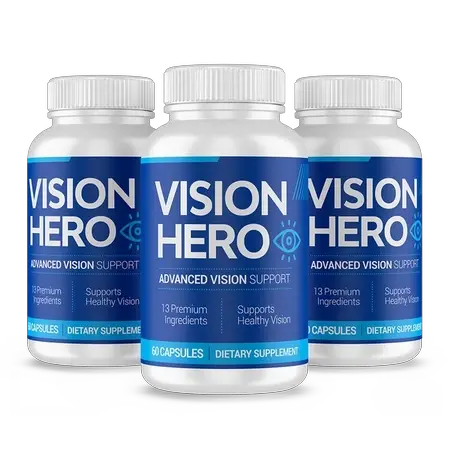
Vision Hero is a dietary supplement sold as an advanced vision-support formula. Current sales pages describe it as a daily capsule intended to support visual clarity, retinal health and protection against age-related vision decline. The current product page promotes a 180-day money-back guarantee and lists ingredients including alpha-lipoic acid, lutein from marigold extract, quercetin, rutin, lycopene, taurine, grape seed extract, vitamins A, B7, C and E, several minerals and bilberry.
Another current product description lists a 60-capsule bottle and a 240.5 mg proprietary blend containing ingredients such as lutein, zeaxanthin, bilberry and eyebright, alongside 13 vitamins and minerals. That already gives me something important to point out: Vision Hero’s formula is not described consistently across all of the websites using the Vision Hero name.
That makes it difficult to know whether every Vision Hero advertisement is selling exactly the same product.
How Vision Hero Claims to Work
The marketing revolves around the idea that vision declines because the eyes accumulate oxidative damage and a substance called lipofuscin. The company describes alpha-lipoic acid as a “toxin scavenger” that removes lipofuscin from the retinal pigment epithelium. It also claims that lutein strengthens the RPE, quercetin repairs damaged eye cells, and various antioxidants protect the retina.
There is some legitimate biology underneath this. The retina does experience oxidative stress, and lutein and zeaxanthin are concentrated in the retina and macula. The National Eye Institute notes that these carotenoids have important functions in the retina and can act as antioxidants and filters for damaging high-energy light. But that does not mean taking Vision Hero will reverse existing vision loss.
That is where the marketing makes a major leap.
The Biggest Red Flag: The Celebrity Videos
This is where Vision Hero moves beyond an ordinary, overhyped supplement. Vision Hero has been promoted through fake celebrity endorsement campaigns. A documented campaign used deepfake footage of Dr. Phil, making it appear that he was endorsing and reviewing Vision Hero. The associated sales funnel claimed the supplement could restore perfect 20/20 vision and overcome conditions including cataracts, glaucoma, myopia and blurry vision.
Another documented campaign used Steve Harvey in a similar deepfake promotion, with claims that Vision Hero could reverse vision loss by 82%. These are not minor exaggerations. A celebrity appearing to personally recommend a health product is fundamentally different from a company saying, “our ingredients have been studied.”
If the video is fabricated, the entire credibility mechanism of the advertisement is fabricated with it.
The “Restore 20/20 Vision” Claim
This is probably the claim I would pay the most attention to. Some Vision Hero advertising has presented the product as a natural way to regain perfect 20/20 vision without surgery, glasses or eye exercises.
There is no credible evidence that a capsule can generally restore 20/20 vision in people with refractive errors. If someone is nearsighted, farsighted or has astigmatism, the underlying optical problem does not simply disappear because they take antioxidants.
And cataracts and glaucoma are not conditions that should be treated by replacing medical care with an online supplement. Cataracts involve clouding of the eye’s lens and are treated medically, while glaucoma involves damage to the optic nerve that can lead to irreversible vision loss.
That makes the “one natural solution for everything” presentation particularly concerning.
Red Flags to Consider
Fake Celebrity Endorsements
The documented Dr. Phil and Steve Harvey campaigns are the biggest red flag here. The advertisements were designed to make viewers believe recognisable television personalities were personally endorsing Vision Hero when the promotional videos were actually manipulated.
That is a completely different situation from a legitimate supplement company simply using a celebrity’s photograph in an advertisement.
Multiple Vision Hero Websites
There are numerous domains currently using the Vision Hero name, including several highly similar “official” websites. Some list different ingredient combinations and different descriptions of the formula.
That makes it difficult to establish a single, consistent product identity. One current domain also receives a 0 trust score from ScamAdviser, with the service flagging the site’s young age, hidden WHOIS information and other risk indicators. That is not proof by itself that the product is fraudulent, but it adds another reason to be careful about where the product is purchased.
Seller-Controlled Testimonials
The sales pages contain dramatic testimonials describing people supposedly seeing better than they have in decades. One version features a 77-year-old customer claiming that he was told his vision was so poor he might have to stop driving, then saying Vision Hero restored his ability to see clearly.
Testimonials are not clinical evidence. Even if every person quoted were genuine, we would have no way of knowing whether the changes were caused by Vision Hero, changes in prescription, natural fluctuations, treatment from an eye doctor or something else entirely.
Confusing Clinical Language With Clinical Evidence
Vision Hero repeatedly uses phrases such as “clinically researched,” “clinically verified,” and references research institutions. But there is a huge difference between an ingredient having been studied and the finished Vision Hero product having been clinically proven.
I found no convincing evidence of a randomized controlled trial demonstrating that Vision Hero itself restores vision or reverses eye disease.
What About the Money-Back Guarantee?
The current sales pages advertise a 180-day money-back guarantee, including claims that even empty bottles can be returned for a refund. That is better than a product offering no refund policy at all. But I would not let a guarantee persuade me that the product works.
A money-back guarantee protects the purchase to some extent. It does not validate the medical claims. There are also customer complaints associated with Vision Hero’s broader sales operation. One BBB review, for example, describes a customer who said the product produced no benefit and that a refund request was denied because the customer was outside the stated 180-day period.
That is one customer’s account, so I would not treat it as proof of a systematic refund problem. But it is still worth keeping in mind when the sales page heavily emphasizes a guarantee.
Is Vision Hero Effective?
There are legitimate nutrients in the formula. That is the part that makes this product more complicated than simply calling it “fake.” Lutein and zeaxanthin have legitimate roles in retinal health, and specific high-dose nutritional formulations can slow AMD progression in appropriate patients.
But Vision Hero has not been shown to:
- Restore 20/20 vision
- Reverse myopia
- Reverse cataracts
- Cure glaucoma
- Reverse general vision loss
- Restore damaged eyes
- Eliminate the need for glasses
And that distinction is crucial. If someone has an actual eye disease or unexplained change in vision, taking Vision Hero instead of getting an eye examination could delay treatment for something that needs medical attention.
Is Vision Hero a Scam?
I would separate the product itself from the marketing operation. There appears to be an actual supplement being sold, and the current formula contains legitimate nutritional ingredients. But the documented use of fake celebrity endorsements, exaggerated vision-restoration claims, multiple sales domains and inconsistent formula descriptions makes the overall marketing operation extremely difficult to trust.
So I would skip Vision Hero. Not because every ingredient is useless, but because the product is being sold with claims that go far beyond what those ingredients have been demonstrated to accomplish.
What I Would Choose Instead
If the goal is general eye nutrition, I would start with the basics rather than buying a supplement that promises to restore eyesight. And if someone actually has intermediate AMD, that is where the evidence-based AREDS2 formulation becomes relevant. The National Eye Institute specifically recommends discussing AREDS2 with an eye-care professional because it is intended for particular stages of AMD, not as a general vision-enhancement supplement.
That is very different from Vision Hero’s “restore your vision” marketing.
Conclusion
Vision Hero is a good example of why I don’t judge a supplement simply by looking at its ingredient list. There are legitimate eye-health ingredients here, particularly lutein and zeaxanthin. But those ingredients do not magically transform the product into a treatment for vision loss.
The much bigger issue is the way Vision Hero has been marketed. Documented campaigns have used deepfake videos of Dr. Phil and Steve Harvey to create fake celebrity endorsements, while associated sales pages have promoted extraordinary claims about restoring 20/20 vision and reversing eye conditions.
There is also no finished-product clinical evidence showing that Vision Hero can do what those advertisements promise. So, while I would not say the capsule itself is imaginary, I would not buy Vision Hero based on its advertised vision-restoration claims.
If you’re looking for genuine eye-health support, there are much better-established options, and if your vision is actually deteriorating, an eye examination is far more important than another bottle of capsules.
Also read – NFLGlow Review: I Dug Into the Football Projector Before Buying