

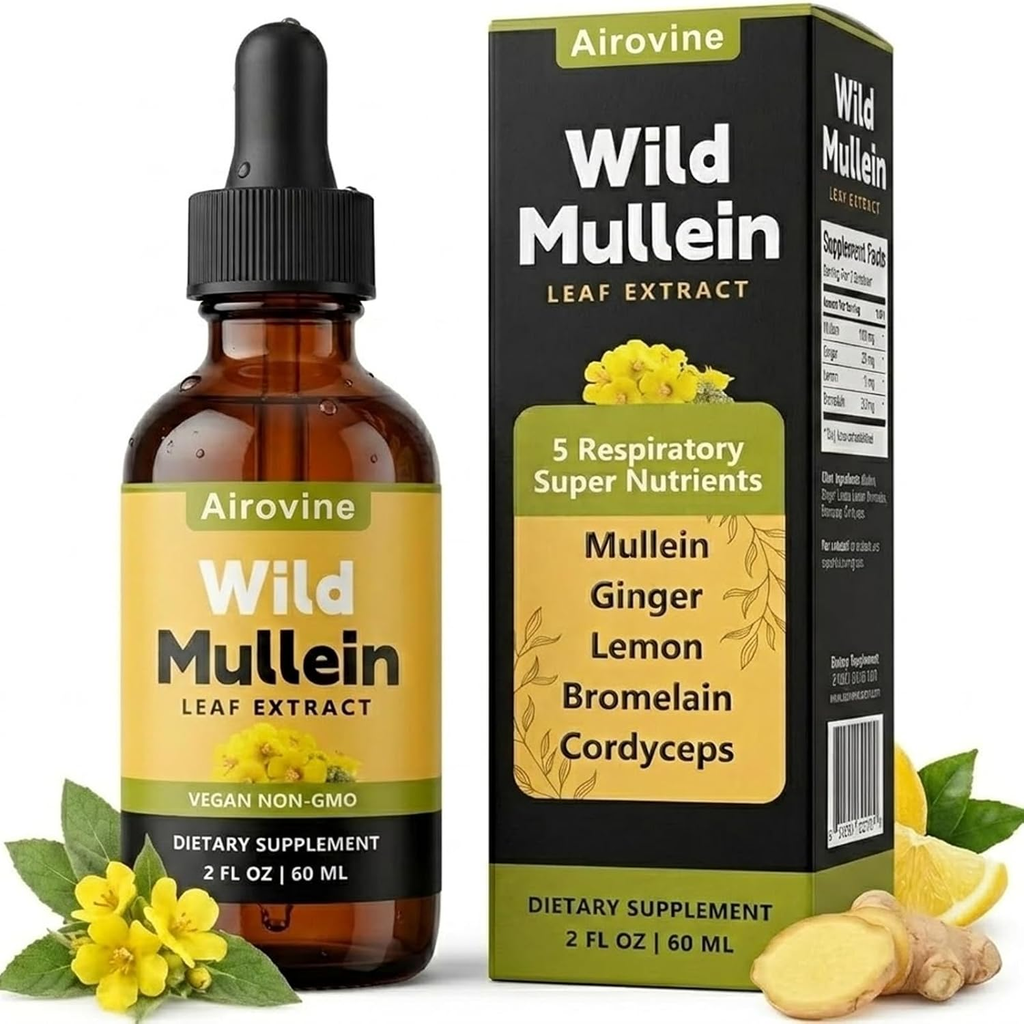
Airovine Wild Mullein Drops is marketed as a natural way to “clear” your lungs, loosen mucus and make breathing easier. But the advertising goes considerably further than ordinary herbal respiratory support. Airovine tells smokers and people with COPD that their lungs aren’t necessarily failing; they’re supposedly “clogged” with hardened mucus and tar, which the company calls “Lung Glue.”
That immediately caught my attention because we’re no longer talking about a supplement that merely supports respiratory health. Airovine is making specific claims about COPD, wheezing, airway obstruction, tar buildup and even how its ingredients supposedly dissolve material inside the lungs. So, I looked into what is actually in these drops and whether the science supports what the sales page is promising.
Key Takeaways
- Airovine contains mullein, cordyceps, ginger, bromelain and lemon peel.
- The company claims its mullein extract is equivalent to 2,000 mg and can break down a supposedly hardened “tar” layer in the lungs.
- Airovine explicitly markets the product toward smokers, former smokers and people with COPD.
- I couldn’t find clinical evidence showing that Airovine clears lung tar, reverses COPD or removes a substance called “Lung Glue.”
- The claim that the drops have 85–95% bioavailability compared with 15–25% for capsules is presented on the sales page without supporting clinical evidence that I could verify.
- There are also some odd inconsistencies around the company’s guarantees and subscription terms that I’d want to resolve before ordering.
- So while I wouldn’t say the bottle itself is imaginary, I have serious doubts about the medical story being used to sell it.
What Is Airovine Wild Mullein?
Airovine is a liquid herbal supplement intended to be taken under the tongue. The current product page says to use two droppers each morning, hold the liquid under the tongue for 30 seconds and then swallow.
The product is positioned as a “Daily Lung Clearance Protocol,” particularly for people dealing with mucus, chest heaviness, coughing, wheezing or breathing discomfort.
And then the marketing gets much more ambitious. Airovine says that years of smoking, pollution, illness and irritation can leave a hardened layer of mucus and other material coating the airways. It calls this “Lung Glue” and claims its formula can dissolve and clear it.
That’s the claim I wanted to investigate most.
What’s Actually in Airovine?
The formula contains five main ingredients:
Mullein leaf extract, cordyceps, ginger, bromelain and lemon peel.
That’s actually a fairly straightforward formula, so let’s look at what each ingredient can and can’t reasonably be expected to do.
Mullein
Mullein is the star of the show, and it’s been traditionally used for respiratory complaints.
Airovine says its wild mullein extract is equivalent to 2,000 mg and describes it as capable of breaking down the sticky material supposedly coating the airways.
The problem is that traditional respiratory use is not evidence that mullein dissolves tar or hardened mucus attached to bronchial walls.
I couldn’t find clinical evidence demonstrating that oral mullein extract removes smoking-related tar deposits from the lungs.
So there’s a reasonable distinction here:
“Mullein has traditionally been used for respiratory comfort” — fair.
“2,000 mg of mullein dissolves lung tar like soap dissolves grease” — that’s a very different claim.
Cordyceps
Cordyceps has been studied for exercise performance, fatigue, inflammation and respiratory-related outcomes.
Airovine describes it as supporting oxygen utilisation and respiratory stamina. That’s plausible as a general supplement claim, but I didn’t find evidence that cordyceps “powers your cilia” to sweep dissolved tar out of the lungs as Airovine claims.
That particular mechanism sounds considerably more certain than the evidence allows.
Ginger
Ginger has genuine biological activity and has been studied for inflammation, nausea and various other conditions. Airovine says it helps with airway comfort and claims it can “open constricted airways” and reduce bronchial spasms.
Again, that’s where I would be careful. Ginger isn’t an established bronchodilator equivalent to an inhaled medication prescribed for obstructive airway disease.
Calling it a supportive botanical is one thing. Suggesting it opens constricted airways in a way that can address COPD is another.
Bromelain
Bromelain is a group of enzymes derived from pineapple. It has been studied for inflammation and other conditions.
Airovine makes a particularly interesting claim about it: that bromelain “dissolves the protein bonds holding Lung Glue to your bronchial walls.”
That sounds wonderfully scientific. But I couldn’t find evidence showing that orally consumed bromelain travels to the bronchial walls and selectively dissolves a layer of hardened mucus and tar.
That’s a perfect example of something that sounds mechanistically plausible while requiring considerably more evidence before I’d accept it as fact.
Lemon Peel
Lemon peel contains various plant compounds and antioxidants. Airovine describes it as supporting respiratory resilience and protecting lung tissue from oxidative stress.
That’s a relatively modest claim compared with the others.
But antioxidant activity doesn’t mean lemon peel can repair smoking-related lung damage or reverse COPD.
The “Lung Glue” Problem
This is easily the biggest issue I found. Airovine repeatedly describes “Lung Glue” as hardened mucus, tar and other buildup coating the airways and supposedly causing COPD symptoms.
The company then positions Airovine as something that dissolves this material. The problem?
“Lung Glue” isn’t a recognized medical diagnosis or established cause of COPD.
COPD is a chronic lung disease involving persistent respiratory symptoms and airflow limitation, with processes including airway inflammation/remodeling and destruction of lung tissue in emphysema. It isn’t simply a case of the lungs being coated in a removable layer of “cement.”
That distinction matters enormously. If the underlying explanation is wrong, then the entire “we found the root cause and created a supplement that removes it” story becomes much less convincing.
The COPD Claims Are Where I Become Especially Skeptical
Airovine’s sales page literally says:
“Your lungs aren’t failing. They’re blocked.”
It then tells people with COPD that the condition is supposedly caused by hardened mucus buildup that inhalers don’t address.
That is a very serious claim. The company is effectively positioning its supplement as something that addresses the underlying problem, while conventional treatments supposedly only mask symptoms.
And that’s dangerous territory because someone with COPD could read that and conclude that their prescribed inhaler isn’t actually treating the important part of their disease.
A supplement shouldn’t be marketed in a way that encourages someone with a chronic lung disease to distrust or abandon evidence-based treatment.
The “85–95% Bioavailability” Claim
This was another claim that made me pause.
Airovine says its liquid delivery provides 85–95% bioavailability, compared with 15–25% for traditional capsules, and says this is why the drops can work in minutes rather than hours.
That’s a very specific number. But the page doesn’t provide a clinical study establishing those percentages for this particular formula. And “liquid” does not automatically mean that 95% of every active compound gets absorbed into the bloodstream.
Bioavailability varies enormously depending on the particular compound, formulation, metabolism and route of administration.
So I’d treat those percentages as marketing claims, not established facts, unless Airovine can produce the pharmacokinetic data behind them.
Reality vs. Claims
Here’s where I think the product falls apart a little. There is nothing inherently absurd about making an herbal respiratory-support supplement containing mullein, ginger, cordyceps and bromelain.
The problem is that Airovine doesn’t stop there.
It takes those ingredients and builds a story around removing hardened tar from the lungs, clearing COPD airway buildup, opening constricted airways and restoring breathing.
I couldn’t find clinical evidence that the finished Airovine formula does those things. And I definitely couldn’t find evidence establishing that the lungs develop the specific removable “Lung Glue” layer described by the company.
Red Flags to Consider
“Works Without Quitting”
Airovine actually advertises itself as being suitable for smokers and says “No Quitting Required.” That’s probably my least favourite claim on the entire website.
Smoking cessation is one of the most important things a smoker can do to reduce ongoing lung damage. Positioning a supplement as something that can clear the consequences without requiring the smoker to stop sends a very misleading message.
“Results From Day 1”
The website says customers may experience changes beginning on Day 1, with increasingly dramatic improvements over the following weeks.
Those timelines appear to be based on customer reports and marketing illustrations rather than a controlled clinical study of Airovine.
That’s not enough for me to treat the timeline as established.
The “Doctor” Sales Page
One Airovine promotional page features “Dr. Hannah Collins,” described as a board-certified pulmonologist and respiratory health specialist, introducing the product and explaining why it works.
That’s exactly the sort of thing I would independently verify before trusting the endorsement. A professional-looking photograph and credentials displayed on a sales page are not, by themselves, proof of a genuine independent medical endorsement.
Conflicting Guarantee Terms
This one is more concrete. The product page advertises a 60-day money-back guarantee, but an investigation published August 24, 2026, found that Airovine’s Terms and Conditions separately referenced a 180-day guarantee. The same investigation also found inconsistencies between the advertised 30-day refill schedule and language in the refund policy referring to 60-day or selected billing cadences.
Those aren’t details I’d ignore when a product uses recurring subscriptions. Before ordering, I’d want the exact renewal amount and billing frequency clearly displayed at checkout.
Does Airovine Actually Work?
I don’t see enough evidence to say that it does what the advertising promises. There may be legitimate reasons someone could take an herbal respiratory supplement and feel that it agrees with them. Mullein has traditional respiratory uses, and some of the other ingredients have interesting biological properties.
But that is very different from proving that Airovine:
- dissolves lung tar,
- removes “Lung Glue,”
- clears COPD,
- opens obstructed airways,
- repairs smoking damage, or
- makes inhalers unnecessary.
I couldn’t find clinical evidence supporting those claims for the finished product. And the fact that the company can describe the mechanism in impressive-sounding language doesn’t change that.
Is Airovine Safe?
I wouldn’t call it automatically dangerous simply because it’s herbal.
But “natural” does not mean “cannot interact with medications.”
And because the product is being marketed toward people with COPD and other respiratory problems, I’d be especially cautious about using it in place of prescribed treatment.
Airovine itself tells customers taking medication or managing a medical condition to consult a healthcare provider.
That’s good advice. I’d also be cautious about the product’s claim that it does not interfere with common medications, because the evidence presented on the sales page isn’t enough for me to make that blanket assurance myself.
Pricing and Where to Buy
The Airovine site currently advertises a 60-day money-back guarantee, although pricing and promotional offers vary across its sales pages.
I also found Airovine Wild Mullein listed elsewhere under the VOKIMAX manufacturer/brand information, which adds another wrinkle to the question of who actually manufactures the product.
That’s something I’d want clarified before treating Airovine as a transparent supplement brand.
What To Do If You Were Scammed
If you bought Airovine because you were told it could clear COPD or remove lung tar, save the advertisement and sales page immediately.
Keep your order confirmation, screenshots of the price, the product label and any subscription information. If you were charged unexpectedly, contact the seller in writing and request cancellation/refund while keeping copies of everything.
If the company doesn’t resolve an unauthorised or disputed charge, contact your card issuer or payment provider. And most importantly, don’t stop prescribed inhalers or other COPD treatment because an Airovine advertisement says the supplement addresses the “real root cause.”
Conclusion
Airovine Wild Mullein Drops isn’t necessarily a case of “there’s nothing in the bottle.” There is a real product, and the formula contains recognizable herbal ingredients. Mullein has traditional respiratory uses, while cordyceps, ginger and bromelain have been investigated for various biological effects.
But the sales story is where I have a serious problem. Airovine doesn’t simply say, “These herbs may support respiratory comfort.” It tells smokers and people with COPD that their lungs are coated in a hardened substance called “Lung Glue,” that this buildup is the real cause of their breathing problems, and that Airovine can dissolve it.
I couldn’t find evidence establishing that “Lung Glue” exists as the medical problem described, nor clinical evidence showing that Airovine removes lung tar or reverses COPD.
The 85–95% bioavailability claim also isn’t backed up by the product page with the kind of clinical data I’d want to see, and the conflicting refund/subscription terms make the purchasing side worth extra caution.
So, is Airovine a scam? I wouldn’t say I found enough evidence to definitively call the physical product itself fake.
But I would not trust the “lung detox,” “Lung Glue” or COPD-clearing claims. The product is being sold on a much stronger medical narrative than the evidence I could find supports.
Also read – I Tried Elvera Elderberry Gut Support: Here’s My Honest Review