

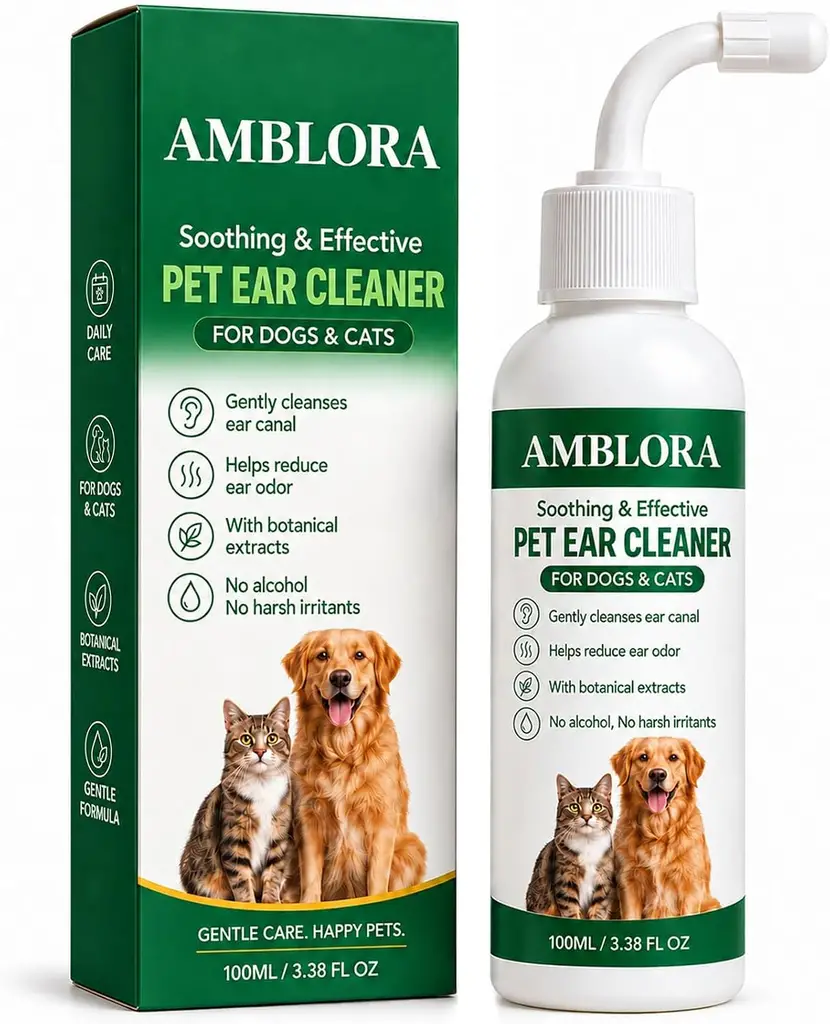
Amblora Ear Cleaner is marketed as a quick solution for dogs and cats with itchy, smelly ears and wax buildup. The company says its lactic acid and boric acid formula lowers the pH inside the ear canal, loosens debris and makes the environment less friendly to yeast.
The basic idea is reasonable, but Amblora’s marketing goes much further, promising that the itching can stop the same night and that owners can see dramatic results after the very first rinse. The product is also backed by more than 25,000 seller-displayed reviews, so I wanted to look past the sales pitch and see how much of this actually holds up. So, is Amblora Ear Cleaner legit? Let’s take a closer look.
Key Takeaways
- Amblora is a real ear-cleaning product for dogs and cats, not some impossible “miracle” device.
- Its lactic acid and boric acid ingredients have legitimate veterinary applications in ear-cleaning products.
- That does not mean Amblora can cure every cause of itchy, smelly or infected ears.
- The company’s 25,000+ review count is seller-hosted and should not be treated as independent clinical evidence.
- I would consider it for routine ear cleaning, but persistent or painful ear problems should be evaluated by a veterinarian.
What Is Amblora Ear Cleaner?
Amblora Ear Cleaner is a liquid ear-cleaning product marketed for both dogs and cats. The current product page says the formula contains lactic acid and boric acid, with no alcohol. Amblora says the acids lower the pH of the ear canal, making it less hospitable to yeast, while the cleaner helps lift wax and debris so it can be wiped away. The company recommends massaging the base of the ear after application and says the product can be used twice a week for most pets.
The current website sells the cleaner for around $29.99 to $34.99, depending on the listing, with the company displaying much higher crossed-out reference prices. It also sells ear and finger wipes.
So, unlike some of the products I investigate, there isn’t anything inherently suspicious about the basic purpose. Dogs and cats really do need ear cleaning sometimes. The question is whether Amblora is simply a decent ear cleaner or whether its marketing is making it sound like a treatment for conditions that require something more.
How Amblora Claims to Work
The explanation is fairly simple. Lactic acid and boric acid are used to acidify the ear environment. Amblora says this makes it harder for yeast to settle in the canal, while the foaming action helps loosen wax and debris.
There is legitimate veterinary precedent for acidifying ear-cleaning products. VCA lists boric acid and other acids among ingredients commonly used in canine and feline ear-cleansing and drying products, and specifically describes acetic acid plus boric acid products as veterinary ear cleaners with antibacterial and antifungal activity. citeturn1search0turn1search3
There is also laboratory research showing antimicrobial activity from some lactic-acid-containing ear-cleaning formulations against organisms associated with canine otitis.
So the underlying chemistry isn’t something Amblora invented for its advertising. Where I become more skeptical is what the company extrapolates from it.
Does Amblora Really Stop Ear Itching Overnight?
This is one of the bigger claims on the sales page. Amblora says, essentially, that the first rinse can bring debris out immediately and that the itching, odor and head shaking can then settle rapidly. It even presents a timeline suggesting noticeable improvement the same evening. citeturn0search0
There is an important distinction here. Removing wax and debris can absolutely make an ear feel cleaner. But itching and head shaking can have many causes. Veterinary references list allergies, parasites, foreign objects, bacteria, yeast, inflammation and middle-ear disease among possible causes of ear problems. Merck Veterinary Manual specifically notes that successful treatment requires identifying and addressing the underlying cause, rather than simply cleaning the ear.
So if your dog has accumulated wax and debris, cleaning may provide noticeable relief. If your dog has a bacterial infection, severe yeast overgrowth, mites or an allergy causing recurrent inflammation, cleaning the ear does not necessarily solve the underlying problem.
That is a very important difference that the Amblora sales page doesn’t emphasize nearly enough.
Let’s Look at the Listed Ingredients
Amblora’s advertised active ingredients are lactic acid and boric acid. That is actually a relatively straightforward formula compared with many pet products. Boric acid is already used in veterinary ear-cleaning formulations, and lactic acid is also used in some ear-cleaning products. A laboratory study examining canine ear-cleaning solutions found that lactic acid demonstrated antimicrobial activity against organisms associated with otitis, although that study tested ingredients and commercial cleaners under laboratory conditions, not proving that Amblora itself cures ear infections.
The major thing missing from Amblora’s marketing is detailed concentration information. Knowing that a product contains lactic acid and boric acid is useful, but the concentration, formulation and other excipients matter when determining exactly how a product behaves in the ear.
And that brings me to one of the biggest issues with judging this product. There is no published clinical trial of Amblora Ear Cleaner itself demonstrating that its specific formulation stops itching, eliminates yeast infections or resolves otitis.
The evidence supports the general concept. It does not prove every Amblora claim.
Red Flags to Consider
The 25,000+ Reviews Need Some Context
The Amblora product page currently displays 4.8/5 based on 25,089 reviews. That is an enormous number. But these are reviews displayed by Amblora itself.
I would not automatically call them fake. There is not enough evidence for that. What I would say is that they are seller-controlled social proof, not independent clinical evidence. Interestingly, Amblora’s Shop presence currently shows the product at 4.5 stars from 1,234 ratings, while the overall Amblora Shop profile has only 35 reviews.
Those numbers aren’t necessarily contradictory because different platforms can aggregate reviews differently, but they make me even less interested in using the company’s enormous on-site review number as proof that the product works.
The Product Is Being Sold Elsewhere
I also found an Amblora-branded ear cleaner being sold on eBay by a separate seller. That listing describes the product as a 3.38 fl oz ear cleaner for dogs and cats and identifies the country of origin as China. It also lists lactic acid and boric acid among the main ingredients.
That does not mean there is anything wrong with a product manufactured in China. It does, however, raise a question about how much of Amblora’s presentation represents a proprietary product versus a branded or private-label product being distributed through multiple channels.
I would want the company to be more transparent about the actual manufacturer and manufacturing location before treating the “Amblora” brand as something particularly distinctive.
The Company Is Extremely New
Amblora’s current Terms of Service were updated on September 29, 2026, and identify RISE GROUP LAB LLC as the operator of the website under the Amblora brand. The Amblora trademark itself was only filed in September 2026, with one application listing Xiaolin Zhang as the owner. A separate “AMBLORA CO” trademark application was filed later that month by another individual.
None of that proves anything improper. But it does tell me that this is a very new brand, despite the website’s presentation making the product look like an established bestseller.
That makes the gigantic review count worth treating cautiously.
“Works Where the Problem Is” Is Oversimplified
Amblora repeatedly contrasts itself with gut supplements, essentially saying that the problem is sitting inside the ear rather than in the gut. That sounds persuasive, but it oversimplifies ear disease.
Some ear problems really are local to the ear. Others are secondary to allergies, skin disease, parasites, foreign bodies or other underlying problems. Merck specifically notes that allergic disease can predispose dogs and cats to secondary yeast and bacterial ear infections.
So yes, an ear cleaner acts locally. But that doesn’t mean the underlying cause is necessarily local.
Is Amblora Ear Cleaner Safe?
The fact that Amblora is alcohol-free is potentially a good thing. VCA notes that alcohol and hydrogen peroxide can irritate the ear canal, particularly when the canal is inflamed or ulcerated. However, “alcohol-free” does not automatically mean “safe for every ear in every situation.”
Veterinary guidance recommends caution when an ear is painful, inflamed or potentially damaged. The condition of the eardrum matters because some substances used in ear products can cause problems if they reach the middle ear. This is why I would not use Amblora, or any other ear cleaner, as a DIY treatment for an ear that is obviously diseased.
If the animal has significant pain, redness, swelling, bloody discharge, pus, a strong persistent odor, head tilting or severe scratching, that’s no longer just a grooming problem.
Amblora vs. an Actual Ear Infection
This is where I think buyers need to set realistic expectations. An ear cleaner can be useful for:
- removing wax and debris
- maintaining ear hygiene
- preparing the ear for veterinary medication
- helping keep some recurrent-prone ears clean
It is not automatically equivalent to treatment for:
- bacterial otitis
- yeast otitis
- ear mites
- allergies
- foreign bodies
- middle-ear disease
Merck Veterinary Manual explains that treatment of otitis externa depends on the underlying cause and may require targeted antimicrobial, antifungal or anti-inflammatory therapy. In other words, cleaning the evidence away is not the same thing as treating the disease that produced it.
That is the distinction I wish Amblora’s sales page made clearer.
Pricing and Money-Back Guarantee
Amblora currently lists the ear cleaner at around $29.99 to $34.99, depending on the product listing, with crossed-out prices of $59.99 or $69.99. The company advertises a 90-day money-back guarantee and says returns are covered. Its shipping policy states that orders are generally processed within one to three business days, with delivery estimated at seven to twelve business days after shipping.
The guarantee is a positive feature, but I would still save the order confirmation and the refund terms when purchasing. A money-back guarantee tells me about the seller’s stated refund policy.
It tells me nothing about whether the product actually works.
What To Do If Your Pet Already Has Ear Problems
If you’re buying Amblora because your dog or cat simply needs occasional ear cleaning, the product is at least based on a legitimate category of veterinary ear-cleaning formulation.
But if you’re buying it because your pet’s ears are persistently itchy, smelly, painful or producing discharge, I would not keep escalating home treatments without finding out why. Merck notes that diagnosing otitis can involve examining the ear canal and examining discharge under a microscope to determine whether yeast, bacteria, mites or another problem is involved.
That matters because the correct treatment can be completely different depending on what is actually causing the problem.
Conclusion
Amblora Ear Cleaner is not an obvious scam. The product itself makes sense. Lactic acid and boric acid are not random ingredients pulled out of thin air, and acidifying ear-cleaning formulations are already used in veterinary medicine. There is also legitimate evidence that some of these ingredients can have antimicrobial activity. But Amblora takes that reasonable foundation and wraps it in some very confident marketing.
The claims about stopping itching the same night, eliminating odor immediately and producing dramatic results after the first rinse are not the same thing as having clinical evidence that Amblora itself treats ear disease. I also don’t love the enormous 25,000-plus seller-hosted review count when the brand itself is extremely new and independent review history is much thinner.
The biggest thing I would keep in mind is that an ear cleaner is not automatically an ear infection treatment.
If a pet simply has wax and needs routine cleaning, Amblora may be a perfectly reasonable type of product to consider. If the animal has recurring itching, foul odor, redness, pain or discharge, I would stop treating the bottle as the solution and find out what is actually causing the problem.
Also read – I Bought the VertiClear Pro: Does This Vertigo Device Really Work? My Honest Review
[…] Also read – Amblora Ear Cleaner Review: Ingredients, Claims and Red Flags […]