

Haima Hematite Bracelet is marketed as a natural menopause solution for women dealing with fatigue, brain fog, mood changes, hot flashes and low energy. The company says the problem isn’t that your iron is low, but that it has “stopped flowing,” and claims wearing iron-rich hematite against the wrist can restore healthy iron flow and hormonal balance.
That sounds scientific until you look at what hematite actually does when it sits on your skin. Haima also leans heavily on its 3,000-year history, thousands of customer reviews and a very specific explanation involving iron, estrogen and the pulse point. So, is Haima actually a menopause breakthrough, or is a $39.90 bracelet being dressed up as something much more? Let’s take a closer look.
Key Takeaways
- Haima is a real hematite bracelet, but there is no good clinical evidence that wearing hematite changes iron levels, estrogen, cortisol or menopause symptoms.
- The central “your iron isn’t low, it stopped flowing” explanation is not an established medical condition or accepted mechanism of iron metabolism.
- Research into transdermal iron does exist, but it involves engineered drug-delivery systems such as microneedles, not a solid hematite stone resting on the skin.
- Haima’s website is very new, despite presenting more than 1,247 women as existing customers and displaying hundreds of highly specific testimonials.
- I would buy Haima only as jewelry or a personal grounding ritual, not as an alternative to investigating fatigue, anemia or menopause symptoms.
What Is the Haima Hematite Bracelet?
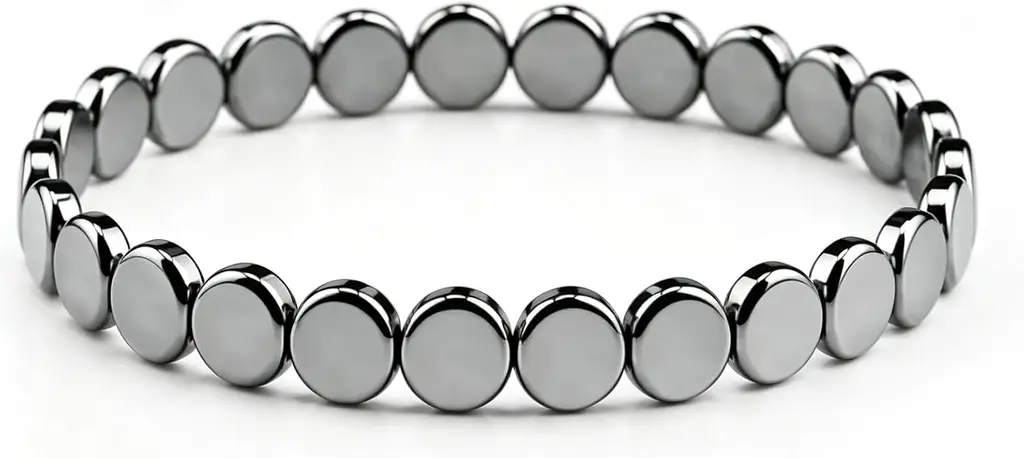
Haima is an elastic bracelet made with 8 mm polished hematite beads. The company says the beads are natural hematite, composed of approximately 70% iron oxide, and designed to be worn around the wrist during the day. The current price is $39.90, with a 30-day money-back guarantee. There is nothing unusual about hematite itself.
Hematite is a genuine mineral composed primarily of iron oxide, Fe₂O₃. It is dense, heavy and has the familiar metallic gray appearance that makes it popular for jewelry.
The problem starts when Haima moves from describing the stone to explaining what it supposedly does to the body. The company says hematite worn at the pulse point creates “direct iron grounding,” with the earth’s iron interacting with the body’s iron through continuous skin contact. It claims this can support healthy iron flow, estrogen balance, cortisol regulation, energy, focus and nervous-system calm.
That is a very different proposition from selling a bracelet.
How Haima Claims to Work
This is the central claim I wanted to examine. Haima’s explanation is that during perimenopause and menopause, hormonal changes interfere with the body’s system for distributing iron. According to the company, the iron is still present, but it isn’t reaching the brain, muscles and nervous system properly.
The bracelet supposedly fixes this by placing hematite directly over the wrist’s pulse point. The company’s wording is very deliberate:
“Your iron isn’t missing. It stopped flowing.”
It then connects this supposed iron-flow problem to fatigue, brain fog, mood changes, cravings, sleep problems and other menopause symptoms. There is one small piece of legitimate science buried underneath all of this.
Iron metabolism really is regulated by a sophisticated system involving hepcidin, ferroportin, iron absorption and iron distribution. Estrogen can also influence aspects of iron metabolism. But that does not mean hematite sitting on the skin can regulate this system.
Haima takes a real biological pathway and makes a very large leap from it.
Does Hematite Actually Put Iron Into Your Body?
This is where the claim falls apart. Haima repeatedly emphasises that hematite is about 70% iron oxide and that iron is essential for carrying oxygen in the blood. All of that is true. But the fact that a mineral contains iron does not mean the iron can simply move from the mineral, through intact skin and into your bloodstream because the stone is touching your wrist.
There is research into transdermal iron delivery, but this is important: researchers have had to develop specialized delivery systems to get iron through the skin.
One published review discusses transdermal iron delivery using specific iron compounds and physical techniques to facilitate delivery, while another study investigated soluble microneedles containing ferric pyrophosphate to deliver iron through the skin. These are drug-delivery technologies, not ordinary pieces of hematite jewellery.
In fact, research examining iron oxide nanoparticles on human skin found that the particles remained primarily on the surface and did not penetrate beyond the outer skin layer under the conditions tested.
So the existence of research into transdermal iron does not rescue Haima’s argument. If anything, it shows how much engineering is required when researchers actually want to deliver iron through the skin. A bracelet does not have those delivery mechanisms.
Red Flags to Consider
The “Iron Stopped Flowing” Story
This is the biggest problem with Haima. There is no recognized medical diagnosis called “stopped iron flow” that explains why someone with normal laboratory iron results experiences menopause symptoms. Iron deficiency is assessed using appropriate clinical history and laboratory measurements, and the body has tightly regulated mechanisms controlling absorption, storage and circulation.
Haima’s explanation turns a complicated physiological system into a simple story: Your blood tests are normal. Your supplements didn’t work. Your iron is actually there. It simply isn’t flowing. Then the bracelet supposedly restores the flow.
That is an extremely convenient explanation because it allows almost any woman experiencing unexplained fatigue or brain fog to identify with the problem without actually having evidence of iron dysfunction.
And the company never provides clinical evidence demonstrating that this supposed phenomenon exists or that hematite corrects it.
The 3,000-Year History Is Doing a Lot of Heavy Lifting
Haima repeatedly invokes ancient Greece and Egypt. It says women have used hematite during hormonal transitions for thousands of years and describes hematite as something ancient women understood through experience before modern science caught up. There is historical evidence that hematite was used as a mineral, pigment, ornament and amulet.
But historical use is not clinical evidence. People have worn countless stones, herbs and objects for symbolic or medicinal reasons throughout history. That doesn’t establish that the object changes iron metabolism or hormone levels. “People have used it for thousands of years” and “clinical research shows it works” are two completely different statements.
Haima blurs that distinction.
“Backed by Science” Is Particularly Misleading
Haima literally uses the phrase “3,000 years of women knew. Science is catching up.” It then references estrogen and the hepcidin pathway as evidence for its explanation. But research showing that estrogen interacts with iron-regulation pathways does not show that hematite bracelets influence those pathways.
This is a classic marketing technique: take a real scientific concept, connect it to a product, and allow the scientific terminology to make the entire explanation feel proven.
The missing step is the most important one:
Where is the study showing that wearing Haima changes iron flow, estrogen, cortisol or menopause symptoms? I couldn’t find one.
The Customer Reviews Are Almost Too Perfect
Haima currently displays hundreds of testimonials, including claims of better sleep, reduced brain fog, improved mood, more stable energy and fewer afternoon crashes. The homepage currently says more than 1,247 women trust Haima. (myhaima.com)
The wording of several testimonials is also strikingly specific. Multiple reviews describe improvement appearing around week three, followed by continued improvement at six weeks or three months. One testimonial even comes from a supposed PhD in biochemistry who says the mechanism is “at least plausible.”
I would not automatically call those testimonials fake. But I would absolutely not treat them as clinical evidence. And there is a much smaller independent review footprint.
Trustpilot currently shows only three reviews, producing a 3.5/5 score. One customer praised the appearance but said the bracelet was too large, while another complained that the bracelets arrived twisted and that customer service had not responded to multiple emails. That is a very different picture from hundreds of overwhelmingly positive testimonials on Haima’s own website.
The Website Is Very New
The domain myhaima.com was registered on June 26, 2026. That’s important because the website presents Haima as though it has already developed a substantial community of more than 1,247 women.
A young company can absolutely become popular quickly. But a brand that is only a few months old should not automatically be treated as an established wellness authority simply because its own website displays a large number of testimonials. Gridinsoft currently gives the site a 63/100 trust score and specifically flags its young domain and limited reputation history. It does not classify the site as a confirmed scam.
That’s the distinction I would make too. New does not equal fraudulent… it simply means there isn’t much history to rely on yet.
There Are Other Haima Sites
This is another detail I wouldn’t ignore. The same Haima bracelet content appears on other domains, including shifenmeiwatch.com and mipeluka.com. The mipeluka website actually identifies Guangzhou Weige Supply Chain Co., Ltd. in Guangzhou, China in its footer.
Meanwhile, the current myhaima.com contact page identifies CODAMERICA LLC in Clovis, New Mexico, as the operator. That doesn’t prove the products are different. It does, however, make the branding and supply chain less straightforward than Haima’s polished presentation suggests.
If a customer is being sold a $39.90 bracelet as a carefully designed menopause wellness product, I’d want to know exactly who manufactures it and whether the bracelet is genuinely proprietary to Haima or simply sourced from a jewelry supplier.
Even the Product Reviews Mention Fit Problems
Interestingly, the company’s own product page contains some negative feedback about the physical bracelet. Customers mention the bracelet being too large, the elastic being flimsy, the bracelet not lying flat and the cords fraying. One customer said she had to secure it with a rubber band because it kept sliding up her arm.
That doesn’t concern me nearly as much as the medical claims. If you’re buying jewelry, sizing and durability are ordinary quality issues. But it does reinforce the point that the product should be evaluated as jewelry first, rather than as a clinically validated menopause treatment.
What About Menopause?
This is where I would be especially careful. Menopause can absolutely cause fatigue, sleep disruption, hot flashes, mood changes and cognitive complaints. But those symptoms have multiple possible causes, and there are evidence-based approaches for managing them.
A hematite bracelet has not been shown in clinical trials to treat menopause. There are randomized controlled trials of actual menopause interventions. For example, published trials have investigated specific pharmacological and botanical treatments using defined doses and placebo groups.
That is what evidence looks like. Haima has testimonials. Those are not equivalent.
Could Wearing It Still Make Someone Feel Better?
Possibly, but that doesn’t establish the mechanism Haima claims. A heavy, cool bracelet that you deliberately touch throughout the day can become a physical reminder to pause, breathe or slow down.
That can be psychologically meaningful. And some people genuinely enjoy the sensation and symbolism of wearing hematite. But that is very different from hematite increasing iron delivery to the brain.
There is actually useful evidence from bracelet research in other areas showing why this distinction matters. In a randomized double-blind trial involving 610 people, an “ionized” bracelet improved pain scores, but the improvement was essentially the same as that seen with the placebo bracelet.
In other words, people can report feeling better while the claimed physical mechanism still fails a proper placebo-controlled test.
Pricing and Where to Buy
Haima currently sells the bracelet for $39.90 and advertises a 30-day money-back guarantee. The company says it fits most 6- to 8-inch wrists and recommends removing it before showering, swimming or sleeping.
That isn’t an outrageous price for a hematite bracelet. In fact, comparable genuine hematite bracelets from established jewelry/crystal retailers can sell for roughly $25 to $34, depending on the stone size and construction.
So the problem isn’t that $39.90 is an inherently ridiculous price. The problem is paying $39.90 because you believe you’re buying a menopause treatment. If Haima were simply marketed as a polished hematite bracelet with a grounding ritual, I would have far fewer objections.
What To Do If You Already Bought One
If you bought Haima because you like the bracelet, there is no reason to panic. Wear it as jewellery. If it makes you feel calmer because it reminds you to slow down, that’s perfectly reasonable. But if you bought it because you have fatigue, brain fog, suspected anaemia, hot flashes or other menopause symptoms, don’t use changes in how you feel as a substitute for proper evaluation.
And don’t stop iron, hormone therapy or any prescribed treatment because Haima says your problem is “iron flow.” The bracelet does not provide a known therapeutic dose of iron.
Conclusion
Haima Hematite Bracelet is a real bracelet built around a real mineral, but the health explanation being sold with it is where the problem lies. Hematite really is iron oxide. Iron really is essential for oxygen transport and energy metabolism. Estrogen really does interact with aspects of iron regulation. And researchers are studying ways of delivering iron through the skin.
None of those facts demonstrate that wearing a hematite bracelet against your wrist can restore iron flow, balance estrogen, regulate cortisol or relieve menopause symptoms.
The transdermal iron research is particularly revealing because researchers trying to deliver iron through the skin use specialized systems such as microneedles or other delivery technologies. A polished hematite bead sitting on intact skin is not comparable.
Then there is the marketing itself: the “your iron stopped flowing” story, the 3,000-year appeal to ancient wisdom, the scientific-sounding hepcidin explanation, the highly specific week-three testimonials and the enormous seller-hosted review count on a website that was only registered in June 2026.
I don’t think the evidence supports calling Haima a proven menopause treatment.
Also read – Scam Alert! Playglobal14.com Is A Fraudulent Crypto Exchange Site – Beware!